I am a Kentucky based USDA Mortgage Lender that has originated over 300 KY Rural Housing Mortgage Loans in Kentucky-CALL OR TEXT 502-905-3708 FOR USDA MORTGAGE LOAN
How to Qualify for a Rural Housing Loan in Kentucky with Student Loans.
For potential home buyers with student loans that are either in a deferred payment status or being paid back through an income based or graduated repayment program, the treatment of this liability needs to be considered.
When student loan debts are not currently being paid upon, due to the loan applicant still being in school or recently graduating from school, the monthly liability will be calculated based on the lower of 1/2 of 1% of the outstanding loan balance or the monthly payment listed on the credit report.
Example if you owe $100,000 in student loan debt the monthly payment will be $500. Also, if the student loan is being paid upon, but at a lesser amount than originally agreed, such as the payment being determined based on repayment ability (i.e. Income Based Repayment Plan), the monthly payment will be calculated the same as above (monthly liability = 1/2 of 1% of the outstanding loan balance).
This offers a significant improvement compared to the FHA Loan guidelines, in which student loans that are in deferment or under an income based repayment plan will have the monthly payment calculated at 1% of the outstanding loan balance.
If the student loan is being paid upon as originally agreed upon when the loan was first obtained, the monthly liability will be the amount specified on the credit report.
Or if the student loans have been consolidated into a new loan, so long as the monthly payment is based on a fixed repayment schedule, that payment will be used when calculating the borrower’s debt to income ratio.
The Single Family Housing Guaranteed Loan Program (SFHGLP) is pleased to announce revisions to technical Handbook-1-3555, Chapter 9, Income Analysis and Chapter 10, Credit Analysis. These changes became effective upon the recent issuance of a Procedure Notice (PN). Below are the highlighted revisions:
Chapter 9 –Income Analysis
Paragraph 9.3 was revised to clarify that although loan closings may proceed without tax transcripts (when permissible), lenders are responsible for obtaining transcripts for their permanent loan file, and the request for tax transcripts must be made timely.
Paragraph 9.4 was revised to clarify that in cases where an applicant owns a business, the lender needs to verify that assets are not transferred between a personal account and a business account. The accounts should function separately. If the accounts are co-mingled, the assets would need to be included in the calculation of net family assets.
Attachment 9-A was revised as follows:
Income and Documentation Matrix – Rental Income: Revised to clarify that unless manually overwritten, GUS auto-calculates net rental income by employing a 25% vacancy factor.
Assets and Reserves: Revised to clarify that when assets are entered into GUS and used as reserves, lenders must ensure that the funds will be available to the borrowers post-closing. In addition, the guidance was revised to clarify that unverified funds are not an acceptable source of funds for down payment or closing costs.
Assets and Reserves – Business Accounts: Revised to state that for reserves, lenders must use the balance as reflected on the most current bank statement or Verification of Deposit (VOD), if the date on the VOD is after the bank statement. Please note, loans already underwritten by the approved lender using the previous, more conservative, asset guidance will continue to be accepted.
Assets and Reserves – Depository Accounts: Revised to state that for reserves, lenders must use the balance as reflected on the most current bank statement or Verification of Deposit (VOD), if the date on the VOD is after the bank statement. Please note, loans already underwritten by the approved lender using the previous, more conservative, asset guidance will continue to be accepted.
Assets and Reserves – Gift Funds: Revised to clarify the sourcing requirements for gift funds.
Attachment 9-C was revised to include a scenario where household members have assets that exceed $50,000 to demonstrate the appropriate calculation that would apply.
Chapter 10 –Credit Analysis
Attachment 10-A, Credit Inquiries/Recent Debts/Undisclosed Debts, was revised to clarify that undisclosed debts that are not listed on the loan application, but discovered during the mortgage loan application process, must be manually entered into GUS.
Attachment 10-A, Overdraft/Non-Sufficient Funds (NSF), was added to include the definition for both overdraft and non-sufficient funds (NSF), to clarify that lenders may choose to include these types of fees in monthly debt, and to clarify that underwriters should consider these types of events in their credit decisions.
Attachment 10-A, Chapter 7 Bankruptcy, was revised to clarify that for manually submitted loans, a bankruptcy debt that was discharged within the previous 36 months is considered significant derogatory credit.
Attachment 10-A, Chapter 11, 12, or 13 Bankruptcy, was revised to clarify that for GUS Refer, Refer with Caution, and manually underwritten files, the lender must obtain, and retain, documentation to verify that 12 months of the debt restructure plan has elapsed.
Attachment 10-A, Delinquent Court Ordered Child Support, was revised to clarify that the lender must provide certification of the applicant’s eligibility as part of the application submission. Any documentation obtained to support the lender’s certification to the Agency will be retained in the lender’s permanent loan file.
Attachment 10-A, Delinquent Federal Non-Tax Debt, was revised to clarify the lender must provide certification of the applicant’s eligibility to the Agency as part of the application submission. Any documentation obtained to support the lender’s certification to the Agency will be retained in the lender’s permanent loan file.
Attachment 10-A, Federal Taxes, was revised to clarify that proof of all repayment plans the applicant has with the IRS must be obtained, and a minimum of three timely payments is required on each active repayment plan. The lender must provide certification of the applicant’s eligibility to the Agency as part of the application submission.
Attachment 10-A, Foreclosure or Repossession, was revised to clarify that foreclosures or repossessions can refer to any type of property and to clarify that on manually submitted loans, a foreclosure or repossession that was discharged within 36 months prior to the date of application is considered significant derogatory credit.
Attachment 10-A, Previous USDA Loss, was revised to clarify that a previous USDA loss that occurred within the last seven years is considered significant derogatory credit.
Attachment 10-A, Rent/Mortgage Payment History, was revised to clarify that underwriters should review and evaluate the risk factors associated with applicants who will be paying a higher proposed mortgage payment compared to their existing housing payment. In addition, this section was revised to clarify that all housing payments entered in GUS should be verified and documented; and rent or mortgage payments received from family members, or other interested parties, must include 12 months of canceled checks, money order receipts, or electronic payment confirmations.
Joel Lobb Mortgage Loan Officer
American Mortgage Solutions, Inc. 10602 Timberwood Circle Louisville, KY 40223 Company NMLS ID #1364
NMLS 57916 | Company NMLS #1364/MB73346135166/MBR1574 Get Approved Now Click HereThe view and opinions stated on this website belong solely to the authors, and are intended for informational purposes only. The posted information does not guarantee approval, nor does it comprise full underwriting guidelines. This does not represent being part of a government agency. The views expressed on this post are mine and do not necessarily reflect the view of my employer. Not all products or services mentioned on this site may fit all people. NMLS ID# 57916, (www.nmlsconsumeraccess.org).
There are two types of Kentucky USDA Rural Housing Home loans available to rural Kentucky Home buyers through Rural Development:
Direct homeownership loans and guaranteed home ownership loans.
Let’s first look at the 502 Direct USDA Loan in Kentucky
502 Direct USDA Loan in Kentucky:
With a Kentucky Direct Loan 502, the applicant applies directly to the USDA office serving their location in Kentucky. There are about 13 different locations . They lend the money direct from USDA , 100 percent financing, for the low rate currently at 3 percent on a 33 year term.
For a direct home loan, the purchase, construction, repair and rehabilitation of a single family home in rural areas must be used for the applicant’s permanent residence. “For manufactured housing, only new construction can be funded,” he explained.
Credit scores of 640 or greater are typically acceptable with a minimum number of trade lines (2 usually for 12 months can be opened or closed) that have been open and active.
No down payment typically is required- Loans may be up to 100 percent of the appraised value. Homebuyer education is required prior to closing for the Direct USDA Loan 502 program
Mortgage payments are based on what the applicant can afford to pay. USDA offers payment assistance/subsidies to make it affordable. When you go to payoff the USDA Direct loan, you may incur a subsidy recapture fee.
Paragraph
There are two types of Kentucky USDA Rural Housing Home loans available to rural Kentucky Home buyers through Rural Development:
Direct homeownership loans and guaranteed home ownership loans.
Let’s first look at the 502 Direct USDA Loan in Kentucky
502 Direct USDA Loan in Kentucky:
Rural Home Loans (Direct Program) What does this program do? Also known as the Section 502 Direct Loan Program, this program assists low- and very-low-income applicants obtain decent, safe, and sanitary housing in eligible rural areas by providing payment assistance to increase an applicant’s repayment ability. Payment assistance is a type of subsidy that reduces the mortgage payment for a short time. The amount of assistance is determined by the adjusted family income. Who may apply for this program? A number of factors are considered when determining an applicant’s eligibility for Single Family Direct Home Loans. At a minimum, applicants interested in obtaining a direct loan must have an adjusted income that is at or below the applicable low-income limit for the area where they wish to buy a house and they must demonstrate a willingness and ability to repay debt. Applicants must: • Be without decent, safe, and sanitary housing • Be unable to obtain a loan from other resources on terms and conditions that can reasonably be expected to meet • Agree to occupy the property as your primary residence • Have the legal capacity to incur a loan obligation • Meet citizenship or eligible noncitizen requirements • Not be suspended or debarred from participation in federal programs Properties financed with direct loan funds must: • Be modest in size for the area • Not have market value in excess of the applicable area loan limit • Not have in-ground swimming pools • Not be designed for income producing activities Borrowers are required to repay all or a portion of the payment subsidy received over the life of the loan when the title to the property transfers or the borrower is no longer living in the dwelling. Applicants must meet income eligibility for a direct loan. Please contact your local RD office to ask for additional details about eligibility requirements. What is an eligible area? Generally, rural areas with a population less than 35,000 are eligible. Visit the USDA Income and Property eligibility website for complete details. How may funds be used? Loan funds may be used to help low-income individuals or households purchase homes in rural areas. Funds can be used to build, repair, renovate, or relocate a home, or to purchase and prepare sites, including providing water and sewage facilities. How much may I borrow? The maximum loan amount an applicant may qualify for will depend on the applicant’s repayment ability. The applicant’s ability to repay a loan considers various factors such as income, debts, assets, and the amount of payment assistance applicants may be eligible to receive. Regardless of repayment ability, applicants may never borrow more than the area loan limit (plus certain costs allowed to be financed) for the county in which the property is located. Rural Home Loans (Direct Program) What is the interest rate and payback period? • Fixed interest rate based on current market rates at loan approval or loan closing, whichever is lower. • The monthly mortgage payment, when modified by payment assistance, may be reduced to as little as an effective 1% interest rate. • Up to 33 year payback period – 38 year payback period for very low income applicants who can’t afford the 33 year loan term. How much down payment is required? No down payment is typically required. Applicants with assets higher than the asset limits may be required to use a portion of those assets. Is there a deadline to apply? Applications for this program are accepted through your local RD office year round. How long does an application take? Processing times vary depending on funding availability and program demand in the area in which an applicant is interested in buying and completeness of the application package. What governs this program? • The Housing Act of 1949 as amended, 7 CFR, Part 3550 • HB-1-3550 – Direct Single Family
How USDA Government Underwriters calculate your Debt-to-Income or DTI ratio.
One of the most frequent questions that come from perspectives Kentucky home buyers is
“How Much House Can I Afford?”
Answering this question is determined based on calculating what are known as the borrower’s Debt-to-Income or DTI ratios. The established standard DTI ratio used for a USDA Loan is based on two sets of ratios, which are as follows:
Front-end or housing ratio – the monthly mortgage payment cannot exceed 29% of the gross monthly income.
Back-end or total debt ratio – the total debts, including the new monthly mortgage payment, cannot exceed 41% of the gross monthly income.
A monthly mortgage payment includes the principal and interest payment on the mortgage note, as well as the monthly pro-rated portion of the annual fee, property tax and homeowner insurance premium.
Specific to the USDA Rural Loan program is the pro-rate portion of the USDA Annual Fee, which is often referred to as a monthly mortgage insurance payment. If there are any Condominium or Homeowner Association (HOA) fees, these fees must be included in the monthly mortgage payment as well.
Total debts include the anticipated monthly mortgage payment and all monthly re-occurring credit obligations.
Examples of reoccurring credit obligations include monthly car payments, minimum payment on credit cards, and student loan payments. If the borrower is obligated to make any alimony or child support payments, these payments will be included within the total debt calculations as well.
If the total debts exceed 41% of the gross monthly income, the maximum monthly mortgage payment must be reduced in order to bring total DTI back down to 41%. For example, assume a monthly income of $5,000.
Based on the 29%/41% ratio requirements, the maximum housing expense will be $1,450 and total debts will be $2,050. If the non-housing expense exceeds $600 ($2,050 – $1,450), the housing expense will need to be reduced by an equal amount to keep the total ratio at 41%.
While the 29%/41% ratio is considered to be the Underwriting standard guideline, the USDA Loan Program will allow for DTI ratios as high as 33.99%/45.99%.
What determines the ability to qualify at a higher ratio is a combination of factors, such as an approval through Guaranteed Underwriting System, which is USDA’s automated approval, and other compensating factors such as:
680 or higher credit score
No or low “payment shock” – less than a 100% increase in proposed mortgage payment vs. current rental housing expenses
Fiscally sound use of credit
Ability to accumulate savings
Stable employment history with 2 or more years in current position or continuous employment history with no job gaps
Cash reserves available for use after settlement
Career advancement as indicated by job training or additional education in the applicant’s profession
Trailing spouse income – as a result of a job transfer, in which the house is being purchased, prior to the secondary wage-earner obtaining employment. This assumes that the secondary wage-earner has an established history of employment and has a reasonable chance to obtain new employment in the area upon relocating to the area
If you are an individual with disabilities who needs accommodation, or you are having difficulty using our website to apply for a loan, please contact us at 502-905-3708.
Disclaimer: No statement on this site is a commitment to make a loan. Loans are subject to borrower qualifications, including income, property evaluation, sufficient equity in the home to meet Loan-to-Value requirements, and final credit approval. Approvals are subject to underwriting guidelines, interest rates, and program guidelines and are subject to change without notice based on applicant’s eligibility and market conditions. Refinancing an existing loan may result in total finance charges being higher over the life of a loan. Reduction in payments may reflect a longer loan term. Terms of any loan may be subject to payment of points and fees by the applicant Equal Opportunity Lender. NMLS#57916http://www.nmlsconsumeraccess.org/
On the top left hand side, click “Single Family Housing Guaranteed”
Click “Accept”
Enter the property address to determine if a specific house or general area is located in an USDA eligible area
The household income must be moderate as determined by USDA. The USDA Loan evaluates household income, which includes the combined income of all adults living in the household; even if they are not on the mortgage loan. Click here to determine your household income eligibility.
If it appears that the household income exceeds the moderate income thresholds established by USDA, do not throw in the towel just yet. USDA allows for deductions for child care and medical expenses as well as for children, students, and elderly members of the household that will be living in the USDA financed property.
This is not a farmer’s loan. As a matter of fact, the property cannot have any income producing capabilities, and when the land value of the property exceeds 30% of the appraised value additional requirements must be met.
The house has to be in fairly good condition. The appraisal type being utilized is an FHA appraisal, so make sure that there are not any safety related challenges(i.e. missing banisters, peeling paint, exposed electric).
This is a true no money down loan program. Or stated differently, you do not need a down payment.
While there is a monthly mortgage insurance premium (or prorated portion of an Annual Fee), the cost of the monthly mortgage insurance is 59% less than a comparable FHA Loan. This makes the USDA loan more affordable than an FHA Loan when analyzing down payment requirements and monthly mortgage payments.
The seller can pay all closing costs and pre-paids (i.e. escrows). Often the home buyer’s only out-of-pocket cost as part of the purchase transaction is approximately $550 for the appraisal report.
If the house appraises for more than the purchase price, the difference can be used to pay for closing costs and pre-paids (i.e. escrows). Only the USDA Loan program allows for closing costs to be rolled on top of the purchase price.
USDA has no restriction on whether you are a first time home buyer or move-up home buyer.
This loan program is only for primary residence (i.e. no second home or investment properties).
You should not own any other functional property; although there are some circumstances under which USDA may waive this requirement.
The preferred minimum credit score is 640. However, if you have a documented rent history, no late payments on your credit cards, and no new collections within the last 12 months, a credit score as low as 620 may be considered.
All property types including single family homes, town homes, modular, and even condominiums qualify for this loan program. Manufacture homes such as single and doublewides constructed prior to January 1, 2006 do not qualify.
There is no maximum mortgage amount, but the house does have to be considered moderate in a size





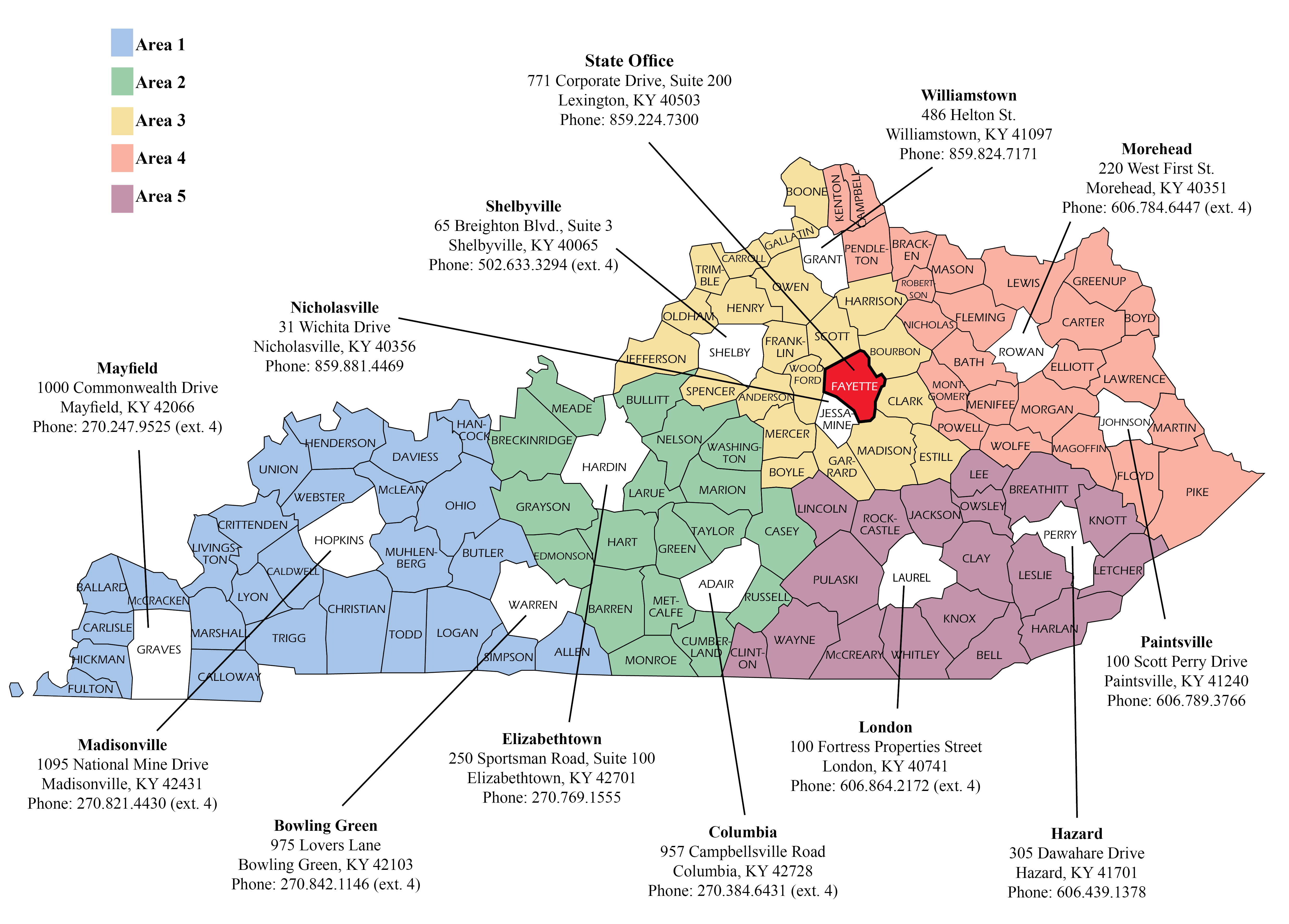


 Kentucky USDA Mortgage Lender for Rural Housing Loans