100% financing · No down payment · Fixed 30-year rate
0%
Down payment required
100%
Financing available
620+
Typical credit score
Key benefits — click to expand
No down payment
Click to learn more ›
Borrowers without savings — or who wish to keep their savings — can qualify. Closing costs may also be financed if the appraised value exceeds the purchase price.
Low mortgage insurance
Click to learn more ›
USDA has the lowest upfront and monthly mortgage insurance of any 100% loan program — keeping your monthly payment as low as possible on a 30-year fixed rate.
Flexible credit guidelines
Click to learn more ›
No minimum credit score is set by USDA, though lenders typically require 620–640. Borrowers with a 640+ score enjoy streamlined processing with no credit explanation letters needed.
Generous income limits
Click to learn more ›
Income limits are based on 115% of the U.S. median. Deductions apply for dependents, child-care expenses, and elderly households — making it easier for Kentucky families to qualify.
Not just first-time buyers
Click to learn more ›
Any qualified buyer may use a USDA loan — not only first-time homebuyers. Sellers are also permitted to pay the buyer’s closing costs, further reducing out-of-pocket expenses.
Rural areas across Kentucky
Click to learn more ›
Eligible areas include open country and most towns and small cities with populations up to about 35,000. Many Kentucky communities outside major metros qualify — check eligibility at the USDA website.
Debt-to-income ratio guidelines
Housing (PITI)
≤ 29%
Total debt
≤ 41%
Buyers with satisfactory credit may qualify with higher ratios in high-cost areas.
USDA eligibility depends on the property’s location, not just whether it looks rural. Homes inside some city limits and subdivisions qualify, depending on the area’s population. Most of Jefferson County (Louisville) and Fayette County (Lexington) are not eligible, but many nearby areas are. Check any address on the Kentucky USDA eligibility map and compare your household income to the 2026 income limits by county.
Credit events and waiting periods
A Chapter 7 bankruptcy must be discharged at least 3 years before you apply.
A foreclosure must be at least 3 years old.
With a 640+ score and an automated GUS approval, USDA usually doesn’t require rental history verification or credit explanation letters.
Joel Lobb · Mortgage Loan Officer · NMLS #57916 · Company NMLS #1738461
Equal Housing Lender · Kentucky mortgage loans only
This page is not endorsed by USDA, FHA, VA, or any government agency.
The Kentucky Rural Housing USDA home loan program offers an excellent opportunity for eligible homebuyers in rural and suburban areas of Kentucky to secure affordable financing with no down payment. To qualify, applicants must meet specific requirements related to credit score, income, work history, bankruptcy, foreclosure, debt-to-income ratio, property requirements, and mortgage insurance. Here’s a detailed guide to help you understand these qualifications:
No minimum credit score but a 580 to 640 is generally required to qualify for a USDA loan. This score allows for streamlined processing through the Guaranteed Underwriting System (GUS). Applicants with scores below 640 may still qualify but will need to undergo manual underwriting, which requires additional documentation and scrutiny.
USDA loans have income limits that vary by county and household size. These limits are designed to ensure the program assists low- to moderate-income families. Generally, your household income should not exceed 115% of the median income for your area. The USDA provides an online tool to check income eligibility based on your location and household size.
A stable work history is essential for Kentucky USDA loan approval. Lenders typically look for at least two years of consistent employment. Any gaps in employment need to be explained and documented. For self-employed applicants, a minimum of two years of tax returns is required to verify income stability.
While past financial difficulties like bankruptcy or foreclosure can affect your eligibility, they do not automatically disqualify you. Here are the typical waiting periods:
Chapter 7 Bankruptcy: At least three years from the discharge date.
Chapter 13 Bankruptcy: At least one year of the payout period must be completed with satisfactory payment history and court approval for a new loan.
Foreclosure: At least three years from the completion date.
The Kentucky USDA loan program has specific DTI requirements to ensure borrowers can manage their mortgage payments. The front-end ratio (housing expenses) should not exceed 29% of your gross monthly income, and the back-end ratio (total monthly debt obligations) should not exceed 45%. Exceptions can be made for borrowers with compensating factors, such as higher credit scores or additional cash reserves.
USDA loans are intended for properties in designated rural areas. The USDA provides an online tool to check property eligibility. The home must be used as the primary residence and meet certain quality standards according to Kentucky FHA Appraisal HUD Guidelines including:
Adequate and functional heating, plumbing, and electrical systems
Structurally sound foundation and roof
Safe water supply and waste disposal systems
Must have an undamaged exterior, foundation and roof
Must have safe and reasonable property access
Must not contain loose wiring and exposed electrical systems
Must have all relevant utilities, including gas, electricity, water and sewage functioning properly.
Must have a working, permanent heating system that can heat the property adequately
Must have surfaces free of chipping or peeling lead-based paint
Must have adequate access to attic spaces and natural ventilation in crawl spaces
Must have access to potable water
Must be free from wood-destroying insect infestations
Must not have interior and exterior health and safety hazards, such as no handrails on steep staircases
Kentucky Rural Housing USDA loans require mortgage insurance, which includes an upfront guarantee fee and an annual fee. The upfront fee is typically 1% of the loan amount, which can be financed into the loan. The annual fee, usually 0.35% of the loan balance, is paid monthly as part of the mortgage payment. These fees help protect lenders and the USDA in case of borrower default.
Summary
Qualifying for a USDA home loan in Kentucky involves meeting specific criteria in several areas:
Credit Score: No Minimum score but a 620-640 for streamlined processing; lower scores may require manual underwriting down to 580 with some lenders but few and far between
Income Requirements: Must not exceed 115% of the median income for your area.
Work History: At least two years of stable employment.
Bankruptcy and Foreclosure: Waiting periods of 1-3 years depending on the situation.
Debt-to-Income Ratio: 29% for housing expenses, 41% for total debt; exceptions possible.
Property Requirements: Must be in a designated rural area and meet quality standards.
Mortgage Insurance: Includes an upfront guarantee fee and an annual fee.
By understanding and meeting these requirements, you can take advantage of the USDA loan program to achieve homeownership in Kentucky’s rural areas. For personalized assistance, consider consulting with a mortgage broker or lender experienced in USDA loans, like Joel Lobb in Louisville, who can guide you through the process and help you qualify.
Joel Lobb
Mortgage Broker – FHA, VA, USDA, KHC, Fannie Mae
EVO Mortgage • Helping Kentucky Homebuyers Since 2001
By Joel Lobb, Kentucky Mortgage Loan Officer | NMLS ID: 57916
If you’re planning to buy your first home in Kentucky with a USDA loan, big changes are coming that could affect your buying power. Starting November 4, 2025, the USDA Single Family Housing Guaranteed Loan Program (SFHGLP) will tighten its affordability standards.
As a Kentucky mortgage loan officer who has helped more than 1,300 families become homeowners, I want to break down what this means, who it impacts, and how you can prepare.
What’s Changing with USDA Loans in 2025?
The USDA is updating its affordability guidelines by setting the maximum PITI ratio at 29%.
What’s PITI? It stands for Principal, Interest, Taxes, and Insurance—your total monthly housing payment compared to your gross monthly income.
Here’s the key difference:
Before November 4, 2025 – USDA allowed more flexible debt-to-income ratios.
After November 4, 2025 – Borrowers will be capped at 29% of gross monthly income for their housing payment.
Translation for Kentucky homebuyers: On the same income, you may qualify for a smaller loan amount than you would under current rules.
Exceptions: How Strong Borrowers Can Still Qualify Above 29%
The 29% cap isn’t a hard stop for everyone. If you have strong credit and compensating factors, you may still qualify for a higher PITI ratio.
Two Main Pathways:
1. Automated Approval (GUS Accept) The USDA’s automated underwriting system (GUS) looks at your entire financial picture. If it issues an “Accept,” higher PITI ratios may still be allowed.
2. Ratio Waiver (Up to 32%) You may qualify for a waiver allowing up to a 32% PITI ratio if:
All borrowers have credit scores of 680 or higher
Your application shows approved compensating factors, such as:
This gives responsible Kentucky first-time homebuyers with solid credit extra flexibility—even under the new rule.
Why November 4, 2025, Is a Critical Deadline
The implementation date is firm, and here’s how it works:
Loans with a Conditional Commitment before November 4, 2025 will follow current guidelines.
Loans without a Conditional Commitment by November 4, 2025 must meet the new 29% PITI rule.
Important caveat: Even if you had a Commitment before the deadline, if your file is released or resubmitted after November 4, the new guidelines apply.
f you’re planning to use a USDA loan in Kentucky, timing matters.
What This Means for Kentucky First-Time Homebuyers
For Standard Borrowers:
Expect to qualify for less house after November 4, 2025
Consider accelerating your home search timeline
Focus on credit score improvement to boost eligibility
For Strong-Credit Borrowers (680+ scores):
You may still qualify up to 32% PITI with a waiver
Strong credit management gives you more options
Use this as leverage to maintain your buying power
For All Kentucky Homebuyers:
Act sooner rather than later if considering a USDA loan
Kentucky Housing Corporation (KHC): Down payment assistance remains available to first-time homebuyers. This can help offset stricter USDA guidelines.
Rural Housing Benefits: USDA loans are still a top option for rural Kentucky families, offering low rates and zero down payment. Use the USDA Property Eligibility Map or my Kentucky USDA property map guide to check if your dream home qualifies.
Local Market Knowledge: From Louisville suburbs to Eastern Kentucky, each market has unique opportunities that an experienced local lender can help you navigate.
Explore Other Loan Options in Kentucky
While USDA loans are powerful, they’re not your only choice. Other strong programs include:
Conventional Loans – Competitive rates for buyers with good credit
The mortgage landscape is tightening, but proactive planning puts you in control. Whether you’re a first-time buyer in Kentucky or looking to upgrade, now is the time to strategize.
📞 Contact Joel Lobb, Kentucky Mortgage Loan Officer
I offer free mortgage consultations with same-day approvals to help Kentucky families make the most of these changing guidelines. Let’s build a plan that works for you.
About the Author
Joel Lobb is a Kentucky Mortgage Loan Officer specializing in first-time homebuyer programs, including FHA, VA, USDA, and KHC loans. With over 20 years of experience, Joel has helped more than 1,300 Kentucky families achieve homeownership. NMLS Personal ID: 57916 | Company NMLS ID: 1738461
EVO Mortgage • Company NMLS #1738461 • Personal NMLS #57916
Equal Housing Lender
Disclosures: Program terms, eligibility, and pricing subject to change without notice. Not a commitment to lend. All loans subject to credit approval, acceptable collateral, and underwriting conditions. Geographic, income, and property restrictions may apply (including KHC/USDA). This content is for informational purposes only and not legal, financial, or tax advice. Verify current guidelines with your loan officer.
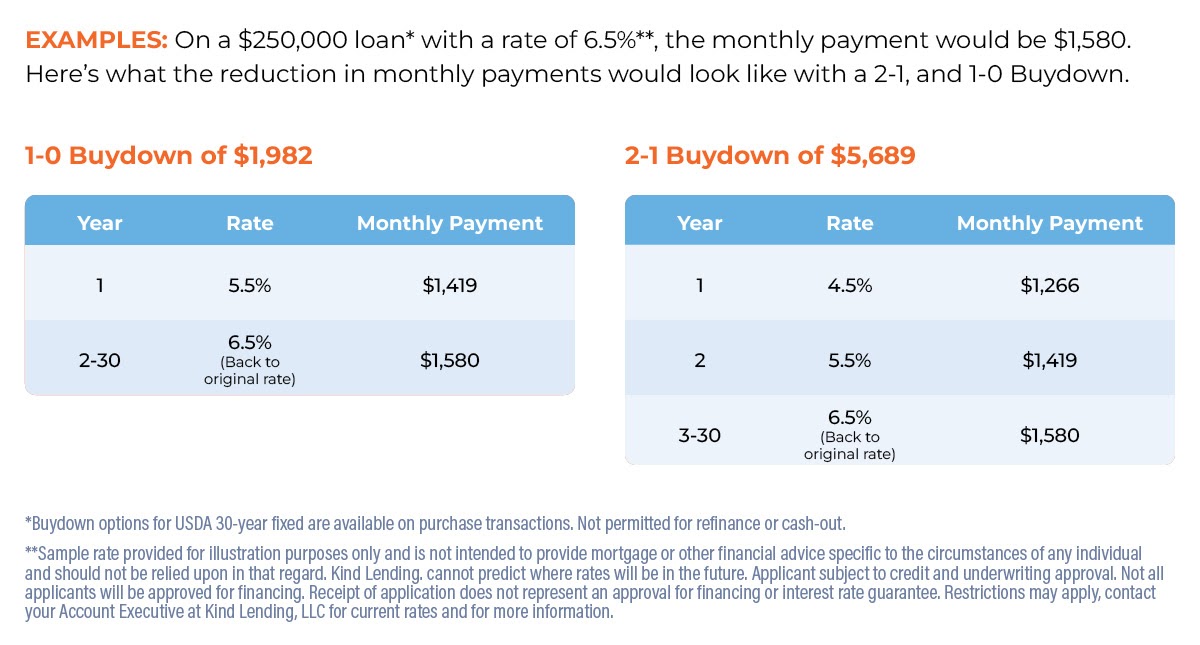
2-1 and 1-0 buydowns for Kentucky Rural Housing USDA RD loans Interest Rates.
What are Buydowns for Kentucky USDA RD Loans?
The Kentucky Rural Housing USDA Buydown Program provides simple financing options that lowers the interest rate on a mortgage for either 1 year (1-0) or 2 years (2-1), before it rises to the regular permanent rate. Specifics2-1, and 1-0 temporary interest rate buydowns are allowed on 30 year fixed-rate mortgages for principal residences, purchase only. Not permitted on refinance transactions.The seller or agent may provide funds for the temporary interest rate buydown, subject to standard interested party contribution limits.Lender paid buydowns are not offered.The borrower is qualified at the note rate fully amortized (not the buydown rate)Minimum credit score for loans with buydown is 620
Have Questions or Need Expert Advice? Text, email, or call me below:
Joel Lobb Mortgage Loan Officer
EVO Mortgage 10602 Timberwood Cir, Ste 3, Louisville, KY 40223
The view and opinions stated on this website belong solely to the authors, and are intended for informational purposes only. The posted information does not guarantee approval, nor does it comprise full underwriting guidelines. This does not represent being part of a government agency. The views expressed on this post are mine and do not necessarily reflect the view of my employer. Not all products or services mentioned on this site may fit all people. NMLS ID# 57916, (www.nmlsconsumeraccess.org).
Kentucky USDA loans are loans offered by the United States Department of Agriculture to those looking to buy homes in rural areas of Kentucky.
There are a few requirements and restrictions associated with this type of loan however, if you are afirst time home buyer in Kentucky with a limited income, no down payment and are looking to live in a rural part of Kentucky, this may be a good option for you to purchase a home going no money down and getting a 30 year fixed rate loan.
Income Requirements for USDA Loans in Kentucky
The Rural Housing USDA website provides an income eligibility calculatordepending on where you are looking for housing in the state of Kentucky. Because it is a nationally funded loan by the United States Government, the income restrictions will vary county-by-county but the loan recipient cannot make more than 115% of the median income for the area in which they are applying. There is also a chart you can consult that provides Kentucky USDA county income limits depending on the number of people in your home. Most Kentucky counties allow up to $122,800 for a household of one to four people, and up to $162,100 for a household of five to eight. The Northern Kentucky counties of Boone, Bracken, Campbell, Gallatin, Kenton and Pendleton allow more: $128,600 for one to four people and $169,800 for five to eight. These limits took effect July 13, 2026.
Households with 1-4 members have different limits as households with 5-8. Similarly, applicants living in high-cost counties will have a higher income limit than those living in counties with a more average cost of living.
Kentucky Score Requirements for a USDA Loan in Kentucky
USDA does not publish a minimum credit score anywhere in Handbook HB-1-3555. What actually drives your file is the underwriting recommendation USDA’s automated system, GUS, gives it. A 640 middle score will typically get a GUS Accept. Below 640 the file gets manually underwritten, which is still possible. Most lenders set a 640 floor as their own overlay, but that is the lender’s rule, not a USDA rule.
If the potential borrower has declared bankruptcy or foreclosure within the last 36 months, they would be ineligible for this type of loan.
If the mortgage was included in the Bankruptcy, sometimes the 36 month hold is ignored and you just have to make sure the property is out of your name before applying for a USDA loan
Can you get a USDA loan in Kentucky with a Previous Bankruptcy?
Chapter 7 bankruptcy, the bankruptcy must have been discharged at least 3 years prior to becoming eligible for a Kentucky USDA home loan.
Borrowers must be in a Chapter 13 bankruptcy for a minimum of 12 months, with documentation of 12 months of on time payments and a letter of authorization from the bankruptcy trustee authorizing you to enter into new debt.
In order to qualify for a USDA home loan after filing a Chapter 13 bankruptcy, additional documentation may be requested/required stating that the reason for the Chapter 13 filing was due to extenuating circumstances beyond the borrower’s control, temporary in nature and not likely to re-occur.
Home must be primary Residence.
Recipients must be U.S. Citizens, U.S. non-citizen nationals or Qualified Aliens to apply for this program. They must also agree to use the home as their primary residence and not as a rental property.
The property has to be residential. That covers single family homes, townhouses, condominiums, new construction, and manufactured homes. A condo project can be approved by FHA, VA, Fannie Mae or Freddie Mac, and it does not have to already be sitting on one of those lists. It can also qualify by being shown to meet one of those agencies’ standards. An attached townhome that is not part of a condominium regime does not need any project approval at all.
What areas of Kentucky Qualify for the USDA Loan Program?
The USDA provides a map of the where you can apply a USDA loans are eligible in Kentucky. The major metro areas of Jefferson County and Fayette County Kentucky are not eligible for Rural Housing Loans in Kentucky, along with some parts of Northern Kentucky next to Cincinnati; parts of Owensboro, Paducah, Bowling Green, Richmond, Frankfort, Winchester, Radcliff, Hopkinsville and Henderson Kentucky are not eligible.
If you have a property in mind, you can head over to the eligibility map to see if the home you are considering qualifies.
What are the advantages of USDA loans in Kentucky?
For many people in a low to middle-income bracket, saving for a down payment can be difficult. A USDA loan does not require the purchaser to put any money down toward the purchase price of a home. The government insures the loan in this case, should the borrower default, therefore the borrower is required to carry mortgage insurance during the life of the loan. The mortgage insurance for the USDA loan is provided at a more discounted rate than that required by traditional loans.
On USDA loans the mortgage insurance is 1% upfront, called a guarantee fee, and .35% monthly called an annual mortgage insurance fee to USDA. The beauty of USDA, is that it does not matter if you have a credit score of 640, or a credit score of 740, everyone pays the same premiums, unlike conventional loans.
They only offer 30 year fixed rates with no prepayment penalty, and usually the rates are very low and compare to FHA rates and much lower than conventional loans.
USDA loans take on average about 30 days to close, and the appraisal must meet FHA requirements. Home inspections are not required. Manufactured homes are allowed, and since May 5, 2025 that includes existing used units, not just brand new ones off a dealer lot. An existing manufactured home has to have been built within 20 years of your closing date, sit on a permanent foundation, never have been installed at another homesite, be at least 400 square feet, still carry both the HUD certification label and the HUD data plate, and have no alterations made after it left the factory other than an engineered porch or deck.
If you are an individual with disabilities who needs accommodation, or you are having difficulty using our website to apply for a loan, please contact us at 502-905-3708.
Disclaimer: No statement on this site is a commitment to make a loan. Loans are subject to borrower qualifications, including income, property evaluation, sufficient equity in the home to meet Loan-to-Value requirements, and final credit approval. Approvals are subject to underwriting guidelines, interest rates, and program guidelines and are subject to change without notice based on applicant’s eligibility and market conditions. Refinancing an existing loan may result in total finance charges being higher over the life of a loan. Reduction in payments may reflect a longer loan term. Terms of any loan may be subject to payment of points and fees by the applicant Equal Opportunity Lender. NMLS#57916 http://www.nmlsconsumeraccess.org/
— Some products and services may not be available in all states. Credit and collateral are subject to approval. Terms and conditions apply. This is not a commitment to lend. Programs, rates, terms and conditions are subject to change without notice. The content in this marketing advertisement has not been approved, reviewed, sponsored or endorsed by any department or government agency. Rates are subject to change and are subject to borrower(s) qualification.

 Call/Text:
 Email:
 Website:

 Address: 10602 Timberwood Cir, Ste 3, Louisville, KY 40223