Category: Bankruptcy

Kentucky Mortgage Options Post-Bankruptcy Explained


Kentucky Mortgage After a Bankruptcy in 2024 – Chapter 7 or 13
Kentucky Mortgage After a Bankruptcy – Chapter 7 or 13

How Long After Bankruptcy Can I Buy a House?

You can buy a house approximately one or two years after filing for bankruptcy, only if you restore your credit and avoid new debt. Filing a Chapter 7 or Chapter 13 bankruptcy will impact your credit report and put a negative score on your credit. But it does not mean that you cannot buy your own house.

Chapter 7 Bankruptcy

The standard type of bankruptcy is Chapter 7, in which the court wipes down your qualifying debts. In this case, your credit score is affected. If you file Chapter 7 bankruptcy, you have to wait for about four years after the court dismisses your bankruptcy to make you eligible for a conventional loan.

However, government-backed mortgage loans are more complex. You have to wait for about three years after your bankruptcies’ dismissal to qualify for a USDA loan. At the same time, you have to wait for about two years in order to qualify for a VA or FHA loan.

Chapter 13 Bankruptcy

Chapter 13 bankruptcy involves the restructuring of your debts. That means you have to make scheduled payments to your creditors. It does not have a substantial effect on your credit score. Moreover, you can keep your assets as well. While regulations for chapter 13 are less severe than Chapter 7, these loans also have a waiting period.

Conventional loans after chapter 13 bankruptcy usually require a waiting period depending on the court’s choice to handle your bankruptcy. Generally, the waiting period is about four years from the date you file bankruptcy and two years from your dismissal date.

While chapter 7 bankruptcy standards are relaxed for government-backed loans, USDA loans have a 1-year waiting period after filing for Chapter 13 bankruptcy. FHA and VA loans need a court to dismiss or discharge approval of your loan before your apply. However, the waiting period remains the same in both cases, whether dismissal or discharge.


Kentucky Mortgage After a Bankruptcy


Chapter 13 Bankruptcy and Mortgage Loans: Buying a Home in Kentucky

Are you currently in or have recently completed a Chapter 13 bankruptcy and want to buy a home in Kentucky? Navigating the mortgage process after bankruptcy can feel overwhelming, but it’s entirely possible to qualify for a home loan with the right knowledge and preparation. Here’s what you need to know about how Chapter 13 bankruptcy impacts your ability to qualify for popular mortgage loan programs like FHA, VA, USDA, and Fannie Mae.

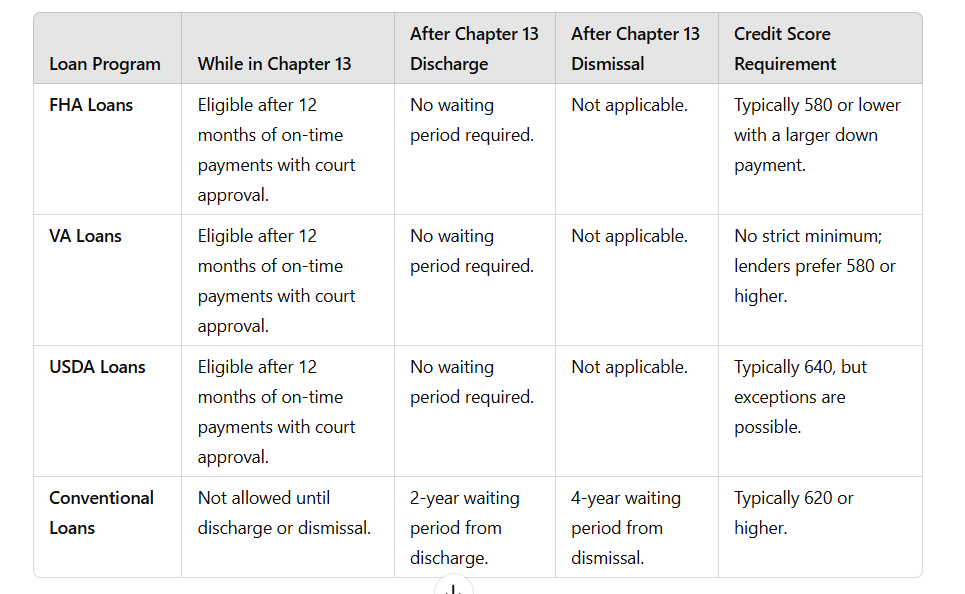
Chapter 13 bankruptcy can impact your ability to qualify for various mortgage loan programs like FHA, VA, USDA, and Fannie Mae. Here are the details for each program regarding waiting times, credit score requirements, down payment, and qualification criteria after a Chapter 13 bankruptcy:

  1. Kentucky FHA Loan after Chapter 13 Bankruptcy:

    • Waiting Time: Typically, you’ll need to wait at least two years after the discharge date of your Chapter 13 bankruptcy before applying for an FHA loan.
    • Credit Score: FHA loans are known for their flexibility with credit scores. While there’s no specific minimum score, a higher score (usually around 580 or above) can help you qualify for better terms.
    • Down Payment: The down payment requirement for an FHA loan after Chapter 13 bankruptcy is relatively low, usually starting at 3.5% of the purchase price.
    • Qualification with Chapter 13 Bankruptcy: To qualify, you must demonstrate that you’ve made all Chapter 13 payments on time for at least one year and receive approval from the bankruptcy court to take on new debt.
  2. Kentucky VA Loan after Chapter 13 Bankruptcy:

    • Waiting Time: The waiting time for a VA loan after Chapter 13 bankruptcy is generally two years from the discharge date.
    • Credit Score: VA loans also have flexible credit score requirements, with many lenders looking for scores around 620 or higher.
    • Down Payment: VA loans are known for offering zero-down financing, but eligibility depends on your military service record and whether you’ve used your VA loan benefits before.
    • Qualification with Chapter 13 Bankruptcy: Similar to FHA, you’ll need to demonstrate a consistent payment history under your Chapter 13 plan and receive approval from the bankruptcy court.
  3. Kentucky USDA Loan after Chapter 13 Bankruptcy:

    • Waiting Time: USDA loans typically require a waiting period of three years from the discharge date of your Chapter 13 bankruptcy.
    • Credit Score: While there’s no official minimum credit score, most lenders look for scores of 640 or higher for USDA loans.
    • Down Payment: USDA loans offer low to no down payment options, making them attractive for eligible borrowers in rural areas.
    • Qualification with Chapter 13 Bankruptcy: You’ll need to show that you’ve been making timely payments under your Chapter 13 plan for at least one year and obtain approval from the bankruptcy court.
  4. Kentucky Fannie Mae Loan after Chapter 13 Bankruptcy:

    • Waiting Time: Fannie Mae typically requires a waiting period of two years from the discharge date of your Chapter 13 bankruptcy.
    • Credit Score: Fannie Mae loans often have stricter credit score requirements compared to FHA, VA, and USDA loans. A score of around 620 or higher is generally needed.
    • Down Payment: Down payment requirements vary based on the type of Fannie Mae loan you apply for, but they can range from 3% to 20%.
    • Qualification with Chapter 13 Bankruptcy: You’ll need to demonstrate responsible financial management after bankruptcy, including rebuilding your credit and showing a stable income.

In all cases, it’s essential to work with a knowledgeable mortgage broker like Joel Lobb, who can guide you through the specific requirements and help you navigate the loan application process after a Chapter 13 bankruptcy.

Chapter 13 Bankruptcy and Mortgage Loans: Buying a Home in Kentucky

Are you currently in or have recently completed a Chapter 13 bankruptcy and want to buy a home in Kentucky? Navigating the mortgage process after bankruptcy can feel overwhelming, but it’s entirely possible to qualify for a home loan with the right knowledge and preparation. Here’s what you need to know about how Chapter 13 bankruptcy impacts your ability to qualify for popular mortgage loan programs like FHA, VA, USDA, and Fannie Mae.

1 –  Email – kentuckyloan@gmail.com 

2.   Call/Text – 502-905-3708

Joel Lobb
Mortgage Loan Officer – Expert on Kentucky Mortgage Loans


🌐 Websitewww.mylouisvillekentuckymortgage.com
🏢 Address: 911 Barret Ave., Louisville, KY 40204


Evo Mortgage
Company NMLS# 1738461
Personal NMLS# 57916

For assistance with Kentucky mortgage loans, reach out via email, call, or text Joel Lobb directly.

4 Things to Know about buying a house and getting a Kentucky Mortgage Loan approval


Kentucky USDA Guideline Updates for


  • Annual Qualifying Income – The requirement for calculations to be included on the Income Calculation worksheet have been removed and should now be included on Attachment 9-B, the underwriter transmittal summary, FNMA form 1008/Freddie form 1077, or equivalent
  • 4506-T – The requirement for asset statements to be reviewed to ensure borrowers have no additional income sources has been removed.
  • Repayment Income – MCC income must now be included in repayment income.
  • Boarder Income – USDA now considers a boarder as a household member and a boarder’s income must now be included in annual income calculation. Rent paid by boarders that is reported on tax returns must also be included in annual income.
  • Capital Gains – USDA removed requirement from Repayment Income to provide evidence showing borrowers own additional property or assets that may be sold if additional income is needed to support the mortgage obligation
  • Commission – The borrower must now show one year history in same or similar line of work to include commission in repayment income.
  • Fellowship, Stipend, Scholarship – Scholarship award letters must now provide date of termination and USDA will no longer presume benefits with no expiration date will continue. USDA also added guidelines for GI Bill income and stated it cannot be included in annual or repayment income.
  • MCC – This income must now be included in repayment income, but no history is required. A copy of the W-4 from employer is required to verify borrower is taking tax credit on monthly basis. Note: MCC’s are ineligible with FWL as qualifying income.
  • Unreimbursed Business Income – only taxable income is allowed to be included in repayment income
  • Section 8 – USDA removed requirement for section 8 income to be deducted from the monthly PITI to determine DTI if it is paid directly to the loan servicer when included in the repayment income.
  • Self Employed Income – Federal tax returns must now be reviewed to determine gross income for annual calculations. Removed requirement to deduct business loss before entering as repayment income into GUS or on loan application. Clarified documentation requirements as most recent 2 years of federal tax returns / transcripts & YTD P&L may be audited or unaudited
  • Social Security Income – clarified documentation options and will allow social security benefit statement or form SSA-1099/1042S to source
  • Temporary Leave – The history requirements for repayment income has been changed and now income must be received by loan closing.
  • Cash on Hand – The underwriter must review the reasonableness of accumulation based upon income stream, spending habits, etc. and cash on hand can no longer be included in reserves
  • Gift Funds – Clarification provided on how gift funds must be sourced when gift funds have been deposited into borrower’s account, not deposited into borrower’s account, or if funds are being wired directly to the settlement agent.
  • Large Deposits – USDA no longer addresses lump sum additions.

click link below

👇

Kentucky USDA Rural Development Loan Program:


The following is a list of the “nuts and bolts” of the Kentucky USDA Rural Development Loan Program:

  • The house has to be located in a Kentucky USDA Rural Development Loan Program: area designated as an USDA eligible area.
  • To determine the USDA approved designated areas, reference the following USDA map instructions:
    • Go the USDA Rural Development Website
    • On the top left hand side, click “Single Family Housing Guaranteed”
    • Click “Accept”
    • Enter the property address to determine if a specific house or general area is located in an USDA eligible area
  • The household income must be moderate as determined by USDA. The USDA Loan evaluates household income, which includes the combined income of all adults living in the household; even if they are not on the mortgage loan. Click here to determine your household income eligibility.
  • If it appears that the household income exceeds the moderate income thresholds established by USDA, do not throw in the towel just yet. USDA allows for deductions for child care and medical expenses as well as for children, students, and elderly members of the household that will be living in the USDA financed property.
  • This is not a farmer’s loan. As a matter of fact, the property cannot have any income producing capabilities, and when the land value of the property exceeds 30% of the appraised value additional requirements must be met.
  • The house has to be in fairly good condition. The appraisal type being utilized is an FHA appraisal, so make sure that there are not any safety related challenges(i.e. missing banisters, peeling paint, exposed electric).
  • This is a true no money down loan program. Or stated differently, you do not need a down payment.
  • While there is a monthly mortgage insurance premium (or prorated portion of an Annual Fee), the cost of the monthly mortgage insurance is 59% less than a comparable FHA Loan. This makes the USDA loan more affordable than an FHA Loan when analyzing down payment requirements and monthly mortgage payments.
  • The seller can pay all closing costs and pre-paids (i.e. escrows). Often the home buyer’s only out-of-pocket cost as part of the purchase transaction is approximately $550 for the appraisal report.
  • If the house appraises for more than the purchase price, the difference can be used to pay for closing costs and pre-paids (i.e. escrows). Only the USDA Loan program allows for closing costs to be rolled on top of the purchase price.
  • USDA has no restriction on whether you are a first time home buyer or move-up home buyer.
  • This loan program is only for primary residence (i.e. no second home or investment properties).
  • You should not own any other functional property; although there are some circumstances under which USDA may waive this requirement.
  • The preferred minimum credit score is 640. However, if you have a documented rent history, no late payments on your credit cards, and no new collections within the last 12 months, a credit score as low as 620 may be considered.
  • All property types including single family homes, town homes, modular, and even condominiums qualify for this loan program. Manufacture homes such as single and doublewides constructed prior to January 1, 2006 do not qualify.
  • There is no maximum mortgage amount, but the house does have to be considered moderate in a size