I am a Kentucky based USDA Mortgage Lender that has originated over 300 KY Rural Housing Mortgage Loans in Kentucky-CALL OR TEXT 502-905-3708 FOR USDA MORTGAGE LOAN
Chapter 13 Bankruptcy and Mortgage Loans: Buying a Home in Kentucky
Are you currently in or have recently completed a Chapter 13 bankruptcy and want to buy a home in Kentucky? Navigating the mortgage process after bankruptcy can feel overwhelming, but it’s entirely possible to qualify for a home loan with the right knowledge and preparation. Here’s what you need to know about how Chapter 13 bankruptcy impacts your ability to qualify for popular mortgage loan programs like FHA, VA, USDA, and Fannie Mae.
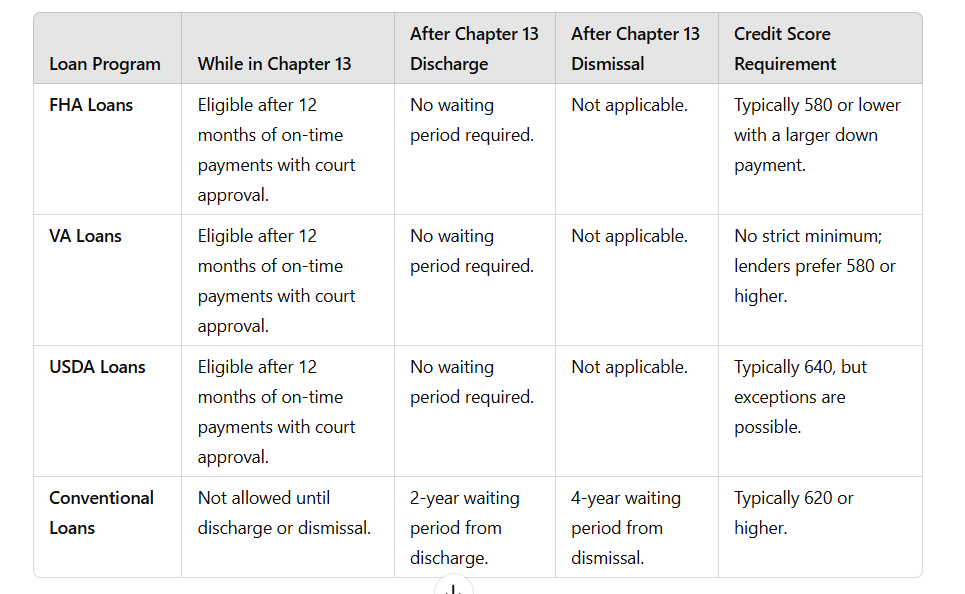
Chapter 13 bankruptcy can impact your ability to qualify for various mortgage loan programs like FHA, VA, USDA, and Fannie Mae. Here are the details for each program regarding waiting times, credit score requirements, down payment, and qualification criteria after a Chapter 13 bankruptcy:
Waiting Time: Typically, you’ll need to wait at least two years after the discharge date of your Chapter 13 bankruptcy before applying for an FHA loan.
Credit Score: FHA loans are known for their flexibility with credit scores. While there’s no specific minimum score, a higher score (usually around 580 or above) can help you qualify for better terms.
Down Payment: The down payment requirement for an FHA loan after Chapter 13 bankruptcy is relatively low, usually starting at 3.5% of the purchase price.
Qualification with Chapter 13 Bankruptcy: To qualify, you must demonstrate that you’ve made all Chapter 13 payments on time for at least one year and receive approval from the bankruptcy court to take on new debt.
Waiting Time: The waiting time for a VA loan after Chapter 13 bankruptcy is generally two years from the discharge date.
Credit Score: VA loans also have flexible credit score requirements, with many lenders looking for scores around 620 or higher.
Down Payment: VA loans are known for offering zero-down financing, but eligibility depends on your military service record and whether you’ve used your VA loan benefits before.
Qualification with Chapter 13 Bankruptcy: Similar to FHA, you’ll need to demonstrate a consistent payment history under your Chapter 13 plan and receive approval from the bankruptcy court.
Waiting Time: USDA loans typically require a waiting period of three years from the discharge date of your Chapter 13 bankruptcy.
Credit Score: While there’s no official minimum credit score, most lenders look for scores of 640 or higher for USDA loans.
Down Payment: USDA loans offer low to no down payment options, making them attractive for eligible borrowers in rural areas.
Qualification with Chapter 13 Bankruptcy: You’ll need to show that you’ve been making timely payments under your Chapter 13 plan for at least one year and obtain approval from the bankruptcy court.
Waiting Time: Fannie Mae typically requires a waiting period of two years from the discharge date of your Chapter 13 bankruptcy.
Credit Score: Fannie Mae loans often have stricter credit score requirements compared to FHA, VA, and USDA loans. A score of around 620 or higher is generally needed.
Down Payment: Down payment requirements vary based on the type of Fannie Mae loan you apply for, but they can range from 3% to 20%.
Qualification with Chapter 13 Bankruptcy: You’ll need to demonstrate responsible financial management after bankruptcy, including rebuilding your credit and showing a stable income.
In all cases, it’s essential to work with a knowledgeable mortgage broker like Joel Lobb, who can guide you through the specific requirements and help you navigate the loan application process after a Chapter 13 bankruptcy.
2026 Guide to USDA Rural Housing Loans for Manufactured Homes in Kentucky: No-Money-Down Options, Even with Bad Credit
100% financing available for qualified Kentucky borrower
Table of Contents
Understanding USDA Mobile Home Loans in Kentucky
2026 Game-Changing Updates
Kentucky USDA Rural Housing Loan Requirements
Bad Credit Mobile Home Loans in Kentucky
No Money Down Mobile Home Financing Options
Kentucky Counties Eligible for USDA Mobile Home Loans
Foundation and Installation Requirements
How to Apply for USDA Mobile Home Loans in Kentucky
Alternative Financing Options
Frequently Asked Questions
Understanding USDA Mobile Home Loans in Kentucky
The United States Department of Agriculture (USDA) Rural Development program has been quietly revolutionizing homeownership opportunities across Kentucky for decades. Many potential homebuyers don’t realize this. The USDA’s Single Family Housing Guaranteed Loan Program (SFHGLP) extends far beyond traditional stick-built homes. It also includes manufactured and mobile homes. This opens doors for thousands of Kentucky families who previously thought homeownership was out of reach.
Kentucky, with its vast rural landscapes and small-town communities, is well-suited to USDA rural housing programs. Conventional mortgages often demand large down payments and excellent credit. USDA loans, however, are designed for low- to moderate-income families in rural areas. They are an excellent option for mobile home buyers across the Commonwealth.
What Makes USDA Mobile Home Loans Different
•100% Financing: No money down is required, making it perfect for buyers with limited savings
•Affordable Terms: Competitive interest rates make monthly payments manageable
•Rural Housing Opportunities: Ideal for Kentucky homebuyers in small towns and rural areas
•Flexible Credit Requirements: Holistic approach to creditworthiness evaluation
On March 4, 2025, the USDA officially expanded its Single Family Housing Guaranteed Loan Program. This expansion provides 100% financing for manufactured homes. Industry experts are calling this change the most significant development in rural housing finance in decades.
Key Program Changes
Expanded Eligibility
Manufactured homes now receive the same favorable treatment as traditional homes
Age Restrictions Relaxed
Existing manufactured homes up to 20 years old can now qualify
Streamlined Process
Processing times reduced by 30-40% with new guidelines
Better Credit Pathways
Clearer guidelines for borrowers with credit challenges
Kentucky USDA Rural Housing Loan Requirements
Borrower Requirements
✓Income cannot exceed 115% of area median income
✓Must occupy home as primary residence
✓U.S. citizen, non-citizen national, or qualified alien
✓Credit score typically 580+ (manual underwriting available)
Property Requirements
✓Built to HUD Code standards (post-1976)
✓Permanent foundation required
✓Minimum 12 feet wide, 400 sq ft living space
✓Located in USDA-eligible rural area
Bad Credit Mobile Home Loans in Kentucky
One of the most significant advantages of USDA mobile home loans is their accessibility to borrowers with less-than-perfect credit. Unlike conventional mortgages, which often have rigid credit score requirements, USDA loans offer flexibility. This flexibility recognizes the unique challenges faced by rural borrowers.
Credit Score Guidelines
640+ Credit Score Streamlined Processing
580 and above Credit Score Manual Underwriting
Note: USDA takes a holistic approach to credit evaluation, considering factors beyond just credit scores.
Often Asked Questions
What credit score do I need for a USDA mobile home loan in Kentucky?
While USDA doesn’t set a minimum credit score, most lenders prefer scores of 580 or higher. Borrowers with lower scores may still qualify through manual underwriting, and the program takes a holistic approach to credit evaluation.
Can I buy a used mobile home with a USDA loan?
Yes, existing manufactured homes can qualify if they’re less than 20 years old. They must meet HUD standards. The homes should be properly installed on permanent foundations. Additionally, they need to meet all other USDA requirements.
Do I need to own the land to get a USDA loan for a mobile home?
USDA loans can finance both the manufactured home and land together. They can also finance just the home if you already own suitable land. However, the home must be permanently installed and classified as real property.
What areas of Kentucky are eligible for USDA loans?
Approximately 97% of Kentucky qualifies as rural for USDA purposes. Most areas outside of Louisville, Lexington, and a few other metropolitan centers are eligible. Use the USDA’s online eligibility tool to check specific addresses.
This comprehensive guide provides general information about USDA mobile home loans in Kentucky. It should not be considered as financial or legal advice. Potential borrowers should consult with qualified lenders, real estate professionals, and legal advisors for guidance specific to their situations.
Contact a Kentucky Mobile Home Loan Expert
For personalized guidance on Kentucky USDA mobile home loans, contact a local mortgage specialist. They can help with options for borrowers with bad credit and no down payment. The specialist will understand the unique requirements of manufactured home financing.
Disclaimer: This website is not endorsed by the FHA, VA, USDA, or any government agency. It is an independent platform created to educate and assist Kentucky homebuyers with expert advice and accessible tools.
Can I buy land and a mobile home together with a USDA loan?
USDA loans can finance both the manufactured home and the land in a single transaction. This is possible if both meet USDA eligibility requirements. The combined purchase must not exceed USDA loan limits for your area.
What if my credit score is below 580?
While challenging, approvals are possible with strong compensating factors such as stable employment, low debt-to-income ratios, and cash reserves. Working with an experienced USDA lender who understands manual underwriting is essential. Honestly, best to get score to 620 or 640 range for better changes of loan approval. USDA does not have minimum credit score requirements.
How long does the USDA loan process take?
Typical processing time is 45-60 days from application to closing. Processing is taking longer due to USDA cutbacks. This delay can vary based on property complexity. It also depends on documentation completeness and current USDA processing volumes.
Can I use gift funds for closing costs?
Yes, gift funds from family members are allowed for closing costs and prepaid items. Proper gift documentation and seasoning requirements must be met.
What happens if the home doesn’t appraise for the purchase price?
If the appraisal comes in low, you have several options. You can negotiate with the seller to reduce the price. Another option is to pay the difference in cash. Alternatively, you can cancel the contract if you have an appraisal contingency.
Are there income limits for USDA mobile home loans?
Yes, household income cannot exceed 115% of the Area Median Income for your county. These limits are updated annually and vary significantly across Kentucky.
Can I refinance my existing mobile home with a USDA loan?
USDA offers refinancing options for existing USDA loans, but cannot refinance non-USDA loans. However, if your current mobile home meets USDA requirements, you might qualify for a new purchase loan.
What areas of Kentucky qualify for USDA loans?
Most of Kentucky qualifies as rural under USDA guidelines. Use the USDA eligibility map to verify specific addresses, as eligibility can vary even within the same county.
Ready to explore USDA mobile home loan options in Kentucky? Don’t wait, as these programs have annual funding limits. Working with an experienced local lender who understands manufactured home financing is crucial for success.
For personalized guidance on Kentucky USDA mobile home loans:
USDA Homes for Sale in Kentucky — No Money Down Loan Guide
Everything Kentucky homebuyers need to know about finding USDA-owned foreclosure homes and purchasing them with zero down payment through the USDA Rural Housing loan program.
By Joel Lobb — Mortgage Loan OfficerNMLS #57916502-905-3708Updated March 2026
📋
Current Kentucky USDA Foreclosure Inventory — March 2026
As of today, Kentucky USDA-owned foreclosure listings are very limited. USDA resale inventory changes weekly — properties sell quickly and new ones are added regularly. This is normal; there are periods of zero listings followed by bursts of new inventory. Check the official USDA resales site below for the most current listings, and contact Joel Lobb immediately when a property appears — these homes move fast.
USDA Homes for Sale in Kentucky — What Buyers Need to Know
If you’re searching for USDA homes for sale in Kentucky, no money down homes in Kentucky, or government foreclosure homes near me, here’s what you need to know: the USDA Rural Development program periodically lists foreclosed homes it has repossessed — and these properties can be purchased with a zero-down USDA loan.
However, USDA-owned foreclosure inventory in Kentucky is limited and moves fast. The good news? Even when USDA-owned foreclosure inventory is low, you can still buy any USDA-eligible home in rural Kentucky with no money down using the USDA Guaranteed Rural Housing loan — not just USDA-owned properties.
💡 Key insight: You don’t have to wait for a USDA foreclosure listing to buy a home with no money down. The USDA Section 502 Guaranteed Loan program allows Kentucky buyers to purchase any USDA-eligible home — including regular market listings — with 100% financing and no down payment required.
Where to Find Listings
Where to Search for USDA Foreclosure Homes in Kentucky
Use these official sources to find current USDA and government-owned homes in Kentucky. Each source lists different types of government-owned properties.
1
USDA Official Resales Site
The only authoritative source for USDA-RD owned foreclosure homes. Search by state and county for live Kentucky listings.
Don’t Wait for a Foreclosure — Buy Any USDA-Eligible Home With Zero Down
Most Kentucky buyers searching for USDA foreclosure homes don’t realize they can purchase any home in a USDA-eligible rural area with no money down — not just government-owned foreclosures. The USDA Section 502 Guaranteed Loan is available on the open market, giving you thousands more homes to choose from across Kentucky’s 120 counties.
Zero Down Payment
100% financing — buy a home in rural Kentucky with no down payment required.
Low Monthly Cost
USDA annual MI is just 0.35% vs FHA’s 0.85% — saving hundreds per year.
Competitive Rates
USDA loan rates are typically at or below conventional mortgage rates for qualified buyers.
Same-Day Approval
Joel offers free mortgage applications with same-day pre-approval decisions.
Roll In Closing Costs
If the home appraises above purchase price, closing costs can be financed into the loan.
First-Time Buyer Friendly
No prior homeownership required. USDA works great for Kentucky first-time buyers.
USDA-Eligible Areas
Kentucky Counties Where USDA No Money Down Loans Are Available
Over 96% of Kentucky’s land area is USDA-eligible. These are popular counties where Kentucky buyers use USDA loans — including areas where USDA foreclosures have historically appeared.
Graves County
Calloway County
Logan County
Montgomery County
Caldwell County
McCracken County
Henderson County
Henry County
Christian County
Muhlenberg County
Barren County
Hart County
Grayson County
Edmonson County
Taylor County
Green County
+ 100 more counties
Qualification Requirements
How to Qualify for a USDA No Money Down Loan in Kentucky — 2025 Guidelines
Requirement
2025 Guideline
Notes
Down Payment
0% Required
100% financing — no savings needed
Credit Score
620 minimum
640+ preferred; below 640 needs manual UW
Income Limit (1–4 people)
~$119,650
Varies by county; higher in some KY areas
Income Limit (5–8 people)
~$158,050
Boone, Campbell, Kenton counties higher
Employment History
2 years required
Self-employed: 2 years tax returns
Property Type
Primary residence only
No investment properties or vacation homes
Property Location
USDA-eligible rural area
96%+ of KY qualifies — verify free at USDA.gov
Debt-to-Income Ratio
41–44% max
Higher ratios allowed with compensating factors
Annual MI Fee
0.35% per year
Much lower than FHA’s 0.85%
Upfront Guarantee Fee
1.0% of loan
Can be financed into the loan — no cash needed
How It Works
Step-by-Step: Buying a USDA Home in Kentucky With No Money Down
1
Get Pre-Approved First — Same Day
Call or text Joel Lobb at 502-905-3708 for a free pre-approval. Most Kentucky buyers receive a decision the same day. This confirms your budget and makes your offer stronger.
2
Check the USDA Resales Site for Foreclosure Inventory
Visit properties.sc.egov.usda.gov and filter by Kentucky → Single Family Housing. Inventory changes weekly. When a listing appears, move quickly — these homes attract multiple offers.
3
Search the Open Market for USDA-Eligible Homes
Any home in a USDA-eligible Kentucky zip code can qualify for zero-down financing. Use Zillow, Realtor.com, or a local agent and filter by your target counties.
4
Verify USDA Eligibility on the Property
Go to eligibility.sc.egov.usda.gov and enter the property address. Joel can also verify this instantly — just text him the address.
5
Submit Your Offer and Apply for USDA Financing
Once your offer is accepted, Joel handles your full USDA loan application. USDA closings in Kentucky typically take 30–45 days.
Pro Tips for Finding USDA Foreclosures Before They’re Gone
Subscribe to email alerts at the USDA resales website (free alert service available)
Call Joel Lobb — he actively monitors Kentucky USDA inventory and can notify you immediately
Check the site every Monday and Wednesday — USDA typically updates listings mid-week
Be ready to move fast — have your pre-approval letter in hand before a property appears
USDA foreclosures require offers through a licensed real estate agent — have one lined up
Frequently Asked Questions
Kentucky USDA Homes for Sale — Common Questions
Why are there no USDA foreclosure homes listed in Kentucky right now?
USDA foreclosure inventory is naturally limited and cyclical. When listings do appear, they sell quickly — sometimes within days. Zero listings is common and temporary. Set up an alert on the USDA resales site or contact Joel to be notified the moment new inventory hits.
Can I still buy a home in Kentucky with no money down if there are no USDA foreclosures available?
Absolutely yes. The USDA Section 502 Guaranteed Loan is available on any USDA-eligible property in Kentucky — not just USDA-owned foreclosures. With over 96% of Kentucky’s land area eligible, you have thousands of homes to choose from right now with zero down payment.
What Kentucky counties have had USDA foreclosure homes for sale historically?
Past USDA foreclosure listings in Kentucky have appeared in Graves, Caldwell, Montgomery, McCracken, Logan, Calloway, Henderson, and Henry counties, among others. Western Kentucky and Eastern Kentucky rural counties tend to see the most inventory.
How fast do USDA foreclosure homes sell in Kentucky?
Very fast — often within 1–2 weeks of listing. Having your USDA pre-approval letter ready before inventory appears is critical. Joel Lobb offers same-day pre-approvals so you can act immediately when a listing hits.
Do I need a real estate agent to buy a USDA foreclosure home?
Yes. USDA requires all offers on USDA-owned resale properties to be submitted through a licensed real estate agent or broker. The seller (USDA) typically pays the buyer’s agent commission — so it’s free to use an agent as a buyer.
What is the income limit for a USDA loan in Kentucky in 2025?
Most Kentucky counties allow household incomes up to $110,650 for 1–4 person households and $146,050 for 5–8 person households. Boone, Campbell, Gallatin, and Kenton counties have higher limits. Call Joel to verify your specific county.
Can I use KHC down payment assistance with a USDA loan in Kentucky?
Yes — KHC (Kentucky Housing Corporation) down payment assistance can be combined with USDA financing in many cases to cover closing costs, making your total out-of-pocket cost potentially zero dollars. Ask Joel about current KHC programs available in your county.
Ready to Buy a Kentucky Home With No Money Down?
Whether a USDA foreclosure listing appears or you want to buy any eligible Kentucky home with zero down, Joel Lobb is your local USDA expert. Free application, same-day approvals, and personal service throughout the process.
Over 20 years of experience helping Kentucky families buy homes with USDA, FHA, VA, KHC, and Fannie Mae loans. More than 1,300 Kentucky families served. Licensed in Kentucky only. Same-day approvals available.
NMLS Personal ID: #57916 · Company NMLS: #1738461 · Equal Housing Lender · Licensed in Kentucky only. This website is not endorsed by the USDA, FHA, VA, or any government agency. All loan approvals subject to underwriting guidelines and eligibility requirements.
USDA Loan Closing Timeline in Kentucky | 30-45 Days Explained
How Long Does It Take to Close on a USDA Rural Development Loan in Kentucky?
Expert guide to USDA loan closing timelines for Kentucky homebuyers
Quick Answer: Most USDA Rural Development loans in Kentucky close in 30 to 45 days. Well-prepared files with clean documentation and early USDA submission can close in under 30 days.
If you’re a first-time homebuyer exploring USDA Rural Development loans in Kentucky, understanding the closing timeline helps you plan your move and set realistic expectations. While USDA loans include an extra approval step compared to FHA or VA loans, the delay is typically minimal—usually just 2 to 3 additional business days when the loan is managed properly.
Why USDA Loans Include an Extra Approval Step
Unlike conventional, FHA, or VA loans, USDA Rural Development loans require two approval stages before closing.
In the first stage, your lender completes full underwriting to verify the loan meets USDA Guaranteed Loan Program guidelines. This underwriting process is similar to FHA or VA loans and includes verification of income, assets, credit, and the property appraisal.
Once your lender issues a final approval, the loan file moves to the second stage: USDA Rural Development review. This centralized review ensures compliance with federal rural lending requirements. In most cases, this review is quick and does not materially delay your closing date.
Kentucky USDA Loan Processing: Production Team Two
Kentucky USDA Rural Development loans are processed by Production Team Two, a centralized team based outside the state. This team handles USDA loans for ten states: Arkansas, Kentucky, Louisiana, Minnesota, Missouri, Mississippi, North Dakota, Nebraska, New Jersey, New York, and Oklahoma.
Production Team Two Contact:
SFHGLPTWO@usda.gov
Production Team Two typically operates on a 2 to 4 business day review cycle. However, timelines can vary based on loan submission volume and seasonal demand. During peak homebuying seasons (spring and summer), review times may extend slightly, while slower periods may see faster approvals.
Current USDA Turn Times for Your Loan
The USDA publishes live updates showing which loan submissions they are currently reviewing. This real-time data is the most accurate way to monitor processing timelines for Kentucky USDA loans.
These updates help lenders optimize submission timing and give borrowers realistic closing estimates based on current workload.
What Causes Delays in USDA Loan Closing?
Most USDA loans close on schedule when documentation is complete and submitted correctly. However, common causes of delays include:
Incomplete Income Documentation: Missing W-2s, tax returns, pay stubs, or verification letters often require back-and-forth communication and can add 5–7 days.
Appraisal Issues: If the property appraises below the purchase price or has condition issues, renegotiation or repairs may be required before closing.
Credit or Employment Changes: Any significant credit inquiry, new debt, job change, or employment gap discovered during underwriting requires explanation and may trigger additional review.
Seasonal Volume Spikes: During peak buying seasons, USDA production teams experience higher submission volumes, which can extend review times by a few business days.
Pro Tip: Submit complete, accurate documentation upfront. Have your lender submit your loan to USDA as soon as lender approval is issued. Early submission often means your loan is in queue when USDA begins their next review cycle, speeding up the overall timeline.
Can USDA Loans Close in Under 30 Days?
Yes—while not guaranteed, a clean file with complete documentation, early USDA submission, and no appraisal conditions can close in under 30 days. This typically requires:
All income and asset documentation submitted with the initial application, a property appraisal with no issues or conditions, no employment changes or credit inquiries during underwriting, and early submission to USDA immediately after lender approval.
If these conditions are met, some Kentucky borrowers have closed USDA loans in 25–28 days.
USDA vs. FHA vs. VA Closing Timelines
While USDA loans do take slightly longer than FHA or VA loans, the difference is minimal:
FHA Loans: 30–40 days (no extra federal review step)
VA Loans: 28–38 days (VA review is faster and often parallel to underwriting)
USDA Loans: 30–45 days (includes two approval stages, but second stage is typically quick)
In practice, the 2–3 day difference rarely impacts your ability to meet contract deadlines, especially if your lender submits to USDA early.
Bottom Line: USDA Loan Closing Timeline in Kentucky
USDA loans in Kentucky are not slow—they are simply structured differently. The extra approval step is built into the process and, when managed correctly, adds minimal delay.
When income, assets, and credit are documented properly and the appraisal is clean, most Kentucky USDA homebuyers close within standard 30–45 day timelines. The deciding factors are early submission and strong file preparation.
Frequently Asked Questions About USDA Loan Closing Times
How long does a USDA loan take to close in Kentucky?
Most USDA loans in Kentucky close in 30 to 45 days. Clean files with early USDA submission can close in under 30 days.
Do USDA loans take longer than FHA or VA loans?
Yes, but typically only by 2–3 business days. USDA loans require an additional final review by Rural Development after lender approval, while FHA and VA loans may not have the same secondary approval step.
Which USDA team handles Kentucky loans?
Kentucky USDA loans are processed by Production Team Two, which serves ten states. They typically operate on a 2–4 business day review cycle.
What causes the most delays with USDA loans?
Incomplete documentation, appraisal issues, credit changes, and seasonal volume spikes are the most common causes of delays. Submitting complete paperwork upfront and early USDA submission help avoid these delays.
Can I track my USDA loan approval status in real time?
Yes. The USDA publishes live turn time updates at rd.usda.gov, showing which submissions they are currently reviewing.
Does Kentucky have slower USDA turn times than other states?
No. Kentucky is handled by the same Production Team Two as nine other states, and turn times are consistent across all ten states—typically 2–4 business days.
What’s the fastest USDA loan I’ve heard of closing in Kentucky?
Some well-prepared files have closed in 25–28 days. This requires complete documentation, a clean appraisal, and early submission to USDA, but it’s achievable.
About the Author
Joel Lobb is a Kentucky-based mortgage loan officer with over 20 years of experience helping first-time homebuyers and families refinance through USDA, FHA, VA, KHC, and Fannie Mae programs. With down payment assistance still available through KHC, Joel specializes in making homeownership accessible to Kentucky families. Reach out for a free consultation and same-day approval.

.jpg)



 Kentucky USDA Mortgage Lender for Rural Housing Loans