Category: 2-1 and 1-0 buydowns for Kentucky Rural Housing USDA RD loans Interest Rates.

How to Get Approved for a USDA Mortgage Loan in Kentucky


Kentucky USDA Mortgage Loan Guide

Your Complete Roadmap to Zero-Down Financing in 2026

What Is a USDA Mortgage Loan?

The USDA Rural Development Guaranteed Loan Program is designed to help Kentucky families purchase homes in eligible rural areas. With over 20 years of experience assisting more than 1,300 Kentucky families, I’ve successfully guided hundreds through USDA loans across all 120 counties.

✓ 100% financing (zero down payment)
✓ Below-market fixed interest rates
✓ Flexible credit requirements
✓ Low mortgage insurance (0.35%)
✓ Financing of closing costs possible
✓ Seller concessions allowed

If you’re a first-time homebuyer looking for a true no-money-down option without VA benefits, USDA is your strongest choice.

Property Eligibility

The property must be located in a USDA-eligible rural zone. The excellent news for Kentucky buyers: most of the state qualifies. While Louisville and Lexington city centers are ineligible, surrounding suburban areas typically qualify.

Typically Eligible Areas

  • Most of Hardin, Meade, Breckenridge, Grayson, Nelson, Spencer, and Shelby Counties
  • Large portions of Bullitt County outside immediate Louisville limits
  • Nearly all of Eastern and Western Kentucky
  • Suburban pockets around Lexington, Georgetown, Winchester, and Nicholasville
Check Eligibility: Use the USDA property eligibility map to verify any address before making an offer. This step saves time and ensures you’re pursuing viable properties.

Income Limits for 2026

Your total household income must not exceed the USDA county limit for your family size. USDA counts all household income, including spouses, adult children, part-time earnings, and bonuses.

Household Size 2026 Income Limit Range
1–4 People Up to approximately $119,850 for 1-4 members and $158,250 for 5-8 members
5–8 People Up to approximately $ $119,850 for 1-4 members and $158,250 for 5-8 members

Note: Limits vary by county. Contact me for your specific county’s limits.

Credit Score Requirements

While USDA doesn’t publish a minimum credit score, Kentucky lenders follow these general guidelines:

640+ Credit Score — Easiest Path to Approval

  • Eligible for automated approval through GUS (USDA’s system)
  • More flexible debt-to-income ratios
  • Faster underwriting timeline

580–639 — Possible With Manual Underwriting

Approvals in this range require strong supporting documentation:

  • Perfect rental history
  • No late payments in the past 12 months
  • Low overall debt
  • Stable employment history

Below 580 — Case-by-Case Review

Not impossible, but uncommon. Success requires significant compensating factors and strong manual underwriting review.

Employment Rules

Underwriters typically require a 2-year work history, though it doesn’t need to be at the same job. USDA is flexible about career transitions within reason.

USDA Accepts

  • Job changes within the same field or industry
  • Recent graduates working in their trained field
  • 12+ months of consistent income
  • Self-employed borrowers (with 2 years of tax returns)

Red Flags to Avoid

  • Job gaps longer than 60 days
  • Declining income trends over time
  • Multiple unrelated job switches

Debt-to-Income Ratio Requirements

Your DTI is calculated as a percentage of your gross monthly income.

DTI Type Standard Limit With Strong Credit (GUS Approve)
Front-End (Housing Only) 29% Up to 29–34%
Back-End (All Debt) 41% 44%+

Manual underwriting files must stay closer to standard limits, while automated approvals offer more flexibility.

Bankruptcy & Foreclosure Waiting Periods

If you’ve experienced financial hardship, USDA has established waiting periods before approval:

Credit Event Waiting Period
Chapter 7 Bankruptcy 3 Years from Discharge
Chapter 13 Bankruptcy 12 Months of On-Time Payments + Trustee Approval
Foreclosure 3 Years from Sale Date
Short Sale 3 Years (Typical)
Medical collections and older accounts rarely require payoff. Your individual circumstances matter—let’s review your specific situation.

Property Condition & Appraisal Requirements

Your home must be safe, sound, and sanitary. The USDA appraiser evaluates:

  • Roof condition and remaining lifespan
  • Foundation stability and integrity
  • Electrical system safety
  • Plumbing functionality
  • Adequate heating system for the entire home
  • Absence of active termite damage
  • No peeling lead-based paint

Most repairs can be handled by the seller before closing. This is a negotiation point in your offer.

The USDA Loan Process

1Pre-Qualification

Credit check, income estimate, DTI calculation, and review of eligible areas

2Full Pre-Approval

Gather pay stubs, W-2s, tax returns, bank statements, and photo ID

3Find Your Home

Use eligibility maps to confirm the property qualifies before making an offer

4Loan Application & Underwriting

Rate lock, appraisal order, document review, and GUS findings

5USDA Final Approval

Conditional Commitment issued (typically 2–7 days)

6Closing Day

Sign final paperwork, receive keys, and move into your new home

Timeline: Most Kentucky USDA loans close within 30–45 days from application.

Frequently Asked Questions

Do I need a down payment?

No—USDA loans provide 100% financing with zero down payment required.

Can I buy in Louisville or Lexington?

City centers are ineligible, but many surrounding suburbs qualify. Always verify the property address on the USDA eligibility map before making an offer.

What credit score do I need?

640+ is ideal for streamlined approval. Manual underwriting may consider scores down to 580 with strong compensating factors.

Can the seller help with closing costs?

Yes—USDA allows seller concessions, and some closing costs can be financed if the appraisal supports it.

How long does the process take?

Most Kentucky USDA loans close in 30–45 days from application.

Are there down payment assistance programs?

Yes. Kentucky Housing Corporation (KHC) programs offer additional assistance for qualified first-time homebuyers to further reduce upfront costs.

Ready to Get Pre-Approved?

Let’s explore your USDA lending options with personalized guidance and same-day approvals.

Call or Text: 502-905-3708
Email: kentuckyloan@gmail.com

Serving qualified homebuyers across all 120 Kentucky counties

Joel Lobb, Mortgage Loan Officer | Specialist in Kentucky FHA, VA, USDA, KHC & Fannie Mae Loans

EVO Mortgage — Helping Kentucky Homebuyers Since 2001

NMLS Personal ID: 57916 | Company NMLS ID: 1738461 | Equal Housing Lender

This website is not endorsed by the USDA, FHA, VA, or any government agency. It is an independent educational resource.

This is not a commitment to lend. All loans subject to credit approval and USDA program guidelines.

Best mortgage rates in Kentucky for FHA, VA, USDA and Conventional Home Loans


Your credit score plays a significant role in determining the interest rate you qualify for. Lenders use credit scores to assess your creditworthiness and the risk associated with lending to you. Generally, the higher your credit score, the lower the interest rate you can secure. Here’s how different credit score ranges typically impact mortgage rates:

  • Excellent Credit (780 and above): Aim for a 780 score or higher for the best rates -Borrowers with excellent credit scores usually qualify for the lowest mortgage rates available.

2. Down Payment:

The down payment amount affects your loan-to-value (LTV) ratio, which is the loan amount divided by the property’s appraised value. A higher down payment reduces the lender’s risk, leading to better mortgage rates. Here’s how down payments typically impact mortgage rates:

  • 40% or more: A down payment of 40% or more often qualifies you for the best rates and eliminates the need for private mortgage insurance (PMI).

3. Debt-to-Income Ratio (DTI):

Your DTI ratio compares your monthly debt payments to your gross monthly income. Lenders use this ratio to assess your ability to manage monthly mortgage payments alongside existing debts. A lower DTI ratio indicates less financial risk to lenders, potentially leading to better rates. Here’s how to calculate DTI and improve it:

  • Calculate Your DTI: Add up all your monthly debt payments (such as credit cards, car loans, student loans) and divide by your gross monthly income.
  • Ideal DTI: Generally, a DTI of 45% or lower is considered good by most lenders.
  • Improve Your DTI: Paying down debts or increasing your income can lower your DTI ratio, improving your chances of securing a better rate.

4. Term of Loan:

The term of your loan, such as 15-year or 30-year, also influences the interest rate. Shorter loan terms often come with lower interest rates but higher monthly payments. Longer terms may have slightly higher rates but offer lower monthly payments.

In conclusion, to get the best Kentucky mortgage rate:

  • Maintain a high credit score by managing credit responsibly. Shoot for 780 or higher for the best mortgage rate on a conventional loan
  • Save for a substantial down payment to reduce the loan amount and LTV ratio. To get the best rate, usually 40% down will get you the best rates on a Conventional loan.
  • Keep your DTI ratio low by managing debts and increasing income where possible. Try to keep the debt to income ratio less than 45%
  • The above scenarios are for conventional loans. Rates could vary for VA, USDA, and FHA mortgage loans due to there mortgage insurance being the same for each borrower whereas conventional loans sway more toward the down payment, credit score, and debt to income ratio.
  • Keep in mind shorter term loans, i.e. 15 year loans vs 30 year loans will get you a better rate for all types of loans
  • Larger loan amounts will yield better rates vs small loan amounts due to the profits involved in the secondary market for the above loans and how lenders are paid.

Best mortgage rates in Kentucky for FHA, VA, USDA and Conventional Home Loans-

Joel Lobb  Mortgage Loan Officer

American Mortgage Solutions, Inc.
10602 Timberwood Circle
Louisville, KY 40223
Company NMLS ID #1364

Text/call: 502-905-3708
fax: 502-327-9119
email:
kentuckyloan@gmail.com
http://www.mylouisvillekentuckymortgage.com/

 
NMLS 57916  | Company NMLS #1364/MB73346135166/MBR1574
 

The view and opinions stated on this website belong solely to the authors, and are intended for informational purposes only. The posted information does not guarantee approvalnor does it comprise full underwriting guidelines. This does not represent being part of a government agency. The views expressed on this post are mine and do not necessarily reflect the view of my employer. Not all products or services mentioned on this site may fit all people.
NMLS ID# 57916, (www.nmlsconsumeraccess.org).


USDA loan in Kentucky


Qualifications for a USDA Loan to Buy a Home in Kentucky

Purchasing a home in Kentucky can be made more accessible through the United States Department of Agriculture (USDA) Loan Program. This program is designed to help low-to-moderate-income individuals and families achieve the dream of homeownership in eligible rural areas. Here are the key qualifications for obtaining a USDA loan in Kentucky:

 Income Limits
To qualify for a USDA loan, applicants must not have an annual adjusted income greater than **115%** of the median household income for the area¹.

 Employment

Applicants are expected to provide proof of stable income and employment for at least two years¹.

 Credit Requirements

While there is no minimum credit score required, applicants must meet USDA’s guaranteed underwriting credit requirements. A fair consideration of the credit background is essential⁴.

Property Location

The property must be situated in an eligible rural area as defined by the USDA¹.
Property Standards
The home must be safe, sanitary, and structurally sound to qualify for a USDA loan¹.

Occupancy

Borrowers must agree to occupy the property as their primary residence³.

 Legal Capacity

Applicants must have the legal capacity to incur a loan obligation³.

 Citizenship

Applicants must meet citizenship or eligible noncitizen requirements³.

 Debt-to-Income Ratio

Your monthly housing costs (mortgage principal and interest, property taxes, and insurance) must not exceed **29%** of your gross monthly income⁴.

 Loan Limits

The USDA does not set specific maximum loan amounts for guaranteed mortgages. Instead, local limits are determined by a combination of the area USDA maximum income limit and the borrower’s debt-to-income ratios⁴.

The USDA loan program is a fantastic opportunity for those looking to buy a home in Kentucky’s rural areas. With no down payment required and flexible qualification criteria, it opens the door to homeownership for many who may not qualify for conventional loans.

For more detailed information or to apply for a USDA loan, it’s recommended to contact a local mortgage lender or visit the USDA Rural Development website.

This article provides a concise overview of the qualifications needed for a USDA loan in Kentucky. Prospective homebuyers should consult with a mortgage professional to understand the full application process and to determine their eligibility.

¹: [Louisville Kentucky Mortgage Lender for FHA, VA, KHC, USDA](https://www.mylouisvillekentuckymortgage.com/p/a-kentucky-usda-home-loan-is-zero.html)
³: [Single Family Housing Direct Home Loans in Kentucky](https://www.rd.usda.gov/programs-services/single-family-housing-programs/single-family-housing-direct-home-loans/ky)
⁴: [Kentucky USDA Loan Limits – Loans101.com](https://www.loans101.com/usda-loans/usda-loan-limits/kentucky-usda-loan-limits-guaranteed-loans/)

(1) Louisville Kentucky Mortgage Lender for FHA, VA, KHC, USDA …. https://www.mylouisvillekentuckymortgage.com/p/a-kentucky-usda-home-loan-is-zero.html.

Joel Lobb  Mortgage Loan Officer

Text/call: 502-905-3708

email:
 kentuckyloan@gmail.com

http://www.mylouisvillekentuckymortgage.com/

5 Things to Know about buying a house and getting a Kentucky Mortgage Loan approval


Understanding Kentucky Mortgage underwriting guidelines

All lending institutions have different Underwriting Guidelines set in place when reviewing a borrower’s financial history to determine the likelihood of receiving on-time payments. The primary items reviewed are the following 5 areas below:

1. Income

2. Debt

3. Credit History

4. Savings

5. Debt vs Income Ratio


Income

Income is one of the most important variables a lender will examine because it is used to repay the loan. Income is reviewed for the type of work, length of employment, educational training required, and opportunity for advancement. An underwriter will look at the source of income and the likelihood of its continuance to arrive at a gross monthly figure.

Salary and Hourly Wages – Calculated on a gross monthly basis, prior to income tax deductions.

Part-time and Second Job Income – Not usually considered unless it is in place for 12 to 24 straight months. Lenders view part-time income as a strong compensating factor.

Commission, Bonus and Overtime Income – Can only be used if received for two previous years. Further, an employer must verify that it is likely to continue. A 24-month average figure is used.

Retirement and Social Security Income – Must continue for at least three years into the future to be considered. If it is tax free, it can be grossed up to an equivalent gross monthly figure. Multiply the net amount by 1.20%.

Alimony and Child Support Income – Must be received for the 12 previous months and continue for the next 36 months. Lenders will require a divorce decree and a court printout to verify on-time payments.

Notes Receivable, Interest, Dividend and Trust Income – Proof of receiving funds for 12 previous months is required. Documentation showing income due for 3 more years is also necessary. Rental Income – Cannot come from a Primary Residence roommate. The only acceptable source is from an investment property. A lender will use 75% of the monthly rent and subtract ownership expenses. The Schedule E of a tax return is used to verify the figures. If a home rented recently, a copy of a current month-to-month lease is acceptable.

Automobile Allowance and Expense Account Reimbursements – Verified with 2 years tax returns and reduced by actual expenses listed on the income tax return Schedule C.

Education Expense Reimbursements – Not considered income. Only viewed as slight compensating factor.

Self-Employment Income – Lenders are very careful in reviewing self-employed borrowers. Two years minimum ownership is necessary because two years is considered a representative sample. Lenders use a 2-year average monthly income figure from the Adjusted Gross Income on the tax returns. A lender may also add back additional income for depreciation and one-time capital expenses. Self-employed borrowers often have difficulty qualifying for a mortgage due to large expense write offs. A good solution to this challenge used to be the No Income Verification Loan, but there are very few of these available any more given the tightened lending standards in the current economy. NIV loan programs can be studied in the Mortgage Program section of the library.

2. Debt

An applicant’s liabilities are reviewed for cash flow. Lenders need to make sure there is enough income for the proposed mortgage payment, after other revolving and installment debts are paid.

All loans, leases, and credit cards are factored into the debt calculation. Utilities, insurance, food, clothing, schooling, etc. are not.

If a loan has less than 10 months remaining, a lender will usually disregard it.

The minimum monthly payment listed on a credit card bill is the figure used, not the payment made.

An applicant who co-borrowed for a friend or relative is accountable for the payment. If the applicant can show 12 months of on-time cancelled checks from the co-borrower, the debt will not count.

Loans can be paid off to qualify for a mortgage, but credit cards sometimes cannot (varies by lender). The reasoning is that if the credit card is paid off, the credit line still exists, and the borrower can run up debt after the loan is closed.

A borrower with fewer liabilities is thought to demonstrate superior cash management skills.

Credit History


Most lenders require a residential merged credit report (RMCR) from the 3 main credit bureaus: Trans Union, Equifax, and Experian. They will order one report which is a blending of all three credit bureaus and is easier to read than the individual reports. This “blended” credit report also searches public records for liens, judgments, bankruptcies and foreclosures. See our credit report index.

Credit report in hand, an underwriter studies the applicant’s credit to determine the likelihood of receiving an on-time mortgage payment. Many studies have shown that past performance is a reflection of future expectations. Hence, most lenders now use a national credit scoring system, typically the FICO score, to evaluate credit risk. If you’re worried about credit scoring, see our articles on it.

The mortgage lending process, once very forgiving, has tightened lending standards considerably. A person with excellent credit, good stability, and sufficient documentable income to make the payments comfortably will usually qualify for an “A” paper loan. “A Paper”, or conforming loans, make up the majority of loans in the U.S. and are loans that must conform to the guidelines set by Fannie Mae or Freddie Mac in order to be saleable by the lender. Such loans must meet established and strict requirements regarding maximum loan amount, down payment amount, borrower income and credit requirements and suitable properties. Loans that do not meet the credit and/or income requirements of conforming “A-paper” loans are known as non-conforming loans and are often referred to as “B”, “C” and “D” paper loans depending on the borrower’s credit history and financial capacity.

Here are some rules of thumb most lenders follow:

12 plus months positive credit will usually equal an A paper loan program, depending on the overall credit. FHA loans usually follow this guideline more often than conventional loans.

Unpaid collections, judgments and charge offs must be paid prior to closing an A paper loan. The only exception is if the debt was due to the death of a primary wage earner, or the bill was a medical expense.

If a borrower has negotiated an acceptable payment plan and has made on time payments for 6 to 12 months, a lender may not require a debt to be paid off prior to closing.

Credit items usually are reported for 7 years. Bankruptcies expire after 10 years.

Foreclosure – 5 years from the completion date. From the fifth to seventh year following the foreclosure completion date, the purchase of a principal residence is permitted with a minimum 10% down and 680 FICO score. The purchase of a second or investment property is not permitted for 7 years. Limited cash out refinances are permitted for all occupancy types.

Pre-foreclosure (Short Sale) – 2 years from the completion date (no exceptions or extenuating circumstances).

Deed-in-Lieu of Foreclosure – 4-year period from the date the deed-in-lieu is executed. From the fifth to the seventh year following the execution date the borrower may purchase a property secured by a principal residence, second home or investment property with the greater of 10 percent minimum down payment or the minimum down payment required for the transaction. Limited cash out and cash out refinance transactions secured by a principal residence, second home or investment property are permitted pursuant to the eligibility requirements in effect at that time.

Chapter 7 Bankruptcy – A borrower is eligible for an A paper loan program 4 years after discharge or dismissal, provided they have reestablished credit and have maintained perfect credit after the bankruptcy.

Chapter 13 Bankruptcy – 2 years from the discharge date or 4 years from the dismissal date.

Multiple Bankruptcies- 5 years from the most recent dismissal or discharge date for borrowers with more than one filing in the past 7 years.

The good credit of a co-borrower does not offset the bad credit of a borrower.

Credit scores usually range from 400 to 800. Changes to lending standards are occurring on a daily basis as a result of tightening lending standards and can vary from lender-to-lender– so this information should be considered simply a guideline. For conforming loans, most lenders will lend down to a FICO of 620, with additional rate hits for the lower-end credit scores and loan-to-values. When you are borrowing more than 80%, they typically will not lend if you have a FICO below 680. The FHA/VA program just changed their minimum required FICO to 620, unless you are qualifying a borrower with non-traditional credit. The few non-conforming loan programs that are still available typically require 30% down payment with a minimum FICO of 700 for self-employed and 650 for W-2 employees, and the loan-to-value will change with the loan amount.

Lenders evaluate savings for three reasons.

The more money a borrower has after closing, the greater the probability of on-time payments.

Most loan programs require a minimum borrower contribution.

Lenders want to know that people have invested their own into the house, making it less likely that they will walk away from their life’s savings. They analyze savings documents to insure the applicant did not borrow the funds or receive a gift.

Lenders look at the following types of accounts and assets for down payment funds:

Checking and Savings – 90 days seasoning in a bank account is required for these funds. Gifts and Grants – After a borrower’s minimum contribution, a gifts or grant is permitted.

Sale of Assets – Personal property can be sold for the required contribution. The property should be appraised, and a bill of sale is required. Also, a copy of the received check and a deposit slip are needed.

Secured Loans – A loan secured by property is also an acceptable source of closing funds.

IRA, 401K, Keogh & SEP – Any amount that can be accessed is an acceptable source of funds.
Sweat Equity and Cash On Hand – Generally not acceptable. FHA programs allow it in special circumstances.
Sale Of Previous Home – Must close prior to new home for the funds to be used. A lender will ask for a listing contract, sales contract, or HUD 1 closing statement.

The percentage of one’s debt to income is one of the most important factors when underwriting a loan. Lenders have determined that a house payment should not exceed approximately 30% of Gross Monthly Income. Gross Monthly Income is income before taxes are taken out. Furthermore, a house payment plus minimum monthly revolving and installment debt should be less than 40% of Gross Monthly Income (this figure varies from 35%-41% contingent on the source of financing).

Example

An applicant has $4,500 gross monthly income. The maximum mortgage payment is:

$4500 X .30 = $1350

Their total debts come to:

$500 Car

$20 Visa

$30 Sears

$75 Master Card

—————-

$625 per month.

Remember, their total debts (mortgage plus other debts) must be less than or equal to 40% of their gross monthly income.

$2,800 X .40 = $1800

$1800 is the maximum debt the borrower can have, debts and mortgage payments combined. Can the borrower keep all their debts and have the maximum mortgage payment allowed? NO!

In this case, the borrower, since they have high debts, must adjust the maximum mortgage payment downward, because:

$625 debts

$1350 mortgage
————-

$1975 – which is more than the $1800 (40% of gross debt) we calculated above.

The maximum mortgage payment is therefore:

$1800 – $625 (monthly debt) = $1175.

Some restrictions apply. Ask for details. Loan decision is subject to satisfactory appraisal and title review and no change in financial condition. This is not an offer for extension of credit or a commitment to lend. Equal Housing Opportunity.
This communication is provided to you for informational purposes only and should not be relied upon by you.

Joel Lobb (NMLS#57916)

Senior  Loan Officer
American Mortgage Solutions, Inc.
10602 Timberwood Circle Suite 3
Louisville, KY 40223
 
Company ID #1364 | MB73346

Text/call 502-905-3708
If you are an individual with disabilities who needs accommodation, or you are having difficulty using our website to apply for a loan, please contact us at 502-905-3708.
Disclaimer: No statement on this site is a commitment to make a loan. Loans are subject to borrower qualifications, including income, property evaluation, sufficient equity in the home to meet Loan-to-Value requirements, and final credit approval. Approvals are subject to underwriting guidelines, interest rates, and program guidelines and are subject to change without notice based on applicant’s eligibility and market conditions. Refinancing an existing loan may result in total finance charges being higher over the life of a loan. Reduction in payments may reflect a longer loan term. Terms of any loan may be subject to payment of points and fees by the applicant  Equal Opportunity Lender. NMLS#57916http://www.nmlsconsumeraccess.org/

Kentucky USDA Rural Housing Loans Direct Programs Interest Rates


What is the interest rate and payback period?

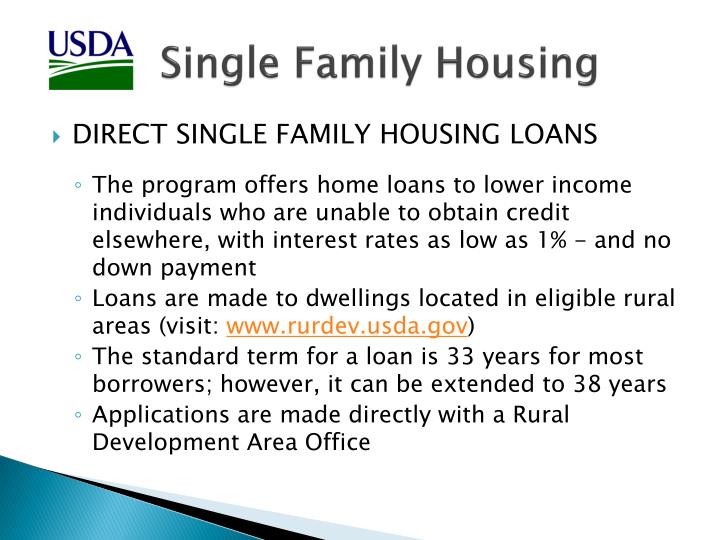
  • Effective January 1, 2024, the current interest rate for Single Family Housing Direct home loans is 5.125% for low-income and very low-income borrowers.
  • Fixed interest rate based on current market rates at loan approval or loan closing, whichever is lower
  • Interest rate when modified by payment assistance, can be as low as 1%
  • Up to 33 year payback period – 38 year payback period for very low income applicants who can’t afford the 33 year loan term
  • Fixed interest rate based on current market rates at loan approval or loan closing, whichever is lower
  • Interest rate when modified by payment assistance, can be as low as 1%
  • Up to 33 year payback period – 38 year payback period for very low income applicants who can’t afford the 33 year loan term

Not the same as the USDA Rural Housing Guaranteed Program. These rates follow the secondary market and change daily like FHA, VA, Conventional Mortgage Loans and set by individual lenders based on lock period, credit score, loan amount, state, and other incentives

the current interest rate for Single Family Housing Direct Home Loans

The USDA 502 Direct Loan Program helps low- and very-low-income applicants in federally-determined rural areas of the state obtain decent, safe and sanitary housing in eligible rural areas by providing payment assistance to increase an applicant’s repayment ability. This payment assistance is a type of subsidy that reduces the mortgage payment. The amount of assistance is determined by the adjusted family income.

A number of factors are considered when determining an applicant’s eligibility for this loan. At a minimum, applicants interested in obtaining a direct loan must have an adjusted income that is at or below the applicable low-income limit for the area where they wish to buy a house and they must demonstrate a willingness and ability to repay debt.

This is a zero down payment loan.

Program Fact Sheet

Program Forms & Resources

Click here for the current rate for the USDA 502 Direct Loan Program