
Tag: Real estate

USDA Loan Payoff Guide for Kentucky Homeowners


MORTGAGE LOAN PAYOFFS
FOR USDA RURAL DEVELOPMENT DIRECT HOUSING LOANS
 
 
What is this? After a loan is closed, the subsidized portion of a borrower’s monthly payment will accrue as a separate account. The Government pays this subsidy each month to help very low and low income household
afford to own a home. This account is subject to being repaid or “recaptured” at the time a borrower
sells or transfers the property to another owner, no longer occupy the property, or pays the loan in full.
The maximum amount of recapture due will be the lesser of the amount of subsidy received or up to
50 percent of the Adjusted Value Appreciation in the property.
 
The Value Appreciation is based on  appraised value and/or sales price at time of sale, refinance, or when the principal and interest balances are paid in full. This value excludes any of the borrower’s original equity or any value that resulted from eligible Capital Improvements that were made by the borrower. Borrowers who
refinance their Rural Development loan and want to pay off the principal and interest balance, have the
option to defer the final amount of Recapture due, or pay it off at closing. (See section below“Deferring
Payment of Recapture Due”).
 
Understanding your need for getting a payoff.
 
There are different options provided by our Centralized Service Center (CSC) for payoffs. These are:
 
􀂾 The Principal and Interest Payoff (P & I) is based on the anticipated principal, interest and
fee balance (if any fees have been added) for the requested date. This form of payoff is used
when the borrower’s account is not subject to recapture or if the borrower is only concerned
with the principal and interest balances due on their loan(s). As a note, all RD Section 504
repair loans are not subject to any recapture due.
 
􀂾 The Maximum Payoff statement indicates the Maximum amount the borrower may be
required to pay as of a requested date. It includes 100% of all Subsidy Recapture funds
including Principal and Interest and any fees that are due. This statement advises borrowers to
submit additional information to CSC so that Subsidy Recapture can be properly calculated for a
Final Payoff statement.
 
􀂾 The Estimated payoff is an estimated figure only. The Agency offers an automated Voice
Response Unit (VRU) by calling our toll-free number (1-800-414-1226). It provides an accurate
P&I balance and an estimated Subsidy Recapture amount based on a hypothetical sales price or
appraised value. Please follow the directions (below) for an “Estimated Payoff”.
 
􀂾 The Final Payoff statement is based on the account balance on the requested payoff date, and
the actual Subsidy Recapture Amount due is calculated based on the final documentation
provided by the borrower/settlement agent. This statement indicates the actual amount the
borrower will be required to pay at loan closing.
“USDA is an equal opportunity provider, employer and lender.”
To file
 
Getting the Estimated Payoff — (Recommended but not required).
 
Please note: This is an Estimated Figure AND CANNOT BE USED TO PAYOFF AN ACCOUNT. It
is calculated as of the date of your call. The Subsidy Recapture amount does not include any
value deductions for Capital Improvements.
 
CALL: 1-800-414-1226 (This is an automated Voice Response Unit (VRU).
You will need the customer’s loan number and the last 4 digits of their Social Security Number
Choose: 1 Touchtone – Then: 1 English Speaking – Then: 2 Payoff Information
Then: You will be asked to input the customer’s loan number and the last four digits
of their Social Security Number. Stay on the line and listen to the entire
explanation of the different types of payoff figures.
 
Then: Go to Calculated Payoff, “Estimated Loan Balance” – Choice Number 2. You will be
asked to input the Estimated Market Value and the Estimated Closing Costs in
whole dollars.
 
Getting a Final Payoff—applies to all transactions (ex. sale, refinance, pay in full)
 
1. A copy of the Residential Appraisal Report and/or a copy of the Signed Contract.
2. A copy of the Estimated Settlement Statement. A Good Faith Estimate from the lending
institution is
3. The Date of the Payoff. Funds are to be received at Rural Development on this date.
4. The reason for paying off the loan: selling, refinancing, pay in full, and paying the recapture, or
refinancing and deferring the Recapture (Subordination).
5. Capital Improvements that the borrower has made to the property can help to reduce the
amount of subsidy that is subject to recapture. If a borrower has made any improvements to the
property, he/she should request that the appraiser provide an addendum to the
appraisal to indicate the value of the improvements. Capital Improvements are additions that
add value to the property above and beyond repairs that maintain the property. General
maintenance to keep the property in good condition is not considered a Capital Improvement.
Examples of Capital Improvements that do not qualify: yard maintenance, painting,
wallpapering, floor coverings, roofing, siding, wells, septic systems, appliances, furnaces or
water heaters. The value of a Capital Improvement must be determined by an appraiser, based
on the increase in the property’s value because of the improvement. The cost of making the
Capital Improvement is not considered when making this assessment, only the value that the
Capital Improvements have added to the property. A copy of the original appraisal can be
requested by the borrower(s) to assist the appraiser in Capital Improvement Determinations.
6. Borrowers who refinance or wish to pay off their loan(s) and subsidy recapture in full
and remain in the property will receive a 25 percent discount on the recapture amount if it is
included in the final payment. Please be aware that the 25 percent discount only applies if the
borrower refinances the loan, or pays the loan in full and continues to occupy and retain title to
the property.
7. Borrower(s) can defer recapture and pay it off later. A mortgage discharge
 
Borrower(s) can defer recapture and pay it off later. A mortgage discharge is not provided,
however, the Agency can subordinate it’s lien to another lender for the new loan (see below).
8. For unpaid or deferred subsidy, the borrower will establish a “Subsidy Receivable” account
with the Agency which will not be due and payable until the borrower transfers title or
vacates the property. The borrower cannot obtain the 25 percent discount if they voluntarily
decide to pay off the balance at a later date. The “Subsidy Receivable” account will not accrue
any interest or fees.
 
Deferring Payment of Recapture due.
 
When a borrower initially refinances their RD loan(s), they have the option to defer their Recapture
payment, or pay it in full. As mentioned above and under current rules, if it is paid in full they will
receive a 25% discount in the amount of recapture owed. A Loan Subordination of the RD debt to
allow another lender to make a loan can be requested by a borrower who wishes to refinance their
Rural Development loan and payoff the principal, interest, and fees (if any) and defer the Subsidy
Recapture Amount. The borrower can receive no “cash out” or consolidate additional debt (including
other liens against the property). Modest real estate improvements may be considered as long as the
Loan to Value for the new loan and the Recapture Receivable Amount are at or below 100% of the
Current “as improved” Market Value of the property. Requests can include reasonable closing costs.
 
A Subordination Package for refinancing and/or making improvements to the property must be
completed and returned to the Agency for review.
 
The following must also be included:
􀂾 If Improvements are being done, a Contractor’s Bid must be provided to the agency for
review prior to approval.
􀂾 A signed, dated authorization from the borrower(s) waiving the 25 Percent Recapture
Discount in lieu of a Subordination must be provided to Rural Development. This form is
included in the Subordination Package.
􀂾 A copy of a recent Uniform Residential Appraisal Report (Pages 1 and 2).
􀂾 A copy of the Estimated Settlement Statement from either a lender or a closing
agency. A Good Faith Estimate is acceptable if it includes the proposed loan
amount.
If this account is a previously established Recapture Receivable Account, we will also need
a Principal and Interest payoff on the first mortgage.
After the Subordination has been approved and prior to the issuance of the Subordination, the
proposed lienholder must complete Form RD 1927-8, Agreement with Prior Lienholder, which
requires the proposed lienholder to provide at least 30 written days notice to Rural Development,
before any foreclosure actions on the proposed lien are initiated. This form is also included in the
Subordination Package.
 
TO COMPLETE A FINAL PAYOFF FOR
TO COMPLETE A FINAL PAYOFF FOR THE USDA/RURAL DEVELOPMENT
 
Date: _____________
Company:______________________________
Fax Number___________________
Attention: ____________________
Your payoff request for borrower(s):_____________________________
Account Number(s)______________________ Phone Number:____________
FOR SALES, PLEASE FAX THE FOLLOWING DOCUMENTS: THE ACCOUNT NUMBER MUST BE
WRITTEN ON EACH PAGE:
• Sales Contract that includes the sales price (establishing market value) and signatures of both
buyer and seller AND/OR Pages 1 and 2 of the Uniform Residential Appraisal Report (with 1st page
as property description, 2nd page to include comparison approach, the estimated market value and
the appraiser’s signature. The appraisal must be less than one year old).
• Estimated Settlement Statement detailing our borrower’s (the sellers) closing costs. THIS MUST BE
COMPLETED BY THE SETTLEMENT/ESCROW AGENT. AN ESTIMATE FROM A REAL ESTATE AGENT IS
NOT ACCEPTABLE.
• Authorization to release information signed by the borrower(s). If the request is from a lender or its
agent, Social Security Number(s) and Account Number(s) are acceptable.
• Effective date of payoff requested.
When the above documentation is received together as a package, a Final Payoff will be
calculated. If you are notified by the Centralized Servicing Center (CSC) that additional
information is needed to calculate the payoff, please fax the entire package together again.
Also, please be sure that the account number is written on every piece of paper. This will
expedite your payoff request.
To complete a Final Payoff Statement: PLEASE FAX ALL REQUIRED DOCUMENTATION
TOGETHER AS A PACKAGE TO: 314-457-4433.
 
For Questions, you may call the Customer Service Department Toll Free at 1-800-414-1226
or TDD (hearing impaired only 1-800-438-1832) 7:00 a.m. to 5:00 p.m. Monday – Friday,
Central Time.
“USDA is an equal opportunity provider, employer and lender.”
 
To file a complaint of discrimination write USDA, Office of Civil Rights, Programs, 300 7th Street SW, Room 400 (Stop 9430),
Washington, DC 20024 or call (866)632-9992 (Voice), (202) 401-0216 (TDD/TTY Hearing Impaired Only) or (202)720-8046 (FAX


Subsidy Recapture


Payment subsidies received on loans approved after October 1, 1979 are subject to recapture. This means that when the property is sold, transferred, or no longer occupied by the customer, all or part of the subsidy granted must be repaid to the government. The amount of subsidy recapture will be determined by the increase in property value since the loan originated. Subsidy recapture must be calculated when the loan is paid off.

Not all USDA Rural Development Loans are subject to recapture. Please call our Customer Service Department at 1-800-414-1226 or 1-800-438-1832 (TDD/TTY Hearing Impaired Only) to find out if your loan is subject to recapture or to receive payoff information. We are available from 7:00 A.M. to 5:00 P.M. Central Standard Time (CST), Monday through Friday.


Subsidy Recapture Payment


Subsidy recapture must be paid when the property is sold, transferred, or no longer occupied by the customer.

If the loan is being paid off but the customer continues to live in the property there are two payment options:

  • Pay the subsidy recapture when the loan is paid off
    The subsidy recapture will be discounted by 25% if this option is chosen.

  • Defer payment of the subsidy recapture until the property is sold, transferred, or no longer occupied by the customer
    The subsidy recapture will not be discounted when the loan is paid off, nor will the discount apply in the future if this option is chosen.


Statement of Loan Balance(s) for Loans Subject to Recapture


With a touch-tone telephone, call 1-800-414-1226, and select option #2 from the Main Menu, and select option #1 from the Payoff Information Menu. Through our Interactive Voice Response system you can request a Statement of Loan Balance be mailed to the homeowner of record. The Statement of Loan Balance(s) provides the current outstanding balances of the loan, which includes principal, interest, fees, late charges, and escrow (if applicable). The statement also includes the total amount of payment assistance (subsidy) granted. The amount of subsidy can be quite large, but in many cases this amount is reduced when subsidy recapture is calculated.


Verbal Estimated Payoff Quotes


With a touch-tone telephone, call 1-800-414-1226, and select option #2 from the Main Menu, and select option #2 from the Payoff Information Menu. Our Interactive Voice Response (IVR) system can provide a verbal estimated payoff amount based on the information you enter. The IVR is easy to use and will provide instructions when you call. To calculate the estimated payoff amount you will need to enter the estimated value of the property and estimated closing costs that may be incurred as a result of selling or refinancing the loan. This information is necessary to estimate the subsidy recapture to be paid. The estimated payoff should not be used to pay off your loan.


How to Receive a Final Payoff Statement


In order to calculate subsidy recapture and provide a payoff statement, certain documents need to be submitted to our Payoff Department. The type of transaction (refinancing, selling, or paying off) will determine the documents needed. The payoff statement will be faxed or mailed to the address of record within 5 business days of receipt.

Refinancing

  • Customer�s name, loan number(s) and written authorization to release payoff(s).

  • A copy of a Uniform Residential Appraisal Report (usually available from the lender). Any capital improvements must be itemized on a separate addendum to the appraisal.

  • A copy of the Good Faith Estimate or estimated settlement statement from the lender.

  • Payoff good thru date.

    Selling

  • Customer�s name, loan number(s) and written authorization to release payoff(s).

  • A copy of the signed sales contract and/or a copy of a Uniform Residential Appraisal Report. Any capital improvements must be itemized on a separate addendum to the appraisal.

  • A copy of the estimated settlement statement from the closing agent.

  • Payoff good thru date.

    Paying off the loan and not refinancing or selling

  • Customer�s name, loan number(s) and written authorization to release payoff(s). Include a statement that the customer is staying in the property and not transferring title.

  • A copy of a Uniform Residential Appraisal Report. Refer to the local yellow pages or the internet for appraisers in your area. Any capital improvements must be itemized on a separate addendum to the appraisal.

  • Payoff good thru date.

    Not Subject to Recapture

  • Customer�s name, loan number and written authorization to release payoff(s).

  • Payoff good thru date.

    Not all USDA Rural Development loans are subject to recapture. Please call our Customer Service Department at 1-800-414-1226 to find out if your loan is subject to recapture and to confirm the documents needed for you to receive final payoff(s). We are available from 7:00 A.M. to 5:00 P.M. Central Standard Time (CST), Monday through Friday.


Capital Improvements


If certain improvements, referred to as capital improvements, are made to the property, the value of the improvements added may be used to reduce subsidy recapture owed. To receive credit for capital improvements, the appraiser should submit an addendum to the appraisal. Instruct the appraiser that an itemized list of the improvements or additions and the value the improvements or additions added to the property should be submitted along with the appraisal. The cost of the improvements or additions should not be submitted and will not be used. Replacement items such as kitchen cabinets, floor coverings, roofing, siding, furnaces, appliances, and water heaters are not considered capital improvements. Maintenance items or repairs that maintain the property in good condition, such as yard maintenance, painting, and wallpapering, are also not considered capital improvements in our calculation of subsidy recapture. Examples of capital improvements include, but are not limited to, room additions, adding a fence, deck or enclosed porch.


Kentucky USDA Loan Payoff Process – Infographic * { margin: 0; padding: 0; box-sizing: border-box; } body { font-family: ‘Arial’, sans-serif; background: linear-gradient(135deg, #667eea 0%, #764ba2 100%); min-height: 100vh; padding: 20px; } .infographic { max-width: 800px; margin: 0 auto; background: white; border-radius: 20px; box-shadow: 0 20px 60px rgba(0,0,0,0.2); overflow: hidden; } .header { background: linear-gradient(135deg, #2c5aa0 0%, #1e3d72 100%); color: white; padding: 30px; text-align: center; position: relative; } .header::before { content: ”; position: absolute; top: 0; left: 0; right: 0; bottom: 0; background: url(‘data:image/svg+xml,’); } .header h1 { font-size: 2.2rem; margin-bottom: 10px; position: relative; z-index: 1; } .header p { font-size: 1.1rem; opacity: 0.9; position: relative; z-index: 1; } .content { padding: 0; } .section { padding: 25px 30px; border-bottom: 2px solid #f0f0f0; } .section:last-child { border-bottom: none; } .section-title { font-size: 1.4rem; color: #2c5aa0; margin-bottom: 20px; display: flex; align-items: center; font-weight: bold; } .section-title .icon { width: 30px; height: 30px; background: linear-gradient(135deg, #667eea, #764ba2); border-radius: 50%; display: flex; align-items: center; justify-content: center; margin-right: 15px; color: white; font-weight: bold; } .step-grid { display: grid; grid-template-columns: repeat(auto-fit, minmax(250px, 1fr)); gap: 20px; margin-top: 20px; } .step-card { background: linear-gradient(135deg, #f8f9ff 0%, #e8efff 100%); padding: 20px; border-radius: 15px; border-left: 5px solid #667eea; transition: transform 0.3s ease, box-shadow 0.3s ease; } .step-card:hover { transform: translateY(-5px); box-shadow: 0 10px 30px rgba(102, 126, 234, 0.2); } .step-number { background: linear-gradient(135deg, #667eea, #764ba2); color: white; width: 30px; height: 30px; border-radius: 50%; display: flex; align-items: center; justify-content: center; font-weight: bold; margin-bottom: 10px; } .step-title { font-weight: bold; color: #2c5aa0; margin-bottom: 8px; font-size: 1.1rem; } .step-desc { color: #666; font-size: 0.95rem; line-height: 1.4; } .payoff-types { display: grid; grid-template-columns: repeat(auto-fit, minmax(180px, 1fr)); gap: 15px; } .payoff-type { background: white; border: 2px solid #e0e7ff; border-radius: 12px; padding: 20px; text-align: center; transition: all 0.3s ease; } .payoff-type:hover { border-color: #667eea; transform: translateY(-3px); box-shadow: 0 8px 25px rgba(102, 126, 234, 0.15); } .payoff-type h3 { color: #2c5aa0; font-size: 1rem; margin-bottom: 10px; } .payoff-type p { color: #666; font-size: 0.85rem; line-height: 1.3; } .highlight-box { background: linear-gradient(135deg, #fef3cd 0%, #fff5b4 100%); border: 2px solid #fbbf24; border-radius: 15px; padding: 20px; margin: 20px 0; } .highlight-box h3 { color: #92400e; margin-bottom: 10px; display: flex; align-items: center; } .highlight-box h3::before { content: ‘⚠️’; margin-right: 10px; } .contact-section { background: linear-gradient(135deg, #1e3d72 0%, #2c5aa0 100%); color: white; text-align: center; padding: 30px; } .contact-section h2 { margin-bottom: 15px; font-size: 1.5rem; } .contact-info { display: flex; justify-content: center; flex-wrap: wrap; gap: 30px; margin: 20px 0; } .contact-item { display: flex; align-items: center; color: white; text-decoration: none; font-weight: bold; } .contact-item:hover { opacity: 0.8; } .contact-item::before { content: attr(data-icon); margin-right: 8px; font-size: 1.2rem; } .cta-button { display: inline-block; background: linear-gradient(135deg, #10b981 0%, #059669 100%); color: white; padding: 15px 30px; border-radius: 50px; text-decoration: none; font-weight: bold; margin-top: 20px; transition: transform 0.3s ease; } .cta-button:hover { transform: scale(1.05); } .timeline { position: relative; padding-left: 30px; } .timeline::before { content: ”; position: absolute; left: 15px; top: 0; bottom: 0; width: 3px; background: linear-gradient(to bottom, #667eea, #764ba2); } .timeline-item { position: relative; margin-bottom: 25px; background: white; padding: 15px; border-radius: 10px; border: 2px solid #e0e7ff; } .timeline-item::before { content: attr(data-step); position: absolute; left: -45px; top: 15px; width: 30px; height: 30px; background: linear-gradient(135deg, #667eea, #764ba2); color: white; border-radius: 50%; display: flex; align-items: center; justify-content: center; font-weight: bold; font-size: 0.9rem; } .stats-grid { display: grid; grid-template-columns: repeat(auto-fit, minmax(150px, 1fr)); gap: 20px; margin-top: 20px; } .stat-item { text-align: center; background: white; padding: 20px; border-radius: 12px; border: 2px solid #e0e7ff; } .stat-number { font-size: 2rem; font-weight: bold; color: #667eea; display: block; } .stat-label { color: #666; font-size: 0.9rem; margin-top: 5px; } @media (max-width: 768px) { .infographic { margin: 10px; } .header h1 { font-size: 1.8rem; } .section { padding: 20px; } .contact-info { flex-direction: column; gap: 15px; } }

🏠 Kentucky USDA Loan Payoff Guide

Your Complete Step-by-Step Process for Rural Development Mortgage Payoffs

💰 Understanding Subsidy Recapture

Important: Most USDA Loans Have Recapture

Loans approved after October 1, 1979, require repayment of government subsidies when you sell, transfer, or pay off your property. The recapture amount is the lesser of total subsidy received OR 50% of property value appreciation.

25%
Discount if paying in full
50%
Max recapture of appreciation
5
Business days for payoff

📋 4 Types of Payoff Statements

Principal & Interest

Basic loan balance only. Used for loans not subject to recapture or Section 504 repair loans.

Maximum Payoff

Shows maximum possible amount including 100% of subsidy recapture. Starting point for calculations.

Estimated Payoff

Quick estimate via phone (1-800-414-1226). Cannot be used for actual payoff transactions.

Final Payoff

Official amount required for closing. Based on actual documentation and final calculations.

📞 Quick Estimate Process

Call USDA
Dial 1-800-414-1226 and follow prompts: 1 → 1 → 2
Enter Information
Provide loan number and last 4 digits of SSN
Get Estimate
Choose option 2 for “Calculated Payoff” and enter property value

📄 Required Documents by Transaction Type

R
Refinancing
• Written authorization
• Uniform Residential Appraisal
• Good Faith Estimate
• Payoff date
• Capital improvements addendum
S
Selling
• Written authorization
• Signed sales contract
• Settlement statement from agent
• Payoff date
• Current appraisal report
P
Paying Off
• Written authorization
• Statement staying in property
• Current appraisal report
• Payoff date
• No transfer of title

🏗️ Capital Improvements Can Reduce Recapture

✅ Qualifying Improvements

  • Room additions
  • Enclosed porches/decks
  • Fencing installations
  • Structural improvements

❌ Non-Qualifying Items

  • Routine maintenance
  • Appliance replacements
  • Painting/wallpapering
  • Roofing/siding replacement

💳 Two Payment Options for Kentucky Homeowners

🎯 Option 1: Pay in Full (Recommended)

  • 25% discount on recapture
  • Clean title with no liens
  • No future obligations
  • Best for refinancing

⏳ Option 2: Defer Payment

  • Pay when you sell/move
  • No discount available
  • USDA maintains lien
  • No interest or fees accrue

Need Help with Your Kentucky USDA Loan Payoff?

Over 20 years helping Kentucky families with mortgage solutions

Get Free Consultation Today

Joel Lobb – Kentucky Mortgage Specialist
Same-day approvals • 1,300+ families helped

Complete Guide to Paying Off Your USDA Rural Development Mortgage Loan in Kentucky

Learn how to pay off your USDA Rural Development mortgage loan in Kentucky. Complete guide covering subsidy recapture, payoff options, required documents, and step-by-step instructions for Kentucky homeowners.

USDA mortgage payoff Kentucky, rural development loan payoff, Kentucky USDA loan, subsidy recapture Kentucky, USDA refinance Kentucky, rural housing loan Kentucky

What You Need to Know About USDA Mortgage Loan Payoffs in Kentucky

If you have a USDA Rural Development mortgage loan in Kentucky, understanding the payoff process is crucial. This is especially important if you are considering paying it off, refinancing, or selling your home. This comprehensive guide will walk you through everything Kentucky homeowners need to know about USDA loan payoffs, including the important subsidy recapture feature that affects most Rural Development loans.

Understanding USDA Subsidy Recapture in Kentucky

Most USDA Rural Development loans approved after October 1, 1979, include a “Subsidy Recapture” feature. When you sell, transfer, or pay off your loan, you may need to repay some government subsidy you received during your loan term. You might need to repay all of it.

Key Facts About Subsidy Recapture:

  • The government pays monthly subsidies to help low and moderate-income Kentucky families afford homeownership
  • These subsidies accumulate in a separate account over time
  • Recapture is triggered when you sell, transfer, or pay off your property
  • The maximum recapture is the lesser of total subsidy received OR 50% of the property’s value appreciation

Types of USDA Loan Payoff Statements Available to Kentucky Borrowers

1. Principal and Interest (P&I) Payoff

This basic payoff covers only the principal, interest, and any fees due on your loan. It’s used when:

  • Your loan isn’t subject to recapture
  • You only need the basic loan balance information
  • You have a Section 504 repair loan (these are never subject to recapture)

2. Maximum Payoff Statement

This statement shows the maximum amount you might owe, including:

  • 100% of all subsidy recapture funds
  • Principal and interest balance
  • Any outstanding fees
  • Serves as a starting point before final calculations

3. Estimated Payoff (Automated System)

Get a quick estimate by calling 1-800-414-1226 and using the automated Voice Response Unit (VRU). You’ll need:

  • Your loan number
  • Last 4 digits of your Social Security Number
  • Estimated property value
  • Estimated closing costs

Important: This is only an estimate and cannot be used for actual payoff.

4. Final Payoff Statement

This is the official payoff amount required for closing, based on:

  • Actual account balance on payoff date
  • Calculated subsidy recapture amount
  • Final documentation you provide

Step-by-Step Guide: Getting Your Kentucky USDA Loan Payoff

Step 1: Determine If Your Loan Has Recapture

Call 1-800-414-1226 (7:00 AM – 5:00 PM, Monday-Friday, Central Time) to confirm if your loan is subject to subsidy recapture.

Step 2: Gather Required Documentation

For Refinancing Your Kentucky USDA Loan:

  • Written authorization to release payoff information
  • Uniform Residential Appraisal Report (from your lender)
  • Good Faith Estimate or estimated settlement statement
  • Payoff date
  • Capital improvements addendum (if applicable)

For Selling Your Kentucky Home:

  • Written authorization to release payoff information
  • Signed sales contract showing sales price
  • Uniform Residential Appraisal Report (less than one year old)
  • Estimated settlement statement from closing agent
  • Payoff date

For Paying Off Without Selling/Refinancing:

  • Written authorization to release payoff information
  • Statement confirming you’re staying in the property
  • Current Uniform Residential Appraisal Report
  • Payoff date

Step 3: Submit Documentation

Fax all required documents together as a complete package to: 314-457-4433

Important: Write your account number on every page for faster processing.

Kentucky USDA Loan Payoff Options

Option 1: Pay Recapture in Full (Recommended)

If you’re refinancing or paying off your loan but staying in the property, you can:

  • Pay the full subsidy recapture amount at closing
  • Receive a 25% discount on the recapture amount
  • Get a clean title with no future obligations

Option 2: Defer Recapture Payment

Alternatively, you can:

  • Defer recapture payment until you sell or move
  • Establish a “Subsidy Receivable” account with USDA
  • No discount available with this option
  • No interest or fees accrue on deferred amount

Reducing Subsidy Recapture with Capital Improvements

Kentucky homeowners can reduce their recapture amount by documenting qualifying capital improvements. These must add value to your property beyond normal maintenance.

Qualifying Capital Improvements Include:

  • Room additions
  • Enclosed porches or decks
  • Fencing installations
  • Structural improvements that increase property value

Non-Qualifying Items:

  • Routine maintenance (painting, wallpapering)
  • Replacement items (roofing, siding, appliances)
  • Yard maintenance
  • Floor coverings

Important: The appraiser must provide an addendum showing the added value (not cost) of improvements.

USDA Loan Subordination for Kentucky Refinances

If you want to refinance your Kentucky USDA loan and defer recapture, you can request loan subordination. This allows another lender to take first position while USDA maintains a lien for the deferred recapture amount.

Subordination Requirements:

  • No cash-out refinancing allowed
  • Cannot consolidate other debts
  • Loan-to-value plus recapture cannot exceed 100% of current market value
  • Must waive the 25% recapture discount
  • Complete subordination package required

Contact Information for Kentucky USDA Loan Payoffs

Customer Service Department:

  • Phone: 1-800-414-1226
  • TDD (Hearing Impaired): 1-800-438-1832
  • Hours: 7:00 AM – 5:00 PM, Monday-Friday (Central Time)
  • Payoff Documentation Fax: 314-457-4433

Why Work with a Kentucky Mortgage Expert

Navigating USDA loan payoffs can be complex, especially when dealing with subsidy recapture calculations. As a Kentucky mortgage specialist with over 20 years of experience helping Kentucky families, I can:

  • Guide you through the payoff process
  • Help coordinate with USDA representatives
  • Assist with refinancing options
  • Ensure all documentation is properly prepared
  • Find the best loan programs for your situation

Ready to Pay Off or Refinance Your Kentucky USDA Loan?

Don’t navigate this process alone. Contact me today for expert guidance on your USDA loan payoff or refinancing options.

Joel Lobb – Kentucky Mortgage Loan Officer

  • 📞 Call/Text: 502-905-3708
  • 📧 Email: kentuckyloan@gmail.com
  • NMLS ID: 57916
  • Free mortgage applications with same-day approvals

Frequently Asked Questions About Kentucky USDA Loan Payoffs

Q: How long does it take to get a final payoff statement?

A: USDA typically provides final payoff statements within 5 business days of receiving all required documentation.

Q: Can I avoid subsidy recapture on my Kentucky USDA loan?

A: Recapture is required by law for eligible loans. However, you may qualify for the 25% discount if you pay in full while remaining in the property.

Q: What happens if I can’t afford the recapture amount?

A: You can defer the recapture payment until you sell or move, but you won’t receive the 25% discount.

Q: Are all USDA loans subject to recapture?

A: No. Section 504 repair loans and some older loans are not subject to recapture. Call 1-800-414-1226 to verify your loan status.


Related Kentucky Mortgage Resources

External Resources:


This website is not endorsed by the FHA, VA, USDA, or any government agency. The information provided is for educational purposes and should not be considered legal or financial advice.

Schema Markup (JSON-LD)

{
  "@context": "https://schema.org",
  "@type": "Article",
  "headline": "Complete Guide to Paying Off Your USDA Rural Development Mortgage Loan in Kentucky",
  "description": "Learn how to pay off your USDA Rural Development mortgage loan in Kentucky. Complete guide covering subsidy recapture, payoff options, required documents, and step-by-step instructions.",
  "author": {
    "@type": "Person",
    "name": "Joel Lobb",
    "jobTitle": "Mortgage Loan Officer",
    "telephone": "502-905-3708",
    "email": "kentuckyloan@gmail.com",
    "identifier": "NMLS 57916"
  },
  "publisher": {
    "@type": "Organization",
    "name": "Kentucky Mortgage Services",
    "url": "https://www.kentuckymortgage.com"
  },
  "datePublished": "2025-07-12",
  "dateModified": "2025-07-12",
  "mainEntityOfPage": {
    "@type": "WebPage",
    "@id": "https://www.kentuckymortgage.com/usda-loan-payoff-kentucky"
  },
  "about": [
    {
      "@type": "Thing",
      "name": "USDA Mortgage Payoff"
    },
    {
      "@type": "Place",
      "name": "Kentucky"
    }
  ],
  "mentions": [
    {
      "@type": "GovernmentOrganization",
      "name": "USDA Rural Development",
      "telephone": "1-800-414-1226"
    }
  ]
}

Local Business Schema

{
  "@context": "https://schema.org",
  "@type": "LocalBusiness",
  "name": "Kentucky Mortgage Services - Joel Lobb",
  "description": "Kentucky First-Time Homebuyer Specialist offering FHA, VA, USDA, and KHC mortgage loans with over 20 years experience.",
  "telephone": "502-905-3708",
  "email": "kentuckyloan@gmail.com",
  "areaServed": {
    "@type": "State",
    "name": "Kentucky"
  },
  "serviceType": "Mortgage Lending",
  "priceRange": "$$",
  "openingHours": "Mo-Fr 08:00-18:00",
  "hasCredential": "NMLS 57916"
}
How to Get Approved for a USDA Mortgage Loan in Kentucky


Kentucky USDA Mortgage Loan Guide

Your Complete Roadmap to Zero-Down Financing in 2026

What Is a USDA Mortgage Loan?

The USDA Rural Development Guaranteed Loan Program is designed to help Kentucky families purchase homes in eligible rural areas. With over 20 years of experience assisting more than 1,300 Kentucky families, I’ve successfully guided hundreds through USDA loans across all 120 counties.

✓ 100% financing (zero down payment)
✓ Below-market fixed interest rates
✓ Flexible credit requirements
✓ Low mortgage insurance (0.35%)
✓ Financing of closing costs possible
✓ Seller concessions allowed

If you’re a first-time homebuyer looking for a true no-money-down option without VA benefits, USDA is your strongest choice.

Property Eligibility

The property must be located in a USDA-eligible rural zone. The excellent news for Kentucky buyers: most of the state qualifies. While Louisville and Lexington city centers are ineligible, surrounding suburban areas typically qualify.

Typically Eligible Areas

  • Most of Hardin, Meade, Breckenridge, Grayson, Nelson, Spencer, and Shelby Counties
  • Large portions of Bullitt County outside immediate Louisville limits
  • Nearly all of Eastern and Western Kentucky
  • Suburban pockets around Lexington, Georgetown, Winchester, and Nicholasville
Check Eligibility: Use the USDA property eligibility map to verify any address before making an offer. This step saves time and ensures you’re pursuing viable properties.

Income Limits for 2026

Your total household income must not exceed the USDA county limit for your family size. USDA counts all household income, including spouses, adult children, part-time earnings, and bonuses.

Household Size 2026 Income Limit Range
1–4 People Up to approximately $119,850 for 1-4 members and $158,250 for 5-8 members
5–8 People Up to approximately $ $119,850 for 1-4 members and $158,250 for 5-8 members

Note: Limits vary by county. Contact me for your specific county’s limits.

Credit Score Requirements

While USDA doesn’t publish a minimum credit score, Kentucky lenders follow these general guidelines:

640+ Credit Score — Easiest Path to Approval

  • Eligible for automated approval through GUS (USDA’s system)
  • More flexible debt-to-income ratios
  • Faster underwriting timeline

580–639 — Possible With Manual Underwriting

Approvals in this range require strong supporting documentation:

  • Perfect rental history
  • No late payments in the past 12 months
  • Low overall debt
  • Stable employment history

Below 580 — Case-by-Case Review

Not impossible, but uncommon. Success requires significant compensating factors and strong manual underwriting review.

Employment Rules

Underwriters typically require a 2-year work history, though it doesn’t need to be at the same job. USDA is flexible about career transitions within reason.

USDA Accepts

  • Job changes within the same field or industry
  • Recent graduates working in their trained field
  • 12+ months of consistent income
  • Self-employed borrowers (with 2 years of tax returns)

Red Flags to Avoid

  • Job gaps longer than 60 days
  • Declining income trends over time
  • Multiple unrelated job switches

Debt-to-Income Ratio Requirements

Your DTI is calculated as a percentage of your gross monthly income.

DTI Type Standard Limit With Strong Credit (GUS Approve)
Front-End (Housing Only) 29% Up to 29–34%
Back-End (All Debt) 41% 44%+

Manual underwriting files must stay closer to standard limits, while automated approvals offer more flexibility.

Bankruptcy & Foreclosure Waiting Periods

If you’ve experienced financial hardship, USDA has established waiting periods before approval:

Credit Event Waiting Period
Chapter 7 Bankruptcy 3 Years from Discharge
Chapter 13 Bankruptcy 12 Months of On-Time Payments + Trustee Approval
Foreclosure 3 Years from Sale Date
Short Sale 3 Years (Typical)
Medical collections and older accounts rarely require payoff. Your individual circumstances matter—let’s review your specific situation.

Property Condition & Appraisal Requirements

Your home must be safe, sound, and sanitary. The USDA appraiser evaluates:

  • Roof condition and remaining lifespan
  • Foundation stability and integrity
  • Electrical system safety
  • Plumbing functionality
  • Adequate heating system for the entire home
  • Absence of active termite damage
  • No peeling lead-based paint

Most repairs can be handled by the seller before closing. This is a negotiation point in your offer.

The USDA Loan Process

1Pre-Qualification

Credit check, income estimate, DTI calculation, and review of eligible areas

2Full Pre-Approval

Gather pay stubs, W-2s, tax returns, bank statements, and photo ID

3Find Your Home

Use eligibility maps to confirm the property qualifies before making an offer

4Loan Application & Underwriting

Rate lock, appraisal order, document review, and GUS findings

5USDA Final Approval

Conditional Commitment issued (typically 2–7 days)

6Closing Day

Sign final paperwork, receive keys, and move into your new home

Timeline: Most Kentucky USDA loans close within 30–45 days from application.

Frequently Asked Questions

Do I need a down payment?

No—USDA loans provide 100% financing with zero down payment required.

Can I buy in Louisville or Lexington?

City centers are ineligible, but many surrounding suburbs qualify. Always verify the property address on the USDA eligibility map before making an offer.

What credit score do I need?

640+ is ideal for streamlined approval. Manual underwriting may consider scores down to 580 with strong compensating factors.

Can the seller help with closing costs?

Yes—USDA allows seller concessions, and some closing costs can be financed if the appraisal supports it.

How long does the process take?

Most Kentucky USDA loans close in 30–45 days from application.

Are there down payment assistance programs?

Yes. Kentucky Housing Corporation (KHC) programs offer additional assistance for qualified first-time homebuyers to further reduce upfront costs.

Ready to Get Pre-Approved?

Let’s explore your USDA lending options with personalized guidance and same-day approvals.

Call or Text: 502-905-3708
Email: kentuckyloan@gmail.com

Serving qualified homebuyers across all 120 Kentucky counties

Joel Lobb, Mortgage Loan Officer | Specialist in Kentucky FHA, VA, USDA, KHC & Fannie Mae Loans

EVO Mortgage — Helping Kentucky Homebuyers Since 2001

NMLS Personal ID: 57916 | Company NMLS ID: 1738461 | Equal Housing Lender

This website is not endorsed by the USDA, FHA, VA, or any government agency. It is an independent educational resource.

This is not a commitment to lend. All loans subject to credit approval and USDA program guidelines.

USDA Eligibility Map


🏠

USDA Rural Development

Eligibility Map Tool

🗺️ How to Check USDA Eligibility

Use the interactive map below to determine if your property is eligible for USDA Rural Development programs. Simply enter your address in the search box within the map to see the eligibility status for your location.

✅ Eligible Areas

Rural areas and towns with populations under 35,000 are typically eligible for USDA programs including home loans, grants, and business development assistance.

❌ Ineligible Areas

Urban areas and cities with populations over 35,000 are generally not eligible. These areas are shown in different colors on the map.

USDA Eligibility Map

🔗 Interactive Map

Use the “Find Your Address” search box in the map below to locate your property and determine USDA eligibility. Green areas indicate eligible locations, while gray areas are typically ineligible.

Eligible Areas

Ineligible Areas

📍 How to Use the Map

1. Click on the “Find Your Address” search box in the map above
2. Enter your complete address (street, city, state, ZIP)
3. Press Enter or click the search button
4. The map will show your location and indicate eligibility status

🏛️ USDA Rural Development Programs

If your property is in an eligible area, you may qualify for various USDA Rural Development programs:

  • Single Family Housing: Direct and guaranteed loans for homebuyers with low to moderate incomes
  • Home Repair Grants: Financial assistance for low-income homeowners to make essential repairs
  • Business Programs: Loans and grants to support rural business development and job creation
  • Community Facilities: Funding for essential community services like healthcare and education

❓ Need Help?

If you need assistance determining eligibility or want to learn more about USDA Rural Development programs, contact your local USDA Rural Development office or visit the official website.

🔗 Find Local Office

This tool provides access to the official USDA Rural Development eligibility map. For the most current information, visit www.rd.usda.gov

Breaking: New USDA Loan Rules Could Limit Your Home Buying Power in Kentucky


By Joel Lobb, Kentucky Mortgage Loan Officer | NMLS ID: 57916

If you’re planning to buy your first home in Kentucky with a USDA loan, big changes are coming that could affect your buying power. Starting November 4, 2025, the USDA Single Family Housing Guaranteed Loan Program (SFHGLP) will tighten its affordability standards.

As a Kentucky mortgage loan officer who has helped more than 1,300 families become homeowners, I want to break down what this means, who it impacts, and how you can prepare.


What’s Changing with USDA Loans in 2025?

The USDA is updating its affordability guidelines by setting the maximum PITI ratio at 29%.

What’s PITI? It stands for Principal, Interest, Taxes, and Insurance—your total monthly housing payment compared to your gross monthly income.

Here’s the key difference:

  • Before November 4, 2025 – USDA allowed more flexible debt-to-income ratios.
  • After November 4, 2025 – Borrowers will be capped at 29% of gross monthly income for their housing payment.

Translation for Kentucky homebuyers: On the same income, you may qualify for a smaller loan amount than you would under current rules.


Exceptions: How Strong Borrowers Can Still Qualify Above 29%

The 29% cap isn’t a hard stop for everyone. If you have strong credit and compensating factors, you may still qualify for a higher PITI ratio.

Two Main Pathways:

1. Automated Approval (GUS Accept)
The USDA’s automated underwriting system (GUS) looks at your entire financial picture. If it issues an “Accept,” higher PITI ratios may still be allowed.

2. Ratio Waiver (Up to 32%)
You may qualify for a waiver allowing up to a 32% PITI ratio if:

  • All borrowers have credit scores of 680 or higher
  • Your application shows approved compensating factors, such as:

This gives responsible Kentucky first-time homebuyers with solid credit extra flexibility—even under the new rule.


Why November 4, 2025, Is a Critical Deadline

The implementation date is firm, and here’s how it works:

  • Loans with a Conditional Commitment before November 4, 2025 will follow current guidelines.
  • Loans without a Conditional Commitment by November 4, 2025 must meet the new 29% PITI rule.
  • Important caveat: Even if you had a Commitment before the deadline, if your file is released or resubmitted after November 4, the new guidelines apply.

f you’re planning to use a USDA loan in Kentucky, timing matters.


What This Means for Kentucky First-Time Homebuyers

For Standard Borrowers:

  • Expect to qualify for less house after November 4, 2025
  • Consider accelerating your home search timeline
  • Focus on credit score improvement to boost eligibility

For Strong-Credit Borrowers (680+ scores):

  • You may still qualify up to 32% PITI with a waiver
  • Strong credit management gives you more options
  • Use this as leverage to maintain your buying power

For All Kentucky Homebuyers:


Kentucky-Specific Considerations

  • Kentucky Housing Corporation (KHC): Down payment assistance remains available to first-time homebuyers. This can help offset stricter USDA guidelines.
  • Rural Housing Benefits: USDA loans are still a top option for rural Kentucky families, offering low rates and zero down payment. Use the USDA Property Eligibility Map or my Kentucky USDA property map guide to check if your dream home qualifies.
  • Local Market Knowledge: From Louisville suburbs to Eastern Kentucky, each market has unique opportunities that an experienced local lender can help you navigate.

Explore Other Loan Options in Kentucky

While USDA loans are powerful, they’re not your only choice. Other strong programs include:


The mortgage landscape is tightening, but proactive planning puts you in control. Whether you’re a first-time buyer in Kentucky or looking to upgrade, now is the time to strategize.

📞 Contact Joel Lobb, Kentucky Mortgage Loan Officer

I offer free mortgage consultations with same-day approvals to help Kentucky families make the most of these changing guidelines. Let’s build a plan that works for you.


About the Author

Joel Lobb is a Kentucky Mortgage Loan Officer specializing in first-time homebuyer programs, including FHA, VA, USDA, and KHC loans. With over 20 years of experience, Joel has helped more than 1,300 Kentucky families achieve homeownership.
NMLS Personal ID: 57916 | Company NMLS ID: 1738461


Contact

Email: kentuckyloan@gmail.com
Call/Text: (502) 905-3708
Website: www.mylouisvillekentuckymortgage.com

EVO Mortgage • 911 Barret Ave., Louisville, KY 40204


Joel Lobb • Senior Loan Officer • Kentucky Mortgage Loan Expert

EVO Mortgage • Company NMLS #1738461 • Personal NMLS #57916

Equal Housing Lender

Disclosures: Program terms, eligibility, and pricing subject to change without notice. Not a commitment to lend. All loans subject to credit approval, acceptable collateral, and underwriting conditions. Geographic, income, and property restrictions may apply (including KHC/USDA). This content is for informational purposes only and not legal, financial, or tax advice. Verify current guidelines with your loan officer.

Kentucky USDA Rural Housing Loans: Complete Guide to Buying Foreclosed & Fixer-Upper Homes with Fixed Income or Disability Benefits


Get Expert Help With Your Kentucky USDA Rural Housing Loan that is a foreclosure or fixer-upper with fixed income

Are you considering a USDA rural housing loan in Kentucky to purchase a foreclosed property or fixer-upper home? This comprehensive guide walks Kentucky homebuyers through everything you need to know about USDA 502 Direct and Guaranteed loans. It is especially useful if you are living on fixed income. It’s also helpful for those on Social Security benefits, disability payments, or lower wages.

Can Kentucky Residents Use USDA Rural Housing Loans for Foreclosures or Fixer-Uppers?

Yes, with important conditions. While USDA loans offer an excellent path to affordable homeownership in rural Kentucky communities, these properties must meet specific standards:

  • The home must be structurally sound
  • The property must be move-in ready (safe and sanitary)
  • All essential systems must be functional
  • The property must be located in a USDA-eligible rural area in Kentucky

Many Kentucky foreclosures can qualify for USDA financing if they’re in good condition or if repairs are completed before closing.

Kentucky USDA Loan Programs: Which Works Best for Your Situation?

Kentucky homebuyers have two primary USDA rural housing loan options:

USDA 502 Direct Loan Program (Kentucky Low-Income Buyers)

  • Income Requirements: 50-80% of Kentucky area median income
  • Funding Source: Direct from USDA (government-funded)
  • Perfect For: Very low to low-income Kentucky residents
  • Credit Flexibility: Higher flexibility with manual underwriting
  • Down Payment: $0 down payment required
  • Mortgage Insurance: Lower annual fee (0.35%)
  • DTI Ratios: May permit higher DTI with strong residual income
  • Asset Restrictions: Stricter requirements (cannot have excessive assets)
  • Best For: Kentucky families with lower, stable incomes including fixed income and disability benefits

USDA 502 Guaranteed Loan Program (Kentucky Moderate-Income Buyers)

  • Income Requirements: Up to 115% of Kentucky area median income
  • Funding Source: Private Kentucky lenders with USDA guarantee
  • Perfect For: Moderate-income Kentucky homebuyers
  • Credit Requirements: Typically 640+ recommended
  • Down Payment: $0 down payment required
  • Mortgage Insurance: 1.0% upfront fee, 0.35% annual fee
  • DTI Ratios: Generally maximum 41-43%
  • Asset Review: More flexible than Direct program
  • Best For: Kentucky working families with moderate, stable income

Kentucky USDA Property Requirements: Will That Foreclosure or Fixer-Upper Qualify?

For Kentucky properties to qualify for USDA rural housing financing:

Location Requirement: Must be in a USDA-eligible rural Kentucky area (Check Kentucky Property Eligibility Here)

Occupancy: Must be your primary Kentucky residence

Condition Standards: Must be move-in ready at closing (safe, sanitary, structurally sound)

Repair Restrictions: Cannot require major repairs unless using USDA repair escrow on Guaranteed loans

Foreclosure Eligibility: Foreclosed properties qualify if they meet condition requirements or repairs are completed before appraisal

Property Types: Single-family homes, condos, townhomes, and even manufactured homes (with specific requirements)

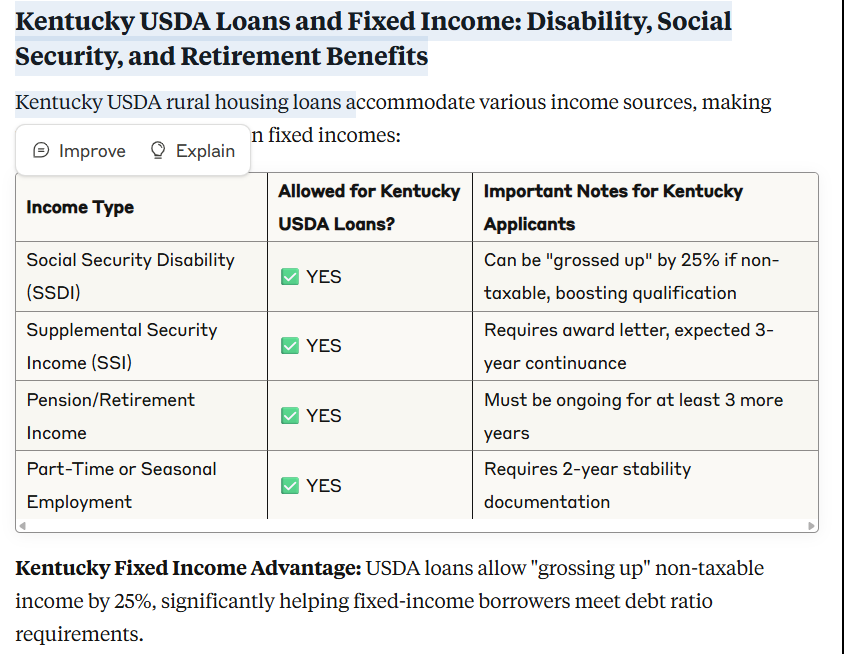
Kentucky USDA Loans and Fixed Income: Disability, Social Security, and Retirement Benefits

Kentucky USDA rural housing loans accommodate various income sources, making them accessible to those on fixed incomes:

Kentucky USDA Loans and Fixed Income: Disability, Social Security, and Retirement Benefits

Kentucky USDA rural housing loans accommodate various income sources, making them accessible to those on fixed incomes:

Kentucky Fixed Income Advantage: USDA loans allow “grossing up” non-taxable income by 25%, significantly helping fixed-income borrowers meet debt ratio requirements.

Kentucky USDA Loan Debt-to-Income Ratio Guidelines

Kentucky USDA Loan Debt-to-Income Ratio Guidelines

Handling Property Repairs with Kentucky USDA Rural Housing Loans

For Kentucky USDA Guaranteed Loans:

  • Repair Escrow Option: Available for minor repairs, typically capped around $10,000
  • Process: Lender holds funds in escrow; repairs completed after closing
  • Limitations: Major structural issues, foundation problems, or unsafe conditions will disqualify the property

For Kentucky USDA Direct Loans:

  • Repair Flexibility: May offer more flexibility for limited rehabilitation needs
  • Requirement: Property must still be habitable at closing
  • Alternative: Consider Kentucky’s FHA 203k or Conventional HomeStyle loans for major renovations

Special Considerations for Kentucky Homebuyers with Disabilities or Lower Income

  • ✅ SSI/SSDI income is fully acceptable for qualification
  • ✅ Credit scores may receive manual underwriting consideration
  • ✅ Asset tests apply only for Direct loan applicants
  • ✅ Kentucky Housing Corporation (KHC) down payment assistance may be combined with USDA
  • ✅ Welcome Home Grant may apply (when seasonally available)

Steps for Kentucky USDA Rural Housing Loan Application

  1. Verify Property Eligibility: Check if your desired Kentucky location qualifies using the USDA Rural Housing Eligibility Map
  2. Get Pre-Qualified: Work with a Kentucky lender experienced in USDA rural housing loans
  3. Property Inspection: Have any potential foreclosure or fixer-upper thoroughly inspected early
  4. Select Appropriate Program: Determine whether Direct or Guaranteed better suits your circumstances
  5. Prepare Documentation: Gather income verification, tax returns, benefit award letters, and other required paperwork

Frequently Asked Questions About Kentucky USDA Rural Housing Loans

Can I use a Kentucky USDA loan to purchase a foreclosed property?

Yes, if the foreclosed home meets all USDA livability and safety standards.

Do Kentucky USDA loans accept disability income for qualification?

Absolutely. Both SSI and SSDI are eligible income sources and can often be “grossed up” by 25% if non-taxable.

What if my desired Kentucky property needs repairs?

USDA Guaranteed loans may allow an escrow holdback for minor repairs (typically up to $10,000). Major issues will disqualify the property.

How do Kentucky’s 502 Direct loans differ from Guaranteed loans?

Direct loans are specifically for very low-income borrowers with tighter restrictions; Guaranteed loans accommodate moderate-income buyers and utilize private lenders. View Kentucky income limits here.

Are manufactured homes eligible for Kentucky USDA loans?

Yes, provided they meet HUD standards and are permanently attached to a foundation.

Can I combine Kentucky Housing Corporation down payment assistance with USDA?

Yes, KHC programs can often be paired with USDA loans for additional assistance.

Get Expert Help With Your Kentucky USDA Rural Housing Loan

Need assistance navigating Kentucky’s USDA rural housing loan options? Our experienced mortgage professionals specialize in helping Kentucky homebuyers with fixed income, disability benefits, and unique financing needs.

Joel Lobb, NMLS #57916
Senior Loan Officer, EVO Mortgage
📍 Based in Louisville, serving homebuyers throughout Kentucky
📞 (502) 905-3708
✉️ kentuckyloan@gmail.com
🌐 Apply Online or Get Pre-Qualified Today

This information is not affiliated with HUD, USDA, FHA, or any government agency. Equal Housing Lender. NMLS #57916