Minimal credit score requirements – NO minimum score
Low monthly mortgage insurance
Home must be located in an eligible area
Home must meet property eligibility requirements
Fill out worksheet to get additional information about qualifying
Must be a regular stick-built home
Single Close Construction Program available
USDA to USDA Streamline Refinances available
SFH Direct Loan and Grant Programs
February 7, 2022
Fee Increases for Origination Appraisals and Conditional Commitments
An Unnumbered Letter (UL) dated February 4, 2022, has been issued which increases the appraisal fee to $750 and the conditional commitment fee to $825 under the direct programs. The fee increases are effective March 6, 2022. The increased fees reflect market price increases for origination appraisals in rural areas and the average cost of appraisals under the programs’ nationwide contract with the Appraisal Management Companies.
FHA loans vs. conventional mortgages
CONVENTIONAL LOAN FHA LOAN
Credit score minimum 620 500
Down payment 3% to 20% 3.5% for credit scores of 580+; 10% for credit scores of 500-579
Loan terms 8- to 30-year terms 15- or 30-year terms
Mortgage insurance premiums PMI (if less than 20% down): 0.58% to 1.86% of loan amount Upfront premium: 1.75% of loan amount; annual premium: 0.45% to 1.05%
Interest type Fixed-rate or adjustable-rate Fixed-rate
Pros and cons of FHA loans
Pros
You can have a lower credit score: If you haven’t established much of a credit history or you’ve encountered some issues in the past with making on-time payments, a 620 credit score — the typical magic number for consideration of a conventional mortgage — might seem out of reach. If your credit score is 580, you’re in good standing with most FHA-approved lenders.
You can make a lower down payment: FHA loans also give the option for a smaller down payment. With a credit score of at least 580, you can make a down payment of as little as 3.5 percent. If your credit score is between 500 and 579, you may still be able to qualify for an FHA-backed loan, but you will need to make a 10 percent down payment.
You can stop renting earlier: Since FHA loans make buying a home easier, you can start building equity sooner. Instead of continuing to rent while trying to save more money or improve your credit score, FHA loans make the dream of being a homeowner possible sooner.
Cons
You won’t be able to avoid mortgage insurance: Since your credit score is lower, you’re a bigger risk of default. To protect the lender, you have to pay mortgage insurance. You can roll the upfront insurance premium into your closing costs, but your annual premiums will be divided into 12 installments and show up on every mortgage bill. If you put down less than 10 percent, you have to pay those annual premiums for the entire life of the loan. There’s no escaping them. That’s a big difference from conventional loans: Once you build up 20 percent equity, you no longer have to pay for private mortgage insurance.
You’ll have to meet property requirements: If you’re applying for an FHA loan, the property has to meet some eligibility requirements. The most important is the price: FHA-backed mortgages are not allowed to exceed certain amounts, which vary based on location. You have to live in the property, too. FHA loans for new purchases are not designed for second homes or investment properties.
You could pay more: When you compare mortgage rates between FHA and conventional loans, you might notice the interest rates on FHA loans are lower. The APR, though, is the better comparison point because it represents the total cost of borrowing. On FHA loans, the APR can sometimes be higher than conventional loans.
Some sellers might shy away: In the ultra-competitive pandemic housing market, sellers weighing multiple offers often viewed FHA borrowers less favorably.
3.5% for credit scores of 580+; 10% for credit scores of 500-579
Loan terms
8- to 30-year terms
15- or 30-year terms
Mortgage insurance premiums
PMI (if less than 20% down): 0.58% to 1.86% of loan amount
Upfront premium: 1.75% of loan amount; annual premium: 0.45% to 1.05%
Interest type
Fixed-rate or adjustable-rate
Fixed-rate
Pros and cons of FHA loans
Pros
You can have a lower credit score: If you haven’t established much of a credit history or you’ve encountered some issues in the past with making on-time payments, a 620 credit score — the typical magic number for consideration of a conventional mortgage — might seem out of reach. If your credit score is 580, you’re in good standing with most FHA-approved lenders.
There are two types of Kentucky USDA Rural Housing Home loans available to rural Kentucky Home buyers through Rural Development:
Direct homeownership loans and guaranteed home ownership loans.
Let’s first look at the 502 Direct USDA Loan in Kentucky
502 Direct USDA Loan in Kentucky:
With a Kentucky Direct Loan 502, the applicant applies directly to the USDA office serving their location in Kentucky. There are about 13 different locations . They lend the money direct from USDA , 100 percent financing, for the low rate currently at 3 percent on a 33 year term.
For a direct home loan, the purchase, construction, repair and rehabilitation of a single family home in rural areas must be used for the applicant’s permanent residence. “For manufactured housing, only new construction can be funded,” he explained.
Credit scores of 640 or greater are typically acceptable with a minimum number of trade lines (2 usually for 12 months can be opened or closed) that have been open and active.
No down payment typically is required- Loans may be up to 100 percent of the appraised value. Homebuyer education is required prior to closing for the Direct USDA Loan 502 program
Mortgage payments are based on what the applicant can afford to pay. USDA offers payment assistance/subsidies to make it affordable. When you go to payoff the USDA Direct loan, you may incur a subsidy recapture fee.
Paragraph
There are two types of Kentucky USDA Rural Housing Home loans available to rural Kentucky Home buyers through Rural Development:
Direct homeownership loans and guaranteed home ownership loans.
Let’s first look at the 502 Direct USDA Loan in Kentucky
502 Direct USDA Loan in Kentucky:
Rural Home Loans (Direct Program) What does this program do? Also known as the Section 502 Direct Loan Program, this program assists low- and very-low-income applicants obtain decent, safe, and sanitary housing in eligible rural areas by providing payment assistance to increase an applicant’s repayment ability. Payment assistance is a type of subsidy that reduces the mortgage payment for a short time. The amount of assistance is determined by the adjusted family income. Who may apply for this program? A number of factors are considered when determining an applicant’s eligibility for Single Family Direct Home Loans. At a minimum, applicants interested in obtaining a direct loan must have an adjusted income that is at or below the applicable low-income limit for the area where they wish to buy a house and they must demonstrate a willingness and ability to repay debt. Applicants must: • Be without decent, safe, and sanitary housing • Be unable to obtain a loan from other resources on terms and conditions that can reasonably be expected to meet • Agree to occupy the property as your primary residence • Have the legal capacity to incur a loan obligation • Meet citizenship or eligible noncitizen requirements • Not be suspended or debarred from participation in federal programs Properties financed with direct loan funds must: • Be modest in size for the area • Not have market value in excess of the applicable area loan limit • Not have in-ground swimming pools • Not be designed for income producing activities Borrowers are required to repay all or a portion of the payment subsidy received over the life of the loan when the title to the property transfers or the borrower is no longer living in the dwelling. Applicants must meet income eligibility for a direct loan. Please contact your local RD office to ask for additional details about eligibility requirements. What is an eligible area? Generally, rural areas with a population less than 35,000 are eligible. Visit the USDA Income and Property eligibility website for complete details. How may funds be used? Loan funds may be used to help low-income individuals or households purchase homes in rural areas. Funds can be used to build, repair, renovate, or relocate a home, or to purchase and prepare sites, including providing water and sewage facilities. How much may I borrow? The maximum loan amount an applicant may qualify for will depend on the applicant’s repayment ability. The applicant’s ability to repay a loan considers various factors such as income, debts, assets, and the amount of payment assistance applicants may be eligible to receive. Regardless of repayment ability, applicants may never borrow more than the area loan limit (plus certain costs allowed to be financed) for the county in which the property is located. Rural Home Loans (Direct Program) What is the interest rate and payback period? • Fixed interest rate based on current market rates at loan approval or loan closing, whichever is lower. • The monthly mortgage payment, when modified by payment assistance, may be reduced to as little as an effective 1% interest rate. • Up to 33 year payback period – 38 year payback period for very low income applicants who can’t afford the 33 year loan term. How much down payment is required? No down payment is typically required. Applicants with assets higher than the asset limits may be required to use a portion of those assets. Is there a deadline to apply? Applications for this program are accepted through your local RD office year round. How long does an application take? Processing times vary depending on funding availability and program demand in the area in which an applicant is interested in buying and completeness of the application package. What governs this program? • The Housing Act of 1949 as amended, 7 CFR, Part 3550 • HB-1-3550 – Direct Single Family
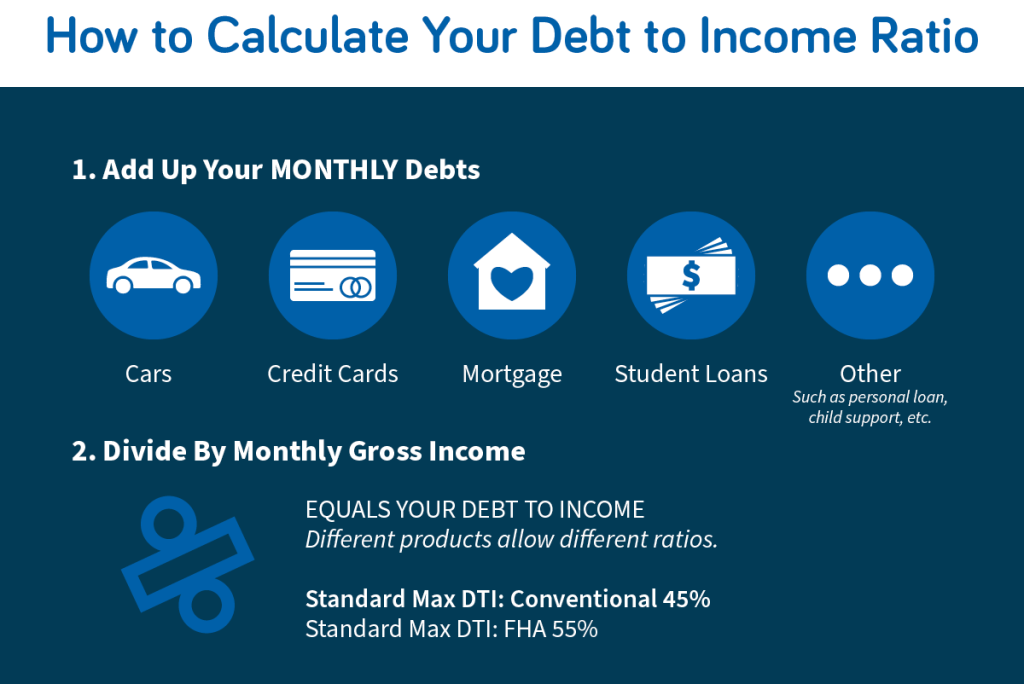
How USDA Government Underwriters calculate your Debt-to-Income or DTI ratio.
One of the most frequent questions that come from perspectives Kentucky home buyers is
“How Much House Can I Afford?”
Answering this question is determined based on calculating what are known as the borrower’s Debt-to-Income or DTI ratios. The established standard DTI ratio used for a USDA Loan is based on two sets of ratios, which are as follows:
Front-end or housing ratio – the monthly mortgage payment cannot exceed 29% of the gross monthly income.
Back-end or total debt ratio – the total debts, including the new monthly mortgage payment, cannot exceed 41% of the gross monthly income.
A monthly mortgage payment includes the principal and interest payment on the mortgage note, as well as the monthly pro-rated portion of the annual fee, property tax and homeowner insurance premium.
Specific to the USDA Rural Loan program is the pro-rate portion of the USDA Annual Fee, which is often referred to as a monthly mortgage insurance payment. If there are any Condominium or Homeowner Association (HOA) fees, these fees must be included in the monthly mortgage payment as well.
Total debts include the anticipated monthly mortgage payment and all monthly re-occurring credit obligations.
Examples of reoccurring credit obligations include monthly car payments, minimum payment on credit cards, and student loan payments. If the borrower is obligated to make any alimony or child support payments, these payments will be included within the total debt calculations as well.
If the total debts exceed 41% of the gross monthly income, the maximum monthly mortgage payment must be reduced in order to bring total DTI back down to 41%. For example, assume a monthly income of $5,000.
Based on the 29%/41% ratio requirements, the maximum housing expense will be $1,450 and total debts will be $2,050. If the non-housing expense exceeds $600 ($2,050 – $1,450), the housing expense will need to be reduced by an equal amount to keep the total ratio at 41%.
While the 29%/41% ratio is considered to be the Underwriting standard guideline, the USDA Loan Program will allow for DTI ratios as high as 33.99%/45.99%.
What determines the ability to qualify at a higher ratio is a combination of factors, such as an approval through Guaranteed Underwriting System, which is USDA’s automated approval, and other compensating factors such as:
680 or higher credit score
No or low “payment shock” – less than a 100% increase in proposed mortgage payment vs. current rental housing expenses
Fiscally sound use of credit
Ability to accumulate savings
Stable employment history with 2 or more years in current position or continuous employment history with no job gaps
Cash reserves available for use after settlement
Career advancement as indicated by job training or additional education in the applicant’s profession
Trailing spouse income – as a result of a job transfer, in which the house is being purchased, prior to the secondary wage-earner obtaining employment. This assumes that the secondary wage-earner has an established history of employment and has a reasonable chance to obtain new employment in the area upon relocating to the area
If you are an individual with disabilities who needs accommodation, or you are having difficulty using our website to apply for a loan, please contact us at 502-905-3708.
Disclaimer: No statement on this site is a commitment to make a loan. Loans are subject to borrower qualifications, including income, property evaluation, sufficient equity in the home to meet Loan-to-Value requirements, and final credit approval. Approvals are subject to underwriting guidelines, interest rates, and program guidelines and are subject to change without notice based on applicant’s eligibility and market conditions. Refinancing an existing loan may result in total finance charges being higher over the life of a loan. Reduction in payments may reflect a longer loan term. Terms of any loan may be subject to payment of points and fees by the applicant Equal Opportunity Lender. NMLS#57916http://www.nmlsconsumeraccess.org/