
Tag: home-buying

What Credit Score Do You Need for a Mortgage in Kentucky?


What Is the Minimum Credit Score Needed to Buy a House and Get a Kentucky Mortgage Loan?

Buying a home is an exciting milestone, but your credit score plays a crucial role in determining your eligibility for a mortgage in Kentucky. Whether you’re a first-time homebuyer or looking to move into a new property, understanding the minimum credit score requirements for different loan types can help you prepare for homeownership.

In this guide, we’ll break down the minimum credit scores needed for various mortgage loans in Kentucky, explain how credit scores impact mortgage interest rates, and share tips to improve your credit score for better loan options.


Minimum Credit Score Requirements for Kentucky Mortgage Loans

Different loan programs have varying credit score requirements, depending on whether they are government-backed or conventional loans. Below is a breakdown of the minimum scores needed for each type of mortgage loan in Kentucky.

1. FHA Loans – Low Credit Score Option

  • Minimum Score: 500-579 (Requires 10% down payment)
  • Minimum Score: 580+ (Requires 3.5% down payment)
  • Best for: First-time homebuyers with lower credit scores

FHA loans are backed by the Federal Housing Administration (FHA), making them easier to qualify for with lower credit scores and small down payments. However, a higher score (580+) allows for a lower down payment.


2. VA Loans – Best for Veterans and Military Members

  • No official minimum credit score
  • Most lenders prefer 580-620
  • 0% down payment available for qualified borrowers
  • Best for: Veterans, active military, and eligible surviving spouses

VA loans are backed by the Department of Veterans Affairs (VA) and offer no down payment and no private mortgage insurance (PMI), making them an excellent option for eligible service members.


3. USDA Loans – Ideal for Rural Homebuyers

  • Minimum Score: 640+ (for automatic approval)–No official minimum score
  • Some lenders accept lower scores with manual underwriting
  • 0% down payment required
  • Best for: Low-to-moderate-income homebuyers in eligible rural areas

USDA loans are designed to help buyers in rural and suburban areas by offering 100% financing with low mortgage insurance costs.


4. Conventional Loans – Best for Good Credit Borrowers

  • Minimum Score: 620+
  • Higher scores (740+) qualify for better interest rates
  • Down payment: 3%-5% or more
  • Best for: Buyers with stable income and strong credit history

Conventional loans, backed by Fannie Mae and Freddie Mac, have stricter credit score requirements than government-backed loans. However, borrowers with higher credit scores (680+) get better interest rates and lower private mortgage insurance (PMI) costs.


5. Kentucky Housing Corporation (KHC) Loans – First-Time Buyer Assistance

  • Minimum Score: 620+
  • Offers down payment assistance
  • Best for: First-time homebuyers needing financial assistance

KHC provides state-level mortgage programs to help first-time homebuyers afford a home with lower down payments and closing cost assistance.


6. Non-QM Loans – Alternative Loan Options

  • Minimum Score: 500-620 (Varies by lender and loan type)
  • Includes Bank Statement Loans, DSCR Loans, and Asset-Based Loans
  • Best for: Self-employed borrowers, real estate investors, and those with unique income sources

Non-QM (Non-Qualified Mortgage) loans don’t follow traditional lending guidelines, making them a great option for borrowers who don’t qualify for conventional or government-backed loans due to income documentation challenges.


How Credit Scores Affect Your Mortgage Interest Rate

Your credit score doesn’t just determine your eligibility for a mortgage—it also influences the interest rate you’ll receive.

Here’s how credit scores impact mortgage rates:

Credit ScoreTypical Interest Rate (Example)
760-850Best rate (lowest cost)
700-759Good rate
640-699Higher rate
620-639Even higher rate
Below 620Limited options, highest rates

Why Does This Matter?

A higher credit score can save you thousands of dollars over the life of your loan. Even a small increase in your score can help you qualify for better loan terms and lower monthly payments.


How to Improve Your Credit Score Before Buying a Home

If your credit score isn’t where you want it to be, here are some steps to improve it before applying for a mortgage:

1. Check Your Credit Report for Errors

2. Pay Bills on Time

  • Payment history makes up 35% of your FICO score
  • Set up auto-pay to avoid late payments

3. Reduce Your Debt-to-Income Ratio (DTI)

  • Pay down credit card balances
  • Keep credit utilization below 30% of your limit

4. Avoid New Credit Inquiries Before Buying a Home

  • Don’t open new credit cards or loans before applying for a mortgage
  • Too many hard inquiries can lower your score

5. Increase Your Credit Mix

  • Having a mix of credit cards, installment loans, and other accounts helps boost your score

6. Work with a Mortgage Expert

  • A Kentucky mortgage broker can help you find the best loan options for your credit situation

Final Thoughts: What Credit Score Do You Need to Buy a Home in Kentucky?

  • 500-579: Possible with FHA (10% down) or Non-QM loans
  • 580+: More options, FHA (3.5% down), VA, and USDA loans
  • 620+: Opens doors to Conventional, KHC, and better loan terms
  • 640+: USDA automatic approval and better mortgage rates
  • 700+: Access to the best interest rates and lowest fees

Your credit score is one of the most important factors in determining what type of mortgage you can qualify for and how much you’ll pay over time.

If you’re unsure about your options, working with a Kentucky mortgage expert can help you navigate the home-buying process and find the best loan for your financial situation.

Thinking About Buying a Home in Kentucky? 🏡 Here’s the Credit Score You Need!

Your credit score plays a BIG role in getting approved for a mortgage loan in Kentucky. Check out the minimum credit scores needed for different loan types:

FHA Loan: 500+ (10% down) or 580+ (3.5% down)
VA Loan: 580-620+ (No down payment for eligible veterans)
USDA Loan: 640+ (0% down for rural homebuyers)
Conventional Loan: 620+ (Lower rates with 740+)
KHC First-Time Buyer: 620+ (Down payment assistance available!)
Non-QM Loans: 500-620 (Alternative options for self-employed & investors)

📉 Higher scores = Lower mortgage rates! Want to boost your score?
👉 Check your credit report
👉 Pay bills on time
👉 Lower credit card balances

🏡 Ready to get pre-approved? I can help!
📞 Call/Text: (502) 905-3708
📧 Email: kentuckyloan@gmail.com
🌎 Apply Now: MyLouisvilleKentuckyMortgage.com

#KentuckyMortgage #HomeLoans #FirstTimeHomebuyer #CreditScore #MortgageApproval #BuyAHome #KentuckyRealEstate #FHA #VA #USDA #ConventionalLoans

Unlock Your Kentucky Dream Home: The Real Minimum Credit Score You Need

So, you’re ready to trade those rolling hills for a set of house keys in Kentucky? That’s fantastic! But before you start packing, let’s tackle a crucial question: “What credit score do I really need to get a mortgage in Kentucky?”

While there’s no single, simple answer, this guide will break down the minimum credit score requirements for various Kentucky mortgage options, empowering you to understand where you stand and how to achieve your homeownership goals. We’ll cut through the confusion and give you the straight facts!

Why Your Credit Score Matters: More Than Just a Number

Think of your credit score as your financial reputation. Lenders use it to assess the risk of lending you money. A higher score signals lower risk, translating to better interest rates, more favorable loan terms, and potentially lower down payment requirements.

Here’s the credit score impact on interest rates and your wallet (in general terms):

  • 760-850: The Gold Standard! Expect the lowest interest rates and the most attractive loan options.
  • 700-759: Excellent! You’ll still qualify for very competitive rates and favorable terms.
  • 640-699: Good. You’ll likely be approved, but interest rates will be slightly higher.
  • 620-639: Acceptable. This range is often the minimum for conventional loans, but be prepared for less favorable rates.

As the guide shows, aiming for a 740+ score can lead to significant savings over the life of your loan!

Kentucky Mortgage Options: Credit Score Requirements Deconstructed

Let’s explore the minimum credit score requirements for different Kentucky mortgage types:

1. FHA Loans: Your Flexible First Step

  • Score 500-579: Requires a 10% Down Payment. Limited lender options.
  • Score 580+: Requires a 3.5% Down Payment. More lenders available.

FHA loans, backed by the government, offer flexibility, especially for borrowers with lower credit scores. They’re a popular option for first-time homebuyers in Kentucky.

  • Why FHA? Government backing reduces the risk for lenders, allowing them to offer mortgages to borrowers who might not qualify for conventional loans.

2. VA & USDA Loans: Serving Those Who Served & Rural Kentucky

  • VA Loan: 580-620+ (While there’s no official minimum, most lenders require this range). May allow zero down payment!
  • USDA Loan: 640+ (Required for Automated Underwriting). Lower scores may need manual approval.

VA loans are a powerful benefit for veterans, active-duty military, and eligible surviving spouses. USDA loans are designed to promote homeownership in rural areas.

  • Zero Down Payment Potential: Both offer the possibility of zero down payment (for eligible borrowers), making homeownership more accessible.

3. Conventional Loans: The 620+ Benchmark

  • Minimum Score: 620+ (Needed to qualify for most conventional loans from Fannie Mae and Freddie Mac).
  • Preferred Score: 740+ Higher scores unlock better interest rates, saving you money over the loan’s lifespan.

Conventional loans aren’t government-backed, so lenders demand higher credit scores to manage their risk.

  • The Payoff: A credit score of 740+ is your ticket to the best possible interest rates.

4. KHC Loans: Kentucky Housing Corporation – First-Time Homebuyer Advantage

  • Score: 620+ (Required for most Kentucky Housing Corporation programs).

KHC programs are specifically designed to make homeownership a reality for first-time buyers in Kentucky.

  • Down Payment Assistance: Eligible buyers may receive help with down payment and closing costs. This can be a game-changer!

5. Non-QM Loans: Alternative Financing for Unique Situations

  • Score Range: 500-620 (Acceptable for certain non-QM – non-qualified mortgage – programs).

Non-QM loans cater to borrowers who don’t fit the traditional mortgage mold.

  • Examples:
    • Bank Statement Loans: For self-employed individuals who may lack traditional income documentation.
    • DSCR Loans: For investors based on the property’s debt service coverage ratio.
  • Important Note: Non-QM loans often come with higher interest rates to compensate for the increased risk.

Key Takeaways: Improve Your Score & Unlock Your Homeownership Potential!

No matter your current credit score, you can improve it! Here’s your action plan:

  1. Check Your Credit Report: Access a free copy at AnnualCreditReport.com. Ensure accuracy and dispute any errors immediately!
  2. Pay Bills On Time, Every Time: Payment history is the biggest factor impacting your credit score.
  3. Reduce Debt: Lower your credit utilization ratio.
  4. Be Strategic: Avoid opening unnecessary new credit accounts.

The Kentucky Mortgage Credit Score Guide says it all: Improving your credit score is essential for securing the best mortgage rates and terms!

Ready to Take the Next Step?

Understanding the minimum credit score requirements for Kentucky mortgages is the first step towards achieving your homeownership dreams. By taking proactive steps to improve your credit and exploring the various loan options available, you can find the perfect mortgage to fit your needs and budget.

Questions about Kentucky mortgages or your credit score? Ask us in the comments below!

I

What are the best strategies to improve my credit score quickly for a mortgage in Kentucky

The minimum credit score required to buy a house and secure a mortgage loan in Kentucky depends on the type of loan program. Here’s a concise breakdown:

Absolute Minimum Credit Score: 500

  • FHA Loans or Non-QM Loans allow scores as low as 500, but with specific conditions:
    • FHA:
      • 500–579: Requires 10% down payment and has limited lender options.
      • 580+: Reduces down payment to 3.5% with broader lender availability.
    • Non-QM Loans:
      • 500–620 (varies by lender): Options include Bank Statement Loans or DSCR Loans, but often come with higher interest rates.

Minimum Scores for Other Loan Types

  1. VA Loans (Veterans/Military)
    • 580–620+: Most lenders require this range.
    • 0% down payment for eligible borrowers.
  2. USDA Loans (Rural Buyers)
    • 640+: Required for automated approval.
    • Lower scores may qualify with manual underwriting.
  3. Conventional Loans
    • 620+: Minimum for most loans (Fannie Mae/Freddie Mac).
    • 740+: Unlocks the best interest rates.
  4. KHC Loans (First-Time Buyers)
    • 620+: Required for down payment and closing cost assistance.

Key Notes

  • Higher Scores = Better Terms: Scores of 700+ qualify for the lowest interest rates, saving thousands over the loan term.
  • Manual Underwriting: Some loans (e.g., USDA, VA) may accept lower scores with additional scrutiny.
  • Down Payments: Lower scores often require larger down payments (e.g., 10% for FHA with 500–579).

Bottom Line

While 500 is the lowest possible score for FHA/Non-QM loans, aiming for 620+ expands your options (Conventional, KHC, USDA/VA with better terms). A 740+ score maximizes savings through lower rates.

USDA Mobile Home Loans Kentucky: No Money Down Options for Bad Credit


2026 Guide to USDA Rural Housing Loans for Manufactured Homes in Kentucky: No-Money-Down Options, Even with Bad Credit

100% financing available for qualified Kentucky borrower
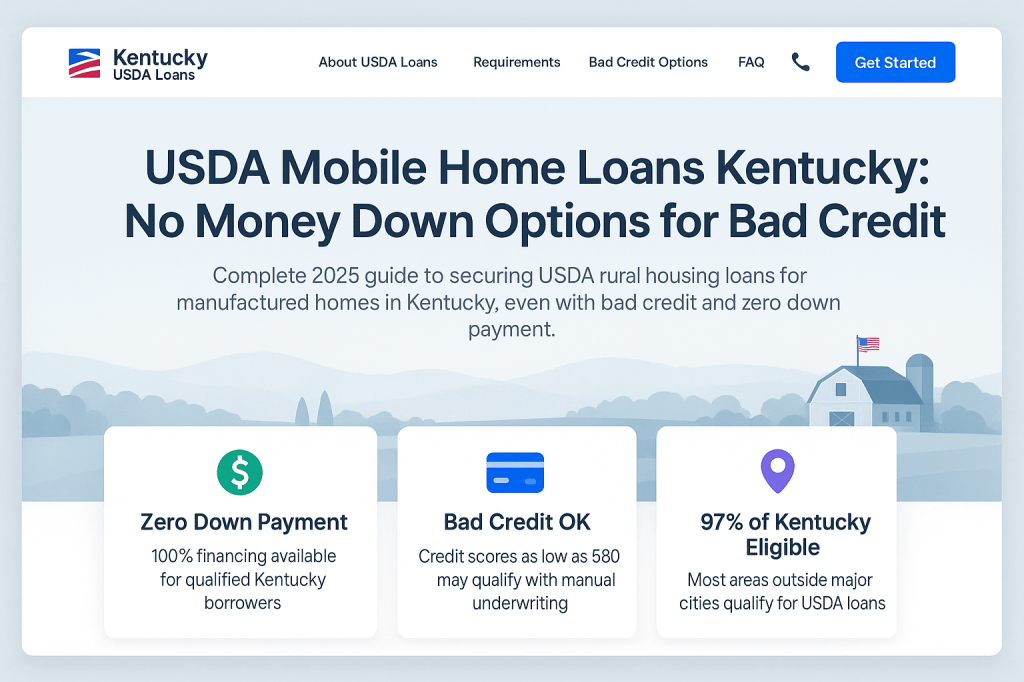
USDA Rural Housing Loans for Manufactured Homes in Kentucky: No-Money-Down Options, Even with Bad Credit

100% financing available for qualified Kentucky borrower

Table of Contents

  • Understanding USDA Mobile Home Loans in Kentucky
  • 2026 Game-Changing Updates
  • Kentucky USDA Rural Housing Loan Requirements
  • Bad Credit Mobile Home Loans in Kentucky
  • No Money Down Mobile Home Financing Options
  • Kentucky Counties Eligible for USDA Mobile Home Loans
  • Foundation and Installation Requirements
  • How to Apply for USDA Mobile Home Loans in Kentucky
  • Alternative Financing Options
  • Frequently Asked Questions

Understanding USDA Mobile Home Loans in Kentucky

The United States Department of Agriculture (USDA) Rural Development program has been quietly revolutionizing homeownership opportunities across Kentucky for decades. Many potential homebuyers don’t realize this. The USDA’s Single Family Housing Guaranteed Loan Program (SFHGLP) extends far beyond traditional stick-built homes. It also includes manufactured and mobile homes. This opens doors for thousands of Kentucky families who previously thought homeownership was out of reach.

Kentucky, with its vast rural landscapes and small-town communities, is well-suited to USDA rural housing programs. Conventional mortgages often demand large down payments and excellent credit. USDA loans, however, are designed for low- to moderate-income families in rural areas. They are an excellent option for mobile home buyers across the Commonwealth.

What Makes USDA Mobile Home Loans Different

  • 100% Financing: No money down is required, making it perfect for buyers with limited savings
  • Affordable Terms: Competitive interest rates make monthly payments manageable
  • Rural Housing Opportunities: Ideal for Kentucky homebuyers in small towns and rural areas
  • Flexible Credit Requirements: Holistic approach to creditworthiness evaluation

On March 4, 2025, the USDA officially expanded its Single Family Housing Guaranteed Loan Program. This expansion provides 100% financing for manufactured homes. Industry experts are calling this change the most significant development in rural housing finance in decades.

Key Program Changes

Expanded Eligibility

Manufactured homes now receive the same favorable treatment as traditional homes

Age Restrictions Relaxed

Existing manufactured homes up to 20 years old can now qualify

Streamlined Process

Processing times reduced by 30-40% with new guidelines

Better Credit Pathways

Clearer guidelines for borrowers with credit challenges

 USDA Mobile Home Loans in Kentucky

Kentucky USDA Rural Housing Loan Requirements

Borrower Requirements

  • ✓Income cannot exceed 115% of area median income
  • ✓Must occupy home as primary residence
  • ✓U.S. citizen, non-citizen national, or qualified alien
  • ✓Credit score typically 580+ (manual underwriting available)

Property Requirements

  • ✓Built to HUD Code standards (post-1976)
  • ✓Permanent foundation required
  • ✓Minimum 12 feet wide, 400 sq ft living space
  • ✓Located in USDA-eligible rural area

Bad Credit Mobile Home Loans in Kentucky

One of the most significant advantages of USDA mobile home loans is their accessibility to borrowers with less-than-perfect credit. Unlike conventional mortgages, which often have rigid credit score requirements, USDA loans offer flexibility. This flexibility recognizes the unique challenges faced by rural borrowers.

Credit Score Guidelines

640+ Credit Score Streamlined Processing

580 and above Credit Score Manual Underwriting

Note: USDA takes a holistic approach to credit evaluation, considering factors beyond just credit scores.

Often Asked Questions

What credit score do I need for a USDA mobile home loan in Kentucky?

While USDA doesn’t set a minimum credit score, most lenders prefer scores of 580 or higher. Borrowers with lower scores may still qualify through manual underwriting, and the program takes a holistic approach to credit evaluation.

Can I buy a used mobile home with a USDA loan?

Yes, existing manufactured homes can qualify if they’re less than 20 years old. They must meet HUD standards. The homes should be properly installed on permanent foundations. Additionally, they need to meet all other USDA requirements.

Do I need to own the land to get a USDA loan for a mobile home?

USDA loans can finance both the manufactured home and land together. They can also finance just the home if you already own suitable land. However, the home must be permanently installed and classified as real property.

What areas of Kentucky are eligible for USDA loans?

Approximately 97% of Kentucky qualifies as rural for USDA purposes. Most areas outside of Louisville, Lexington, and a few other metropolitan centers are eligible. Use the USDA’s online eligibility tool to check specific addresses.

This comprehensive guide provides general information about USDA mobile home loans in Kentucky. It should not be considered as financial or legal advice. Potential borrowers should consult with qualified lenders, real estate professionals, and legal advisors for guidance specific to their situations.

Contact a Kentucky Mobile Home Loan Expert

For personalized guidance on Kentucky USDA mobile home loans, contact a local mortgage specialist. They can help with options for borrowers with bad credit and no down payment. The specialist will understand the unique requirements of manufactured home financing.

Emailkentuckyloan@gmail.com
Call/Text: 502-905-3708

Joel Lobb – Kentucky Mortgage Loan Officer
NMLS ID: 57916 | Company NMLS ID: 1738461
Equal Housing Lender


Helpful USDA Resources for Kentucky Borrowers

Disclaimer: This website is not endorsed by the FHA, VA, USDA, or any government agency. It is an independent platform created to educate and assist Kentucky homebuyers with expert advice and accessible tools.

Can I buy land and a mobile home together with a USDA loan?

USDA loans can finance both the manufactured home and the land in a single transaction. This is possible if both meet USDA eligibility requirements. The combined purchase must not exceed USDA loan limits for your area.

What if my credit score is below 580?

While challenging, approvals are possible with strong compensating factors such as stable employment, low debt-to-income ratios, and cash reserves. Working with an experienced USDA lender who understands manual underwriting is essential. Honestly, best to get score to 620 or 640 range for better changes of loan approval. USDA does not have minimum credit score requirements.

How long does the USDA loan process take?

Typical processing time is 45-60 days from application to closing. Processing is taking longer due to USDA cutbacks. This delay can vary based on property complexity. It also depends on documentation completeness and current USDA processing volumes.

Can I use gift funds for closing costs?

Yes, gift funds from family members are allowed for closing costs and prepaid items. Proper gift documentation and seasoning requirements must be met.

What happens if the home doesn’t appraise for the purchase price?

If the appraisal comes in low, you have several options. You can negotiate with the seller to reduce the price. Another option is to pay the difference in cash. Alternatively, you can cancel the contract if you have an appraisal contingency.

Are there income limits for USDA mobile home loans?

Yes, household income cannot exceed 115% of the Area Median Income for your county. These limits are updated annually and vary significantly across Kentucky.

Can I refinance my existing mobile home with a USDA loan?

USDA offers refinancing options for existing USDA loans, but cannot refinance non-USDA loans. However, if your current mobile home meets USDA requirements, you might qualify for a new purchase loan.

What areas of Kentucky qualify for USDA loans?

Most of Kentucky qualifies as rural under USDA guidelines. Use the USDA eligibility map to verify specific addresses, as eligibility can vary even within the same county.

Resources and Next Steps

Official USDA Resources

Kentucky Housing Resources

Ready to Get Started?

Ready to explore USDA mobile home loan options in Kentucky? Don’t wait, as these programs have annual funding limits. Working with an experienced local lender who understands manufactured home financing is crucial for success.

For personalized guidance on Kentucky USDA mobile home loans:

Contact Joel Lobb – Kentucky Mortgage Specialist

  • Email: kentuckyloan@gmail.com
  • Phone/Text: 502-905-3708
  • Experience: 20+ years helping Kentucky families
  • Track Record: Over 1,300 successful Kentucky home purchases and refinances
  • Specialization: USDA, FHA, VA, and Kentucky Housing Corporation loans

NMLS Personal ID: 57916 | Company NMLS ID: 1738461
Equal Housing Lender

How to Get Approved for a USDA Mortgage Loan in Kentucky


Kentucky USDA Mortgage Loan Guide

Your Complete Roadmap to Zero-Down Financing in 2026

What Is a USDA Mortgage Loan?

The USDA Rural Development Guaranteed Loan Program is designed to help Kentucky families purchase homes in eligible rural areas. With over 20 years of experience assisting more than 1,300 Kentucky families, I’ve successfully guided hundreds through USDA loans across all 120 counties.

✓ 100% financing (zero down payment)
✓ Below-market fixed interest rates
✓ Flexible credit requirements
✓ Low mortgage insurance (0.35%)
✓ Financing of closing costs possible
✓ Seller concessions allowed

If you’re a first-time homebuyer looking for a true no-money-down option without VA benefits, USDA is your strongest choice.

Property Eligibility

The property must be located in a USDA-eligible rural zone. The excellent news for Kentucky buyers: most of the state qualifies. While Louisville and Lexington city centers are ineligible, surrounding suburban areas typically qualify.

Typically Eligible Areas

  • Most of Hardin, Meade, Breckenridge, Grayson, Nelson, Spencer, and Shelby Counties
  • Large portions of Bullitt County outside immediate Louisville limits
  • Nearly all of Eastern and Western Kentucky
  • Suburban pockets around Lexington, Georgetown, Winchester, and Nicholasville
Check Eligibility: Use the USDA property eligibility map to verify any address before making an offer. This step saves time and ensures you’re pursuing viable properties.

Income Limits for 2026

Your total household income must not exceed the USDA county limit for your family size. USDA counts all household income, including spouses, adult children, part-time earnings, and bonuses.

Household Size 2026 Income Limit Range
1–4 People Up to approximately $119,850 for 1-4 members and $158,250 for 5-8 members
5–8 People Up to approximately $ $119,850 for 1-4 members and $158,250 for 5-8 members

Note: Limits vary by county. Contact me for your specific county’s limits.

Credit Score Requirements

While USDA doesn’t publish a minimum credit score, Kentucky lenders follow these general guidelines:

640+ Credit Score — Easiest Path to Approval

  • Eligible for automated approval through GUS (USDA’s system)
  • More flexible debt-to-income ratios
  • Faster underwriting timeline

580–639 — Possible With Manual Underwriting

Approvals in this range require strong supporting documentation:

  • Perfect rental history
  • No late payments in the past 12 months
  • Low overall debt
  • Stable employment history

Below 580 — Case-by-Case Review

Not impossible, but uncommon. Success requires significant compensating factors and strong manual underwriting review.

Employment Rules

Underwriters typically require a 2-year work history, though it doesn’t need to be at the same job. USDA is flexible about career transitions within reason.

USDA Accepts

  • Job changes within the same field or industry
  • Recent graduates working in their trained field
  • 12+ months of consistent income
  • Self-employed borrowers (with 2 years of tax returns)

Red Flags to Avoid

  • Job gaps longer than 60 days
  • Declining income trends over time
  • Multiple unrelated job switches

Debt-to-Income Ratio Requirements

Your DTI is calculated as a percentage of your gross monthly income.

DTI Type Standard Limit With Strong Credit (GUS Approve)
Front-End (Housing Only) 29% Up to 29–34%
Back-End (All Debt) 41% 44%+

Manual underwriting files must stay closer to standard limits, while automated approvals offer more flexibility.

Bankruptcy & Foreclosure Waiting Periods

If you’ve experienced financial hardship, USDA has established waiting periods before approval:

Credit Event Waiting Period
Chapter 7 Bankruptcy 3 Years from Discharge
Chapter 13 Bankruptcy 12 Months of On-Time Payments + Trustee Approval
Foreclosure 3 Years from Sale Date
Short Sale 3 Years (Typical)
Medical collections and older accounts rarely require payoff. Your individual circumstances matter—let’s review your specific situation.

Property Condition & Appraisal Requirements

Your home must be safe, sound, and sanitary. The USDA appraiser evaluates:

  • Roof condition and remaining lifespan
  • Foundation stability and integrity
  • Electrical system safety
  • Plumbing functionality
  • Adequate heating system for the entire home
  • Absence of active termite damage
  • No peeling lead-based paint

Most repairs can be handled by the seller before closing. This is a negotiation point in your offer.

The USDA Loan Process

1Pre-Qualification

Credit check, income estimate, DTI calculation, and review of eligible areas

2Full Pre-Approval

Gather pay stubs, W-2s, tax returns, bank statements, and photo ID

3Find Your Home

Use eligibility maps to confirm the property qualifies before making an offer

4Loan Application & Underwriting

Rate lock, appraisal order, document review, and GUS findings

5USDA Final Approval

Conditional Commitment issued (typically 2–7 days)

6Closing Day

Sign final paperwork, receive keys, and move into your new home

Timeline: Most Kentucky USDA loans close within 30–45 days from application.

Frequently Asked Questions

Do I need a down payment?

No—USDA loans provide 100% financing with zero down payment required.

Can I buy in Louisville or Lexington?

City centers are ineligible, but many surrounding suburbs qualify. Always verify the property address on the USDA eligibility map before making an offer.

What credit score do I need?

640+ is ideal for streamlined approval. Manual underwriting may consider scores down to 580 with strong compensating factors.

Can the seller help with closing costs?

Yes—USDA allows seller concessions, and some closing costs can be financed if the appraisal supports it.

How long does the process take?

Most Kentucky USDA loans close in 30–45 days from application.

Are there down payment assistance programs?

Yes. Kentucky Housing Corporation (KHC) programs offer additional assistance for qualified first-time homebuyers to further reduce upfront costs.

Ready to Get Pre-Approved?

Let’s explore your USDA lending options with personalized guidance and same-day approvals.

Call or Text: 502-905-3708
Email: kentuckyloan@gmail.com

Serving qualified homebuyers across all 120 Kentucky counties

Joel Lobb, Mortgage Loan Officer | Specialist in Kentucky FHA, VA, USDA, KHC & Fannie Mae Loans

EVO Mortgage — Helping Kentucky Homebuyers Since 2001

NMLS Personal ID: 57916 | Company NMLS ID: 1738461 | Equal Housing Lender

This website is not endorsed by the USDA, FHA, VA, or any government agency. It is an independent educational resource.

This is not a commitment to lend. All loans subject to credit approval and USDA program guidelines.

How to Get a USDA Rural Housing Loan in Kentucky (After Bankruptcy or Foreclosure)


By Joel Lobb, Kentucky Mortgage Loan Officer | NMLS ID: 57916

Your Second Chance at Homeownership in the Bluegrass State

Dreaming of homeownership in Kentucky but think a past bankruptcy or foreclosure has you permanently sidelined? Think again! USDA Rural Housing loans offer a powerful pathway to homeownership, even after financial setbacks. With over 20 years of helping Kentucky families achieve their homeownership dreams, I’ve guided hundreds of clients through this exact situation.

In this comprehensive guide, you’ll discover how to qualify for a USDA loan after bankruptcy, understand the credit requirements, navigate income limits, and find your perfect Kentucky home in an eligible rural area.


Table of Contents

  1. Why USDA Loans Are Perfect for Kentucky Homebuyers
  2. Bankruptcy & Foreclosure Requirements
  3. Credit Score Essentials
  4. Understanding Income Limits in Kentucky
  5. The New 29% DTI Rule & Property Eligibility
  6. Key Features & Fees of USDA Loans
  7. The Application Process & Required Documents
  8. Pros & Cons of USDA Loans
  9. How to Get Started Today

Why USDA Loans Are Perfect for Kentucky Homebuyers {#why-usda-loans}

USDA Rural Housing loans aren’t just for farmers! These government-backed mortgages are designed to promote homeownership in rural America, and 97% of Kentucky qualifies as “rural” under USDA guidelines.

Key Benefits for Kentucky Residents:

Zero Down Payment Required – 100% financing available ✅ No Monthly PMI – Unlike FHA loans ✅ Lower Interest Rates – Competitive rates backed by the federal government ✅ Flexible Credit Requirements – Options for borrowers rebuilding credit ✅ Forgiving After Financial Hardship – Shorter waiting periods than conventional loans ✅ Kentucky-Wide Availability – Most areas outside Louisville and Lexington qualify

Important Update: New affordability rules take effect November 4, 2025, making it crucial to apply sooner rather than later to maximize your buying power.


Bankruptcy & Foreclosure Requirements {#bankruptcy-requirements}

One of the most common questions I hear is: “Can I still get a USDA loan after bankruptcy?” The answer is YES – but timing matters.

Chapter 7 Bankruptcy Requirements

Standard Waiting Period: 3 years from discharge date

Reduced Waiting Period: 2 years with extenuating circumstances

What counts as “extenuating circumstances”?

  • Job loss beyond your control
  • Serious illness or medical emergency
  • Death of a primary wage earner
  • Divorce resulting in loss of household income
  • Military deployment affecting finances

Important Note: The waiting period begins from the discharge date, not the filing date. Make sure you have your bankruptcy discharge paperwork ready.

Chapter 13 Bankruptcy Requirements

Waiting Period: 12 months of consistent, on-time, court-approved payments

Key Requirements:

  • Must have court trustee’s written approval to incur new debt
  • All 12 months of payments must be verified and on-time
  • Must demonstrate improved financial management
  • Cannot have any late payments during the 12-month period

Pro Tip: Start preparing your USDA loan application around month 10 of your Chapter 13 payments so you’re ready to move forward immediately after meeting the 12-month requirement.

Foreclosure Requirements

USDA Waiting Period After Foreclosure: 3 years from completion date

Can Be Reduced to 2 Years If:

  • The foreclosure resulted from documented extenuating circumstances
  • You’ve re-established good credit since the foreclosure
  • You can demonstrate the circumstances that caused the foreclosure are unlikely to recur

Short Sales and Deed-in-Lieu

Waiting Period: Generally 3 years, similar to foreclosure

Exception: May be reduced with extenuating circumstances and strong compensating factors


Credit Score Essentials {#credit-score}

Minimum Credit Score: 620 (For Most Lenders)

While the USDA doesn’t set an official minimum credit score, most Kentucky lenders require a FICO score of at least 620 to qualify for automated underwriting approval.

What If Your Score Is Below 620?

Don’t give up! You may still qualify through manual underwriting if you can demonstrate:

Strong Compensating Factors:

  • 12+ months of on-time rent payments (documented)
  • Stable employment history (2+ years same employer)
  • Low debt-to-income ratio (under 29% PITI)
  • Cash reserves (3-6 months of housing payments)
  • Previous successful homeownership
  • Significant down payment (even though USDA allows 0% down)

Rebuilding Your Credit for USDA Approval

After Bankruptcy or Foreclosure, Focus On:

  1. Payment History (35% of score)
    • Pay ALL bills on time for at least 12 months
    • Set up automatic payments to avoid missed due dates
    • Even small bills matter (utilities, phone, etc.)
  2. Credit Utilization (30% of score)
    • Keep credit card balances below 30% of limits
    • Pay down existing debt aggressively
    • Don’t close old accounts (hurts credit age)
  3. New Credit (15% of score)
    • Consider a secured credit card to rebuild
    • Become an authorized user on someone’s card
    • Avoid multiple credit applications
  4. Credit Mix (10% of score)
    • Maintain different types of credit (installment + revolving)
    • Car loans, credit cards, and personal loans help

Timeline for Credit Recovery:

  • 6 months: Begin seeing improvement with on-time payments
  • 12 months: Significant score increases possible
  • 24 months: Approaching pre-bankruptcy score levels

Understanding Income Limits in Kentucky {#income-limits}

USDA loans have income limits to ensure they benefit moderate-income families. Your total household income must not exceed 115% of the area median income (AMI).

2025 Kentucky USDA Income Limits

Statewide Standard Limits (Most Counties):

  • Household of 1-4 people: $119,850
  • Household of 5-8 people: $158,250

Note: Some high-cost Kentucky counties may have higher limits. Contact me for specific county information.

What Income Counts?

INCLUDED in Household Income:

  • Gross wages and salaries (before taxes)
  • Self-employment income
  • Social Security benefits (non-elderly/disabled)
  • Pension and retirement income
  • Alimony and child support received
  • Investment and rental income
  • Income from ALL household members age 18+

EXCLUDED from Household Income:

  • Income from elderly household members (62+)
  • Income from disabled household members
  • Income from full-time students under 18
  • Foster care payments
  • Temporary/non-recurring income
  • Income from minors under 18

Kentucky County-Specific Examples

Jefferson County (Louisville Metro): Mostly ineligible due to population, but surrounding counties qualify Fayette County (Lexington): Core city ineligible, but outer areas may qualify Warren County (Bowling Green): Many eligible areas with standard income limits McCracken County (Paducah): Extensive eligible areas Pike County (Eastern Kentucky): Nearly 100% eligible

Important: Income limits are updated annually. Always verify current limits for your specific Kentucky county.


The New 29% DTI Rule & Property Eligibility {#dti-rule}

Critical Update: New USDA Affordability Standards

Effective November 4, 2025, USDA is implementing stricter debt-to-income ratio requirements:

New Standard PITI Ratio: Maximum 29% of gross monthly income

What This Means:

  • With the same income, you may qualify for less house after November 4, 2025
  • Current applicants should secure Conditional Commitment BEFORE the deadline
  • Strong-credit borrowers (680+) can still qualify up to 32% with ratio waiver

Exception: The 32% Ratio Waiver

You May Qualify for Up to 32% PITI If:

  • All borrowers have credit scores of 680 or higher
  • You demonstrate approved compensating factors:
    • Significant cash reserves (6+ months)
    • Stable employment history
    • Low overall debt-to-income ratio
    • Previous successful homeownership
    • Minimal monthly debts outside housing payment

Property Eligibility: Is Your Dream Home in a USDA Zone?

USDA Definition of “Rural”: Communities with populations of 35,000 or less

Kentucky Coverage: Approximately 97% of the state qualifies!

How to Check Property Eligibility

  1. Visit: USDA Property Eligibility Website
  2. Enter: The property address or county
  3. Look for: “Eligible” status confirmation
  4. Contact me: I can verify eligibility instantly for any Kentucky property

Kentucky Areas That Typically Qualify

Eastern Kentucky: Nearly 100% eligible (Pikeville, Prestonsburg, Hazard, Morehead) ✅ Western Kentucky: Extensive coverage (Paducah, Mayfield, Murray, Hopkinsville) ✅ Central Kentucky: Rural areas outside Lexington core ✅ Northern Kentucky: Towns outside Covington/Florence metro ✅ Southern Kentucky: Most of the region (Somerset, Corbin, Middlesboro)

Kentucky Areas That Typically DON’T Qualify

Louisville Metro: Core city and dense suburbs ❌ Lexington: Central urban areas ❌ Northern Kentucky: Covington, Florence urban core ❌ Bowling Green: Downtown and dense suburbs

Pro Tip: Many desirable suburban areas within 20-30 minutes of major cities still qualify! Don’t assume your preferred location is ineligible without checking.


Key Features & Fees of USDA Loans {#features-fees}

Loan Features

Down Payment: 0% – 100% financing available Loan Terms: 30-year fixed rate (most common) Loan Limits: No maximum loan amount (subject to income and appraisal) Interest Rates: Competitive, government-backed rates Property Types: Single-family homes, townhomes, condos (USDA-approved)

USDA Loan Fees

1. Upfront Guarantee Fee: 1% of loan amount

  • Can be rolled into the loan (financed)
  • Example: $200,000 loan = $2,000 upfront fee
  • Paid at closing, not out-of-pocket

2. Annual Fee: 0.35% of remaining loan balance

  • Divided into 12 monthly payments
  • Included in your monthly mortgage payment
  • Example: $200,000 loan = $58/month (first year)
  • Decreases as loan balance decreases

Cost Comparison Example

$200,000 Kentucky Home Purchase:

Loan TypeDown PaymentUpfront CostMonthly PMI/FeeTotal 1st Year CostUSDA$0$2,000 (financed)$58$696FHA$7,000 (3.5%)$3,500$145$5,240Conventional$10,000 (5%)$0$150$11,800

USDA wins for low upfront costs and competitive monthly payments!


The Application Process & Required Documents {#application-process}

Step-by-Step: Getting Your USDA Loan Approved in Kentucky

Step 1: Check Property Eligibility

Verify your desired area qualifies using the USDA property map or contact me for instant verification.

Step 2: Verify Income Limits

Confirm your household income falls within Kentucky county limits for your household size.

Step 3: Get Pre-Approved

Work with a Kentucky USDA lender (like me!) to get pre-approved and understand your budget.

Step 4: Gather Required Documents

Personal Identification:

  • Government-issued photo ID (driver’s license, passport)

Income Documentation:

  • Last 2 years complete tax returns (all pages, schedules, W-2s, 1099s)
  • Last 30 days of paystubs (all borrowers)
  • 2-year employment history (addresses, phone numbers)

Asset Documentation:

  • Last 2 months bank statements (all pages, all accounts)
  • 401(k) and retirement account statements (most recent quarter)
  • Documentation of any other assets (investments, stocks, bonds)

Credit & Housing History:

  • 12 months canceled rent checks or money order receipts
  • Landlord contact information
  • Bankruptcy discharge papers (if applicable)
  • Foreclosure documents (if applicable)

Additional Documents for Self-Employed:

  • Last 2 years business tax returns (1120, 1120S, or 1065)
  • Year-to-date profit & loss statement
  • Business bank statements

Step 5: Submit Application

Complete the full USDA loan application with your lender and submit all documentation.

Step 6: Processing & Underwriting

  • Lender reviews your file
  • Orders home appraisal
  • Verifies employment and income
  • Confirms credit meets guidelines
  • Submits to USDA for final approval

Step 7: USDA Conditional Commitment

USDA issues Conditional Commitment approving your loan (this is the critical document for locking in current guidelines before November 4, 2025!).

Step 8: Clear Conditions & Close

  • Satisfy any remaining conditions
  • Final walk-through of property
  • Sign closing documents
  • Receive keys to your new Kentucky home!

Typical Timeline

Pre-Approval: 1-2 days (same-day available) Full Application to Closing: 30-45 days average With Bankruptcy/Foreclosure: May need additional documentation, add 5-10 days


Pros & Cons of USDA Loans {#pros-cons}

Advantages of USDA Loans in Kentucky

No Down Payment Required – 100% financing means you can buy now ✅ Lower Monthly Costs – No PMI like conventional loans under 20% down ✅ Competitive Interest Rates – Government-backed programs offer great rates ✅ Flexible Credit Standards – Options for credit scores below 680 ✅ Forgiving After Financial Hardship – Shorter waiting periods than conventional ✅ 97% of Kentucky Qualifies – Extensive rural coverage throughout the state ✅ Income Limits Are Generous – Most moderate-income families qualify ✅ Allows Seller Concessions – Sellers can pay up to 6% of closing costs

Disadvantages to Consider

Geographic Restrictions – Must buy in USDA-eligible rural area ❌ Income Limits Apply – High-income earners may not qualify ❌ Upfront and Annual Fees – 1% upfront + 0.35% annual (but still competitive) ❌ Longer Processing Times – Additional USDA approval step adds time ❌ Property Standards – Home must meet USDA minimum standards ❌ Occupancy Requirement – Must be primary residence (no investment properties) ❌ New Rules Coming November 2025 – Tighter DTI requirements ahead

Is a USDA Loan Right for You?

USDA loans are PERFECT if you:

  • Want to buy in rural Kentucky with little or no down payment
  • Have moderate income within county limits
  • Have credit score of 620+ (or strong compensating factors)
  • Are buying your primary residence
  • Have waited required time after bankruptcy/foreclosure
  • Want competitive rates and low monthly payments

Consider other options if you:

  • Want to buy in Louisville or Lexington city centers
  • Exceed income limits for your county
  • Are buying investment property or second home
  • Have very low credit score with no compensating factors
  • Need to close extremely quickly (under 30 days)

How to Get Started Today {#get-started}

Your Next Steps to Kentucky Homeownership

1. Check Your Property Eligibility Use the USDA map or contact me to verify your desired area qualifies.

2. Review Your Credit Report Get a free copy at AnnualCreditReport.com and check for errors. If you’ve had bankruptcy/foreclosure, confirm you’ve met waiting periods.

3. Calculate Your Income Add up ALL household income (except elderly/disabled) and compare to Kentucky county limits.

4. Contact a Kentucky USDA Specialist Work with an experienced local lender who understands Kentucky’s market and USDA guidelines.

5. Get Pre-Approved BEFORE November 4, 2025 Lock in current guidelines and maximize your buying power!

Why Work With Joel Lobb for Your Kentucky USDA Loan?

20+ Years Kentucky Mortgage Experience1,300+ Kentucky Families HelpedUSDA Loan Specialist – I know the program inside and out ✅ Bankruptcy/Foreclosure Expertise – I’ve helped hundreds rebuild ✅ Same-Day Pre-Approvals – Fast service to meet your timeline ✅ Local Kentucky Knowledge – I understand every county’s unique situation ✅ Free Consultation – No obligation to discuss your options

Special Resources for Kentucky Homebuyers

  • Down Payment Assistance: KHC programs still available
  • First-Time Buyer Education: Free resources and guidance
  • Credit Rebuilding Strategies: Personalized plans after bankruptcy
  • Property Search Assistance: I’ll help verify USDA eligibility
  • Multiple Loan Options: FHA, VA, conventional, and KHC programs too

Important Disclaimer

This article provides general information about USDA Rural Housing loans in Kentucky. Individual circumstances vary, and this should not be considered legal or financial advice. USDA guidelines are subject to change, and all information is current as of October 2025.

This website and its content are not endorsed by the USDA, FHA, VA, or any government agency. It is an independent platform created to educate and assist Kentucky homebuyers.

Bankruptcy and foreclosure situations require individual assessment. Always consult with a qualified mortgage professional and, if needed, legal counsel for guidance specific to your situation.


Contact Joel Lobb – Kentucky Mortgage Loan Officer

Ready to explore your USDA loan options after bankruptcy or foreclosure?

📧 Email: kentuckyloan@gmail.com 📞 Call/Text: 502-905-3708

Licensed Kentucky Mortgage Professional

Visit: www.nmlsconsumeraccess.org


Related Kentucky Mortgage Resources


Last Updated: October 2025 Remember: New USDA guidelines take effect November 4, 2025. Apply now to lock in current standards!

USDA Eligibility Map


🏠

USDA Rural Development

Eligibility Map Tool

🗺️ How to Check USDA Eligibility

Use the interactive map below to determine if your property is eligible for USDA Rural Development programs. Simply enter your address in the search box within the map to see the eligibility status for your location.

✅ Eligible Areas

Rural areas and towns with populations under 35,000 are typically eligible for USDA programs including home loans, grants, and business development assistance.

❌ Ineligible Areas

Urban areas and cities with populations over 35,000 are generally not eligible. These areas are shown in different colors on the map.

USDA Eligibility Map

🔗 Interactive Map

Use the “Find Your Address” search box in the map below to locate your property and determine USDA eligibility. Green areas indicate eligible locations, while gray areas are typically ineligible.

Eligible Areas

Ineligible Areas

📍 How to Use the Map

1. Click on the “Find Your Address” search box in the map above
2. Enter your complete address (street, city, state, ZIP)
3. Press Enter or click the search button
4. The map will show your location and indicate eligibility status

🏛️ USDA Rural Development Programs

If your property is in an eligible area, you may qualify for various USDA Rural Development programs:

  • Single Family Housing: Direct and guaranteed loans for homebuyers with low to moderate incomes
  • Home Repair Grants: Financial assistance for low-income homeowners to make essential repairs
  • Business Programs: Loans and grants to support rural business development and job creation
  • Community Facilities: Funding for essential community services like healthcare and education

❓ Need Help?

If you need assistance determining eligibility or want to learn more about USDA Rural Development programs, contact your local USDA Rural Development office or visit the official website.

🔗 Find Local Office

This tool provides access to the official USDA Rural Development eligibility map. For the most current information, visit www.rd.usda.gov