Kentucky USDA Home Loan Guide: Qualifying Criteria Explained


The Kentucky Rural Housing  USDA home loan program offers an excellent opportunity for eligible homebuyers in rural and suburban areas of Kentucky to secure affordable financing with no down payment. To qualify, applicants must meet specific requirements related to credit score, income, work history, bankruptcy, foreclosure, debt-to-income ratio, property requirements, and mortgage insurance. Here’s a detailed guide to help you understand these qualifications:

Credit Score Required For Kentucky Rural Housing Approval

No minimum credit score but a 580 to  640 is generally required to qualify for a USDA loan. This score allows for streamlined processing through the Guaranteed Underwriting System (GUS). Applicants with scores below 640 may still qualify but will need to undergo manual underwriting, which requires additional documentation and scrutiny.

Income Requirements for Kentucky USDA Rural Housing Approval

USDA loans have income limits that vary by county and household size. These limits are designed to ensure the program assists low- to moderate-income families. Generally, your household income should not exceed 115% of the median income for your area. The USDA provides an online tool to check income eligibility based on your location and household size.

Work History requirements for Kentucky USDA loan Approval 

A stable work history is essential for Kentucky  USDA loan approval. Lenders typically look for at least two years of consistent employment. Any gaps in employment need to be explained and documented. For self-employed applicants, a minimum of two years of tax returns is required to verify income stability.

Kentucky USDA Rural Housing Bankruptcy and Foreclosure Guidelines

While past financial difficulties like bankruptcy or foreclosure can affect your eligibility, they do not automatically disqualify you. Here are the typical waiting periods:

  • Chapter 7 Bankruptcy: At least three years from the discharge date.
  • Chapter 13 Bankruptcy: At least one year of the payout period must be completed with satisfactory payment history and court approval for a new loan.
  • Foreclosure: At least three years from the completion date.

Kentucky USDA Debt-to-Income Ratio (DTI) Requirements

The Kentucky USDA loan program has specific DTI requirements to ensure borrowers can manage their mortgage payments. The front-end ratio (housing expenses) should not exceed 29% of your gross monthly income, and the back-end ratio (total monthly debt obligations) should not exceed 45%. Exceptions can be made for borrowers with compensating factors, such as higher credit scores or additional cash reserves.

Kentucky USDA Property Requirements

USDA loans are intended for properties in designated rural areas. The USDA provides an online tool to check property eligibility. The home must be used as the primary residence and meet certain quality standards according to Kentucky FHA Appraisal HUD Guidelines  including:

  • Adequate and functional heating, plumbing, and electrical systems
  • Structurally sound foundation and roof
  • Safe water supply and waste disposal systems
  • Must have an undamaged exterior, foundation and roof
  • Must have safe and reasonable property access
  • Must not contain loose wiring and exposed electrical systems
  • Must have all relevant utilities, including gas, electricity, water and sewage functioning properly.
  • Must have a working, permanent heating system that can heat the property adequately
  • Must have surfaces free of chipping or peeling lead-based paint
  • Must have adequate access to attic spaces and natural ventilation in crawl spaces
  • Must have access to potable water
  • Must be free from wood-destroying insect infestations
  • Must not have interior and exterior health and safety hazards, such as no handrails on steep staircases
  • Must be a marketable property

Mortgage Insurance Required For Kentucky USDA loan Approval

Kentucky Rural Housing USDA loans require mortgage insurance, which includes an upfront guarantee fee and an annual fee. The upfront fee is typically 1% of the loan amount, which can be financed into the loan. The annual fee, usually 0.35% of the loan balance, is paid monthly as part of the mortgage payment. These fees help protect lenders and the USDA in case of borrower default.


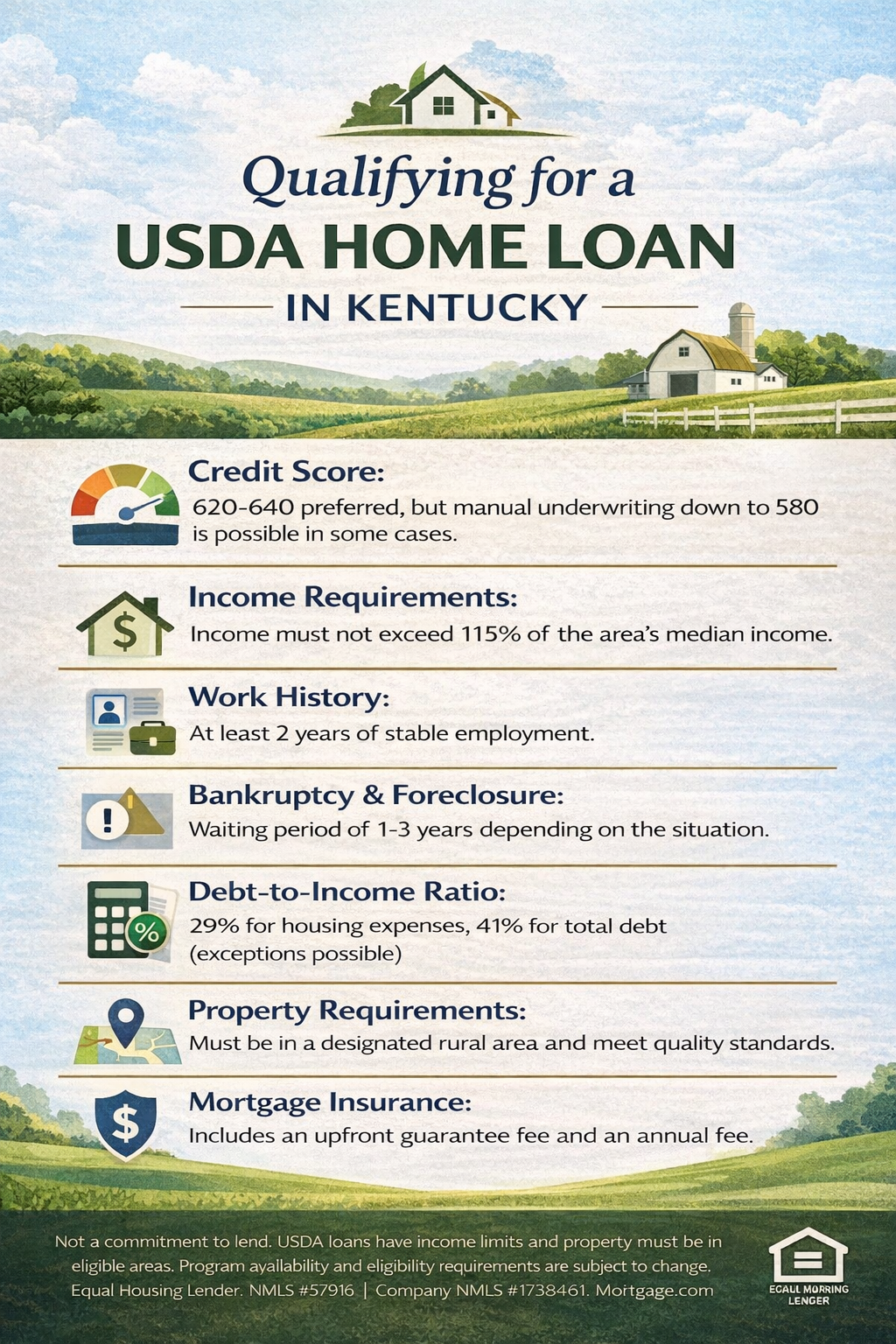
Qualifying for a USDA home loan in Kentucky involves meeting specific criteria in several areas: Credit Score: No Minimum score but a 620-640 for streamlined processing; lower scores may require manual underwriting down to 580 with some lenders but few and far between Income Requirements: Must not exceed 115% of the median income for your area. Work History: At least two years of stable employment. Bankruptcy and Foreclosure: Waiting periods of 1-3 years depending on the situation. Debt-to-Income Ratio: 29% for housing expenses, 41% for total debt; exceptions possible. Property Requirements: Must be in a designated rural area and meet quality standards. Mortgage Insurance: Includes an upfront guarantee fee and an annual

Summary

Qualifying for a USDA home loan in Kentucky involves meeting specific criteria in several areas:

  • Credit Score: No Minimum score but a 620-640 for streamlined processing; lower scores may require manual underwriting down to 580 with some lenders but few and far between
  • Income Requirements: Must not exceed 115% of the median income for your area.
  • Work History: At least two years of stable employment.
  • Bankruptcy and Foreclosure: Waiting periods of 1-3 years depending on the situation.
  • Debt-to-Income Ratio: 29% for housing expenses, 41% for total debt; exceptions possible.
  • Property Requirements: Must be in a designated rural area and meet quality standards.
  • Mortgage Insurance: Includes an upfront guarantee fee and an annual fee.

By understanding and meeting these requirements, you can take advantage of the USDA loan program to achieve homeownership in Kentucky’s rural areas. For personalized assistance, consider consulting with a mortgage broker or lender experienced in USDA loans, like Joel Lobb in Louisville, who can guide you through the process and help you qualify.

Joel Lobb
Mortgage Broker – FHA, VA, USDA, KHC, Fannie Mae
EVO Mortgage • Helping Kentucky Homebuyers Since 2001
📞 Call/Text: 502-905-3708
📧 Email: kentuckyloan@gmail.com
🌐 Website: www.mylouisvillekentuckymortgage.com
🏠 Address: 911 Barret Ave, Louisville, KY 40204
NMLS #57916 | Company NMLS #1738461
Free Info & Homebuyer Advice →
Kentucky Mortgage Loan Expert
FHA | VA | USDA | KHC Down Payment Assistance | Fannie Mae
Equal Housing Lender. This is not a commitment to lend. All loans are subject to credit approval and program requirements.

Kentucky Rural Housing Homes for Foreclosures USDA


Direct USDA Resale Search Link

If the embedded search tool does not display on your device, you can access the official USDA foreclosure and resale listings directly using the link below:


Visit the USDA Single-Family Housing Resale Website

Current USDA Homes for Sale in Kentucky: Foreclosure Listings

Homebuyers searching for affordable USDA homes for sale in Kentucky may find opportunities through select single-family foreclosure listings in rural areas. At this time, two foreclosure properties are available that may be eligible for USDA Rural Housing financing for qualified owner-occupants.

USDA Rural Housing loans allow eligible Kentucky buyers to purchase a primary residence with no down payment, provided income limits, property location, and minimum property condition requirements are met.

Can USDA buy foreclosure homes?

Yes. A foreclosure home can be purchased using a USDA Rural Housing loan if the property is located in a USDA-eligible area, the buyer meets total household income limits, the home will be owner-occupied, and the property meets USDA minimum safety and livability standards after appraisal.

  • Owner-occupied primary residence only
  • Total household income limits apply
  • Property location must be USDA eligible
  • USDA appraisal and condition standards still apply

Current Single-Family USDA Foreclosure Homes in Kentucky

Search criteria:

  • State: Kentucky
  • Property Type: Single Family
  • Listing Type: Foreclosure
  • Total Properties Available: 2
Address City County Price Beds Baths Sq Ft
65 Country Club Est Le Center Ballard County $33,500 2 1.5 2,147
1993 Hickory Camp Road Springfield Washington County $33,500 3 1 1,185

Important USDA considerations for foreclosure homes

  • Foreclosure homes are sold as-is
  • USDA loans still require a satisfactory appraisal
  • Some foreclosures may require repairs before approval
  • Mortgage pre-approval should be completed before submitting an offer
  • Availability can change quickly

How to confirm USDA eligibility before making an offer

  1. Verify the property address using the USDA eligibility map
  2. Confirm total household income is within county limits
  3. Obtain a USDA-specific mortgage pre-approval
  4. Review repair requirements early

Helpful USDA resources for Kentucky buyers

NMLS #57916 | Company NMLS #1738461
Mortgage Broker – FHA, VA, USDA, KHC, Fannie Mae
Kentucky properties only. Not a commitment to lend. Equal Housing Lender.

Want Help Checking a Specific Address?

USDA resale homes are rare and sell quickly. If you want me to verify eligibility, financing options, or payment estimates for a specific property, start with a USDA pre-approval.


Get Pre-Approved for a USDA Loan in Kentucky

What is a Kentucky USDA Loan?
A Kentucky USDA loan is a zero-down-payment mortgage backed by the U.S. Department of Agriculture, designed to help low-to-moderate income families purchase homes in eligible rural and suburban areas of Kentucky. These loans are issued through USDA-approved lenders with the government guaranteeing the loan.

Key Benefits of USDA Loans:
100% financing - No down payment required
Low mortgage insurance - 1% upfront, 0.35% annual (much lower than FHA)
Competitive interest rates - Often lower than conventional loans
Flexible credit requirements - Options available for credit scores as low as 620
No maximum purchase price - Loan amount based on your income and debt ratios

Kentucky Mortgage Broker Offering FHA, VA, USDA, Conventional, and KHC Down Payment Assistance Home Loans's avatarLouisville Kentucky Mortgage Loans

Single Family Housing Properties Found: 10

Filtered By:State> Kentucky;Property Type> Single Family; Listing Type> All Types;
Rows:5102550100AllFilter:

PhotoListing TypeStreet AddressCityStateCountyZipPrice/BidBedsBathsSq. Ft.

Details
Foreclosure107 Debbie Ave
Map
LancasterKentuckyGarrard40444$24,120311144

Details
Foreclosure86 Solitude Dr
Map
SomersetKentuckyPulaski42503$43,550321162

Details
Foreclosure104 Holly Grove Rd
Map
CorbinKentuckyLaurel40701$72,072321376

Details
Foreclosure100 Colonial Park Dr
Map
WinchesterKentuckyClark40391$79,225311075

Details
Foreclosure95 Nagy Dr
Map
LebanonKentuckyMarion40033$80,925321299

Details
Foreclosure310 Sarah Ct
Map
WinchesterKentuckyClark40391$81,260321072

Details
Foreclosure107 Ridgefield Rd
Map
LancasterKentuckyGarrard40444$82,79031.51232

Details
Foreclosure28 Harbor St
Map
NancyKentuckyPulaski42544$89,375321568

Details
Foreclosure412 Seth…

View original post 25 more words

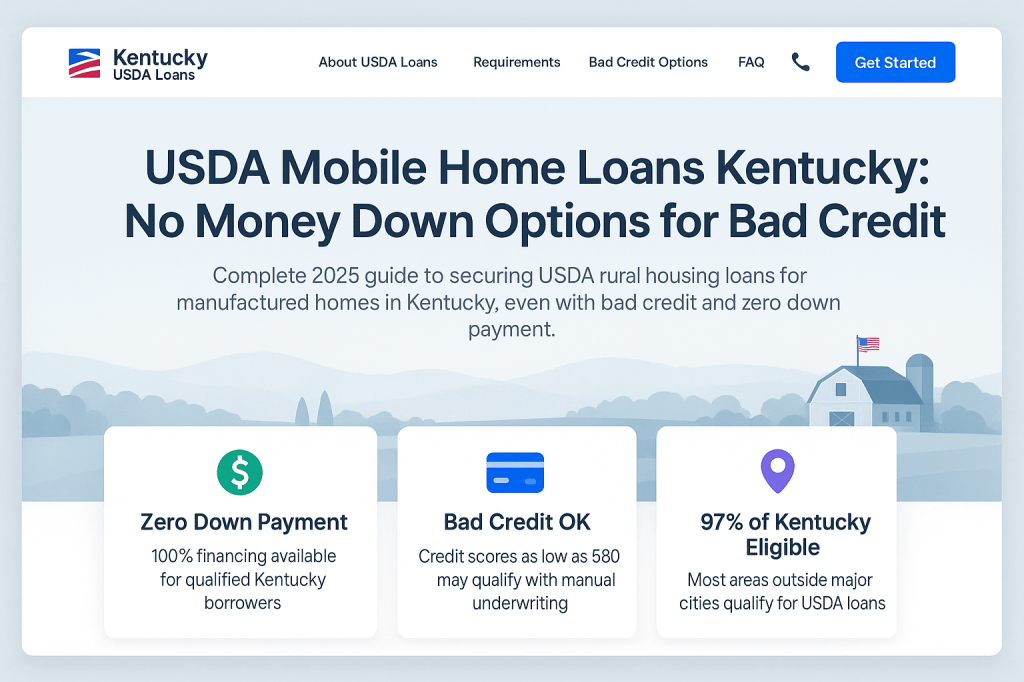
2026 USDA Loans for Kentucky Mobile Homes: Bad Credit Options


2026 Guide to USDA Rural Housing Loans for Manufactured Homes in Kentucky: No-Money-Down Options, Even with Bad Credit

100% financing available for qualified Kentucky borrower

USDA Rural Housing Loans for Manufactured Homes in Kentucky: No-Money-Down Options, Even with Bad Credit

100% financing available for qualified Kentucky borrower

Table of Contents

  • Understanding USDA Mobile Home Loans in Kentucky
  • 2026 Game-Changing Updates
  • Kentucky USDA Rural Housing Loan Requirements
  • Bad Credit Mobile Home Loans in Kentucky
  • No Money Down Mobile Home Financing Options
  • Kentucky Counties Eligible for USDA Mobile Home Loans
  • Foundation and Installation Requirements
  • How to Apply for USDA Mobile Home Loans in Kentucky
  • Alternative Financing Options
  • Frequently Asked Questions

Understanding USDA Mobile Home Loans in Kentucky

The United States Department of Agriculture (USDA) Rural Development program has been quietly revolutionizing homeownership opportunities across Kentucky for decades. Many potential homebuyers don’t realize this. The USDA’s Single Family Housing Guaranteed Loan Program (SFHGLP) extends far beyond traditional stick-built homes. It also includes manufactured and mobile homes. This opens doors for thousands of Kentucky families who previously thought homeownership was out of reach.

Kentucky, with its vast rural landscapes and small-town communities, is well-suited to USDA rural housing programs. Conventional mortgages often demand large down payments and excellent credit. USDA loans, however, are designed for low- to moderate-income families in rural areas. They are an excellent option for mobile home buyers across the Commonwealth.

What Makes USDA Mobile Home Loans Different

  • 100% Financing: No money down is required, making it perfect for buyers with limited savings
  • Affordable Terms: Competitive interest rates make monthly payments manageable
  • Rural Housing Opportunities: Ideal for Kentucky homebuyers in small towns and rural areas
  • Flexible Credit Requirements: Holistic approach to creditworthiness evaluation

On March 4, 2025, the USDA officially expanded its Single Family Housing Guaranteed Loan Program. This expansion provides 100% financing for manufactured homes. Industry experts are calling this change the most significant development in rural housing finance in decades.

Key Program Changes

Expanded Eligibility

Manufactured homes now receive the same favorable treatment as traditional homes

Age Restrictions Relaxed

Existing manufactured homes up to 20 years old can now qualify

Streamlined Process

Processing times reduced by 30-40% with new guidelines

Better Credit Pathways

Clearer guidelines for borrowers with credit challenges

 USDA Mobile Home Loans in Kentucky

Kentucky USDA Rural Housing Loan Requirements

Borrower Requirements

  • ✓Income cannot exceed 115% of area median income
  • ✓Must occupy home as primary residence
  • ✓U.S. citizen, non-citizen national, or qualified alien
  • ✓Credit score typically 580+ (manual underwriting available)

Property Requirements

  • ✓Built to HUD Code standards (post-1976)
  • ✓Permanent foundation required
  • ✓Minimum 12 feet wide, 400 sq ft living space
  • ✓Located in USDA-eligible rural area

Bad Credit Mobile Home Loans in Kentucky

One of the most significant advantages of USDA mobile home loans is their accessibility to borrowers with less-than-perfect credit. Unlike conventional mortgages, which often have rigid credit score requirements, USDA loans offer flexibility. This flexibility recognizes the unique challenges faced by rural borrowers.

Credit Score Guidelines

640+ Credit Score Streamlined Processing

580 and above Credit Score Manual Underwriting

Note: USDA takes a holistic approach to credit evaluation, considering factors beyond just credit scores.

Often Asked Questions

What credit score do I need for a USDA mobile home loan in Kentucky?

While USDA doesn’t set a minimum credit score, most lenders prefer scores of 580 or higher. Borrowers with lower scores may still qualify through manual underwriting, and the program takes a holistic approach to credit evaluation.

Can I buy a used mobile home with a USDA loan?

Yes, existing manufactured homes can qualify if they’re less than 20 years old. They must meet HUD standards. The homes should be properly installed on permanent foundations. Additionally, they need to meet all other USDA requirements.

Do I need to own the land to get a USDA loan for a mobile home?

USDA loans can finance both the manufactured home and land together. They can also finance just the home if you already own suitable land. However, the home must be permanently installed and classified as real property.

What areas of Kentucky are eligible for USDA loans?

Approximately 97% of Kentucky qualifies as rural for USDA purposes. Most areas outside of Louisville, Lexington, and a few other metropolitan centers are eligible. Use the USDA’s online eligibility tool to check specific addresses.

This comprehensive guide provides general information about USDA mobile home loans in Kentucky. It should not be considered as financial or legal advice. Potential borrowers should consult with qualified lenders, real estate professionals, and legal advisors for guidance specific to their situations.

Contact a Kentucky Mobile Home Loan Expert

For personalized guidance on Kentucky USDA mobile home loans, contact a local mortgage specialist. They can help with options for borrowers with bad credit and no down payment. The specialist will understand the unique requirements of manufactured home financing.

Emailkentuckyloan@gmail.com
Call/Text: 502-905-3708

Joel Lobb – Kentucky Mortgage Loan Officer
NMLS ID: 57916 | Company NMLS ID: 1738461
Equal Housing Lender


Helpful USDA Resources for Kentucky Borrowers

Disclaimer: This website is not endorsed by the FHA, VA, USDA, or any government agency. It is an independent platform created to educate and assist Kentucky homebuyers with expert advice and accessible tools.

Can I buy land and a mobile home together with a USDA loan?

USDA loans can finance both the manufactured home and the land in a single transaction. This is possible if both meet USDA eligibility requirements. The combined purchase must not exceed USDA loan limits for your area.

What if my credit score is below 580?

While challenging, approvals are possible with strong compensating factors such as stable employment, low debt-to-income ratios, and cash reserves. Working with an experienced USDA lender who understands manual underwriting is essential. Honestly, best to get score to 620 or 640 range for better changes of loan approval. USDA does not have minimum credit score requirements.

How long does the USDA loan process take?

Typical processing time is 45-60 days from application to closing. Processing is taking longer due to USDA cutbacks. This delay can vary based on property complexity. It also depends on documentation completeness and current USDA processing volumes.

Can I use gift funds for closing costs?

Yes, gift funds from family members are allowed for closing costs and prepaid items. Proper gift documentation and seasoning requirements must be met.

What happens if the home doesn’t appraise for the purchase price?

If the appraisal comes in low, you have several options. You can negotiate with the seller to reduce the price. Another option is to pay the difference in cash. Alternatively, you can cancel the contract if you have an appraisal contingency.

Are there income limits for USDA mobile home loans?

Yes, household income cannot exceed 115% of the Area Median Income for your county. These limits are updated annually and vary significantly across Kentucky.

Can I refinance my existing mobile home with a USDA loan?

USDA offers refinancing options for existing USDA loans, but cannot refinance non-USDA loans. However, if your current mobile home meets USDA requirements, you might qualify for a new purchase loan.

What areas of Kentucky qualify for USDA loans?

Most of Kentucky qualifies as rural under USDA guidelines. Use the USDA eligibility map to verify specific addresses, as eligibility can vary even within the same county.

Resources and Next Steps

Official USDA Resources

Kentucky Housing Resources

Ready to Get Started?

Ready to explore USDA mobile home loan options in Kentucky? Don’t wait, as these programs have annual funding limits. Working with an experienced local lender who understands manufactured home financing is crucial for success.

For personalized guidance on Kentucky USDA mobile home loans:

Contact Joel Lobb – Kentucky Mortgage Specialist

  • Email: kentuckyloan@gmail.com
  • Phone/Text: 502-905-3708
  • Experience: 20+ years helping Kentucky families
  • Track Record: Over 1,300 successful Kentucky home purchases and refinances
  • Specialization: USDA, FHA, VA, and Kentucky Housing Corporation loans

NMLS Personal ID: 57916 | Company NMLS ID: 1738461
Equal Housing Lender

Understanding USDA Loan Guidelines in Kentucky


Kentucky USDA Loan Handbook

USDA RD Underwriting HandbookUSDA Home Loan Handbook Chapter 1USDA Home Loan Handbook Chapter 2
USDA Home Loan Handbook Chapter 3USDA Home Loan Handbook Chapter 4USDA Home Loan Handbook Chapter 5
USDA Home Loan Handbook Chapter 6USDA Home Loan Handbook Chapter 7USDA Home Loan Handbook Chapter 8
USDA Home Loan Handbook Chapter 9USDA Home Loan Handbook Chapter 10USDA Home Loan Handbook Chapter 11
USDA Home Loan Handbook Chapter 12USDA Home Loan Handbook Chapter 13USDA Home Loan Handbook Chapter 14
USDA Home Loan Handbook Chapter 15USDA Home Loan Handbook Chapter 16

The USDA’s Single Family Housing Guaranteed Loan Program Technical Handbook (HB-1-3555) is a comprehensive resource. It details the guidelines and procedures for USDA home loans. Each chapter addresses specific aspects of the loan process:​

Kentucky Mortgage Underwriting: Key Guidelines Explained


Understanding Kentucky Mortgage underwriting guidelines

All lending institutions have different Underwriting Guidelines set in place when reviewing a borrower’s financial history to determine the likelihood of receiving on-time payments. The primary items reviewed are the following 5 areas below:

1. Income

2. Debt

3. Credit History

4. Savings

5. Debt vs Income Ratio


Income

Income is one of the most important variables a lender will examine because it is used to repay the loan. Income is reviewed for the type of work, length of employment, educational training required, and opportunity for advancement. An underwriter will look at the source of income and the likelihood of its continuance to arrive at a gross monthly figure.

Salary and Hourly Wages – Calculated on a gross monthly basis, prior to income tax deductions.

Part-time and Second Job Income – Not usually considered unless it is in place for 12 to 24 straight months. Lenders view part-time income as a strong compensating factor.

Commission, Bonus and Overtime Income – Can only be used if received for two previous years. Further, an employer must verify that it is likely to continue. A 24-month average figure is used.

Retirement and Social Security Income – Must continue for at least three years into the future to be considered. If it is tax free, it can be grossed up to an equivalent gross monthly figure. Multiply the net amount by 1.20%.

Alimony and Child Support Income – Must be received for the 12 previous months and continue for the next 36 months. Lenders will require a divorce decree and a court printout to verify on-time payments.

Notes Receivable, Interest, Dividend and Trust Income – Proof of receiving funds for 12 previous months is required. Documentation showing income due for 3 more years is also necessary. Rental Income – Cannot come from a Primary Residence roommate. The only acceptable source is from an investment property. A lender will use 75% of the monthly rent and subtract ownership expenses. The Schedule E of a tax return is used to verify the figures. If a home rented recently, a copy of a current month-to-month lease is acceptable.

Automobile Allowance and Expense Account Reimbursements – Verified with 2 years tax returns and reduced by actual expenses listed on the income tax return Schedule C.

Education Expense Reimbursements – Not considered income. Only viewed as slight compensating factor.

Self-Employment Income – Lenders are very careful in reviewing self-employed borrowers. Two years minimum ownership is necessary because two years is considered a representative sample. Lenders use a 2-year average monthly income figure from the Adjusted Gross Income on the tax returns. A lender may also add back additional income for depreciation and one-time capital expenses. Self-employed borrowers often have difficulty qualifying for a mortgage due to large expense write offs. A good solution to this challenge used to be the No Income Verification Loan, but there are very few of these available any more given the tightened lending standards in the current economy. NIV loan programs can be studied in the Mortgage Program section of the library.

2. Debt

An applicant’s liabilities are reviewed for cash flow. Lenders need to make sure there is enough income for the proposed mortgage payment, after other revolving and installment debts are paid.

All loans, leases, and credit cards are factored into the debt calculation. Utilities, insurance, food, clothing, schooling, etc. are not.

If a loan has less than 10 months remaining, a lender will usually disregard it.

The minimum monthly payment listed on a credit card bill is the figure used, not the payment made.

An applicant who co-borrowed for a friend or relative is accountable for the payment. If the applicant can show 12 months of on-time cancelled checks from the co-borrower, the debt will not count.

Loans can be paid off to qualify for a mortgage, but credit cards sometimes cannot (varies by lender). The reasoning is that if the credit card is paid off, the credit line still exists, and the borrower can run up debt after the loan is closed.

A borrower with fewer liabilities is thought to demonstrate superior cash management skills.

Credit History


Most lenders require a residential merged credit report (RMCR) from the 3 main credit bureaus: Trans Union, Equifax, and Experian. They will order one report which is a blending of all three credit bureaus and is easier to read than the individual reports. This “blended” credit report also searches public records for liens, judgments, bankruptcies and foreclosures. See our credit report index.Credit report in hand, an underwriter studies the applicant’s credit to determine the likelihood of receiving an on-time mortgage payment. Many studies have shown that past performance is a reflection of future expectations. Hence, most lenders now use a national credit scoring system, typically the FICO score, to evaluate credit risk. If you’re worried about credit scoring, see our articles on it.

The mortgage lending process, once very forgiving, has tightened lending standards considerably. A person with excellent credit, good stability, and sufficient documentable income to make the payments comfortably will usually qualify for an “A” paper loan. “A Paper”, or conforming loans, make up the majority of loans in the U.S. and are loans that must conform to the guidelines set by Fannie Mae or Freddie Mac in order to be saleable by the lender. Such loans must meet established and strict requirements regarding maximum loan amount, down payment amount, borrower income and credit requirements and suitable properties. Loans that do not meet the credit and/or income requirements of conforming “A-paper” loans are known as non-conforming loans and are often referred to as “B”, “C” and “D” paper loans depending on the borrower’s credit history and financial capacity.

Here are some rules of thumb most lenders follow:

12 plus months positive credit will usually equal an A paper loan program, depending on the overall credit. FHA loans usually follow this guideline more often than conventional loans.

Unpaid collections, judgments and charge offs must be paid prior to closing an A paper loan. The only exception is if the debt was due to the death of a primary wage earner, or the bill was a medical expense.

If a borrower has negotiated an acceptable payment plan and has made on time payments for 6 to 12 months, a lender may not require a debt to be paid off prior to closing.

Credit items usually are reported for 7 years. Bankruptcies expire after 10 years.

Foreclosure – 5 years from the completion date. From the fifth to seventh year following the foreclosure completion date, the purchase of a principal residence is permitted with a minimum 10% down and 680 FICO score. The purchase of a second or investment property is not permitted for 7 years. Limited cash out refinances are permitted for all occupancy types.

Pre-foreclosure (Short Sale) – 2 years from the completion date (no exceptions or extenuating circumstances).

Deed-in-Lieu of Foreclosure – 4-year period from the date the deed-in-lieu is executed. From the fifth to the seventh year following the execution date the borrower may purchase a property secured by a principal residence, second home or investment property with the greater of 10 percent minimum down payment or the minimum down payment required for the transaction. Limited cash out and cash out refinance transactions secured by a principal residence, second home or investment property are permitted pursuant to the eligibility requirements in effect at that time.

Chapter 7 Bankruptcy – A borrower is eligible for an A paper loan program 4 years after discharge or dismissal, provided they have reestablished credit and have maintained perfect credit after the bankruptcy.

Chapter 13 Bankruptcy – 2 years from the discharge date or 4 years from the dismissal date.

Multiple Bankruptcies- 5 years from the most recent dismissal or discharge date for borrowers with more than one filing in the past 7 years.

The good credit of a co-borrower does not offset the bad credit of a borrower.

Credit scores usually range from 400 to 800. Changes to lending standards are occurring on a daily basis as a result of tightening lending standards and can vary from lender-to-lender– so this information should be considered simply a guideline. For conforming loans, most lenders will lend down to a FICO of 620, with additional rate hits for the lower-end credit scores and loan-to-values. When you are borrowing more than 80%, they typically will not lend if you have a FICO below 680. The FHA/VA program just changed their minimum required FICO to 620, unless you are qualifying a borrower with non-traditional credit. The few non-conforming loan programs that are still available typically require 30% down payment with a minimum FICO of 700 for self-employed and 650 for W-2 employees, and the loan-to-value will change with the loan amount.

Lenders evaluate savings for three reasons.

The more money a borrower has after closing, the greater the probability of on-time payments.

Most loan programs require a minimum borrower contribution.

Lenders want to know that people have invested their own into the house, making it less likely that they will walk away from their life’s savings. They analyze savings documents to insure the applicant did not borrow the funds or receive a gift.

Lenders look at the following types of accounts and assets for down payment funds:

Checking and Savings – 90 days seasoning in a bank account is required for these funds. Gifts and Grants – After a borrower’s minimum contribution, a gifts or grant is permitted.

Sale of Assets – Personal property can be sold for the required contribution. The property should be appraised, and a bill of sale is required. Also, a copy of the received check and a deposit slip are needed.

Secured Loans – A loan secured by property is also an acceptable source of closing funds.

IRA, 401K, Keogh & SEP – Any amount that can be accessed is an acceptable source of funds.
Sweat Equity and Cash On Hand – Generally not acceptable. FHA programs allow it in special circumstances.
Sale Of Previous Home – Must close prior to new home for the funds to be used. A lender will ask for a listing contract, sales contract, or HUD 1 closing statement.

The percentage of one’s debt to income is one of the most important factors when underwriting a loan. Lenders have determined that a house payment should not exceed approximately 30% of Gross Monthly Income. Gross Monthly Income is income before taxes are taken out. Furthermore, a house payment plus minimum monthly revolving and installment debt should be less than 40% of Gross Monthly Income (this figure varies from 35%-41% contingent on the source of financing).

Example

An applicant has $4,500 gross monthly income. The maximum mortgage payment is:

$4500 X .30 = $1350

Their total debts come to:

$500 Car

$20 Visa

$30 Sears

$75 Master Card

—————-

$625 per month.

Remember, their total debts (mortgage plus other debts) must be less than or equal to 40% of their gross monthly income.

$2,800 X .40 = $1800

$1800 is the maximum debt the borrower can have, debts and mortgage payments combined. Can the borrower keep all their debts and have the maximum mortgage payment allowed? NO!

In this case, the borrower, since they have high debts, must adjust the maximum mortgage payment downward, because:

$625 debts

$1350 mortgage
————-

$1975 – which is more than the $1800 (40% of gross debt) we calculated above.

The maximum mortgage payment is therefore:

$1800 – $625 (monthly debt) = $1175.

Some restrictions apply. Ask for details. Loan decision is subject to satisfactory appraisal and title review and no change in financial condition. This is not an offer for extension of credit or a commitment to lend. Equal Housing Opportunity.
This communication is provided to you for informational purposes only and should not be relied upon by you.
Joel Lobb
Mortgage Broker – FHA, VA, USDA, KHC, Fannie Mae
EVO Mortgage • Helping Kentucky Homebuyers Since 2001
📞 Call/Text: 502-905-3708
📧 Email: kentuckyloan@gmail.com
🌐 Website: www.mylouisvillekentuckymortgage.com
🏠 Address: 911 Barret Ave, Louisville, KY 40204
NMLS #57916 | Company NMLS #1738461
Free Info & Homebuyer Advice →
Kentucky Mortgage Loan Expert
FHA | VA | USDA | KHC Down Payment Assistance | Fannie Mae
Equal Housing Lender. This is not a commitment to lend. All loans are subject to credit approval and program requirements.
Disclaimer: No statement on this site is a commitment to make a loan. Loans are subject to borrower qualifications, including income, property evaluation, sufficient equity in the home to meet Loan-to-Value requirements, and final credit approval. Approvals are subject to underwriting guidelines, interest rates, and program guidelines and are subject to change without notice based on applicant’s eligibility and market conditions. Refinancing an existing loan may result in total finance charges being higher over the life of a loan. Reduction in payments may reflect a longer loan term. Terms of any loan may be subject to payment of points and fees by the applicant  Equal Opportunity Lender. NMLS#57916http://www.nmlsconsumeraccess.org/